What trimethoprim-sulfamethoxazole is
Trimethoprim-sulfamethoxazole, often shortened to TMP-SMX or co-trimoxazole, is a combination antibacterial sold under brand names including Bactrim and Septra. It pairs two drugs that attack the same bacterial production line at two consecutive steps. Sulfamethoxazole blocks the synthesis of dihydrofolic acid by competing with para-aminobenzoic acid, and trimethoprim blocks the conversion of dihydrofolic acid into tetrahydrofolic acid by inhibiting the enzyme dihydrofolate reductase. Because bacteria need folates to build nucleic acids and proteins, shutting down two steps in a row kills many bacteria that could survive either drug alone, and resistance develops more slowly with the combination than with either component on its own.
Every formulation keeps the two components in a fixed ratio of one part trimethoprim to five parts sulfamethoxazole. That ratio is why the doses on this page are always written as pairs: the standard oral suspension contains 40 mg of trimethoprim plus 200 mg of sulfamethoxazole in each 5 mL teaspoonful, the single-strength tablet contains 80 mg plus 400 mg, and the double-strength (DS) tablet contains 160 mg plus 800 mg. The 1:5 ratio also explains the chart that accompanies this page, where every dose can be read in trimethoprim milligrams and multiplied by five for the sulfamethoxazole component. Both drugs are rapidly absorbed after oral administration, reach peak blood levels within 1 to 4 hours, and are excreted mainly by the kidneys, which is why kidney function shapes every dose.
FDA-approved pediatric indications
The FDA label approves trimethoprim-sulfamethoxazole for a specific list of infections in children. For urinary tract infections, it covers disease caused by susceptible strains of Escherichia coli, Klebsiella species, Enterobacter species, Morganella morganii, Proteus mirabilis, and Proteus vulgaris. For shigellosis, it covers enteritis caused by susceptible strains of Shigella flexneri and Shigella sonnei. For acute otitis media in children, it covers infections due to susceptible strains of Streptococcus pneumoniae or Haemophilus influenzae, when the physician judges that the combination offers some advantage over other antimicrobial agents. The label also covers documented Pneumocystis jiroveci pneumonia and prophylaxis against it in immunosuppressed individuals at increased risk. Two honest limits are written into the label: initial episodes of uncomplicated urinary tract infections should be treated with a single effective antibacterial rather than the combination, and the suspension is not indicated for prophylactic or prolonged administration in otitis media at any age.
Antibiotics are only useful against bacteria, and the label repeats the standard stewardship warning: prescribing TMP-SMX without a proven or strongly suspected bacterial infection, or outside a prophylactic indication, is unlikely to benefit the patient and increases the risk of drug-resistant bacteria. The calculator on this page assumes a clinician has already decided that TMP-SMX is the right drug and confirmed the organism is susceptible.
Urinary tract infections, shigellosis, and acute otitis media: the 8/40 regimen
For children 2 months of age or older with a urinary tract infection or acute otitis media, the label dose is 40 mg/kg of sulfamethoxazole plus 8 mg/kg of trimethoprim per 24 hours, given in two divided doses every 12 hours, for 10 days. The identical daily dosage is used for 5 days in the treatment of shigellosis. The arithmetic is deliberately simple: divide the daily trimethoprim milligrams by two to get each dose, then divide by 8 (the milligrams of trimethoprim per millilitre of suspension) to get the millilitres. The label's own weight table confirms this: a 10 kg child receives 1 teaspoonful (5 mL) every 12 hours, 20 kg receives 2 teaspoonfuls (10 mL), 30 kg receives 3 teaspoonfuls (15 mL), and 40 kg receives 4 teaspoonfuls (20 mL).
| Weight (kg) | Daily dose (8/40 mg/kg) | Dose every 12 hours | mL of 40/200 per 5 mL suspension |
|---|---|---|---|
| 10 | 80 mg TMP / 400 mg SMX | 40 mg / 200 mg | 5 mL |
| 16 | 128 mg TMP / 640 mg SMX | 64 mg / 320 mg | 8 mL |
| 20 | 160 mg TMP / 800 mg SMX | 80 mg / 400 mg | 10 mL |
| 24 | 192 mg TMP / 960 mg SMX | 96 mg / 480 mg | 12 mL |
| 30 | 240 mg TMP / 1200 mg SMX | 120 mg / 600 mg | 15 mL |
| 40 | 320 mg TMP / 1600 mg SMX | 160 mg / 800 mg | 20 mL |
For reference, the adult label dose for urinary tract infections is 4 teaspoonfuls (20 mL) of suspension every 12 hours for 10 to 14 days, with the identical daily dosage for 5 days in shigellosis. The calculator mirrors the pediatric regimen and also converts each per-dose result into single-strength and double-strength tablet equivalents for older children who can swallow tablets, rounding to the nearest half tablet. One 10 mL dose for a 20 kg child, for example, equals exactly one single-strength tablet (80/400), which is a useful cross-check when a family switches between liquid and tablets mid-course.
PCP treatment: the 15 to 20 / 75 to 100 regimen
Pneumocystis jiroveci pneumonia (PCP) is treated with much higher doses than a urinary tract infection, because the organism is harder to reach and the stakes are higher. For both adults and children with documented PCP, the label dose is 75 to 100 mg/kg of sulfamethoxazole plus 15 to 20 mg/kg of trimethoprim per 24 hours, given in equally divided doses every 6 hours, for 14 to 21 days. The label's weight table is written for the upper limit: an 8 kg child receives 1 teaspoonful (5 mL) every 6 hours, 16 kg receives 2 teaspoonfuls (10 mL), 24 kg receives 3 teaspoonfuls (15 mL), 32 kg receives 4 teaspoonfuls (20 mL), 40 kg receives 5 teaspoonfuls (25 mL), and 48 kg receives 6 teaspoonfuls (30 mL). For the lower limit dose, the label directs giving 75 percent of the upper-limit table dose.
The calculator offers both the upper limit (20/100) and the lower limit (15/75), defaulting to the upper limit, and divides the daily dose into four equal doses every 6 hours exactly as the label's table does. Note a deliberate design choice explained in the label clarifications below: the FDA label sets no dose ceiling for PCP treatment, so the calculator never caps a treatment dose, but it flags doses that exceed the 320 mg TMP / 1600 mg SMX per day prophylaxis level so the clinician double-checks them.
| Weight (kg) | Daily dose, upper limit (20/100 mg/kg) | Dose every 6 hours | mL per dose |
|---|---|---|---|
| 8 | 160 mg TMP / 800 mg SMX | 40 mg / 200 mg | 5 mL |
| 16 | 320 mg TMP / 1600 mg SMX | 80 mg / 400 mg | 10 mL |
| 24 | 480 mg TMP / 2400 mg SMX | 120 mg / 600 mg | 15 mL |
| 32 | 640 mg TMP / 3200 mg SMX | 160 mg / 800 mg | 20 mL |
| 40 | 800 mg TMP / 4000 mg SMX | 200 mg / 1000 mg | 25 mL |
| 48 | 960 mg TMP / 4800 mg SMX | 240 mg / 1200 mg | 30 mL |
High doses are where the safety monitoring described later in this page matters most. The label's precautions section is explicit: high doses of trimethoprim, as used in PCP, induce a progressive but reversible increase of serum potassium concentrations in a substantial number of patients, so potassium monitoring is warranted. During PCP treatment, the label also states that co-administration of TMP-SMX and leucovorin should be avoided, because a randomized trial in HIV-positive patients showed treatment failure and excess mortality with the combination. These are not optional refinements; they are part of the regimen.
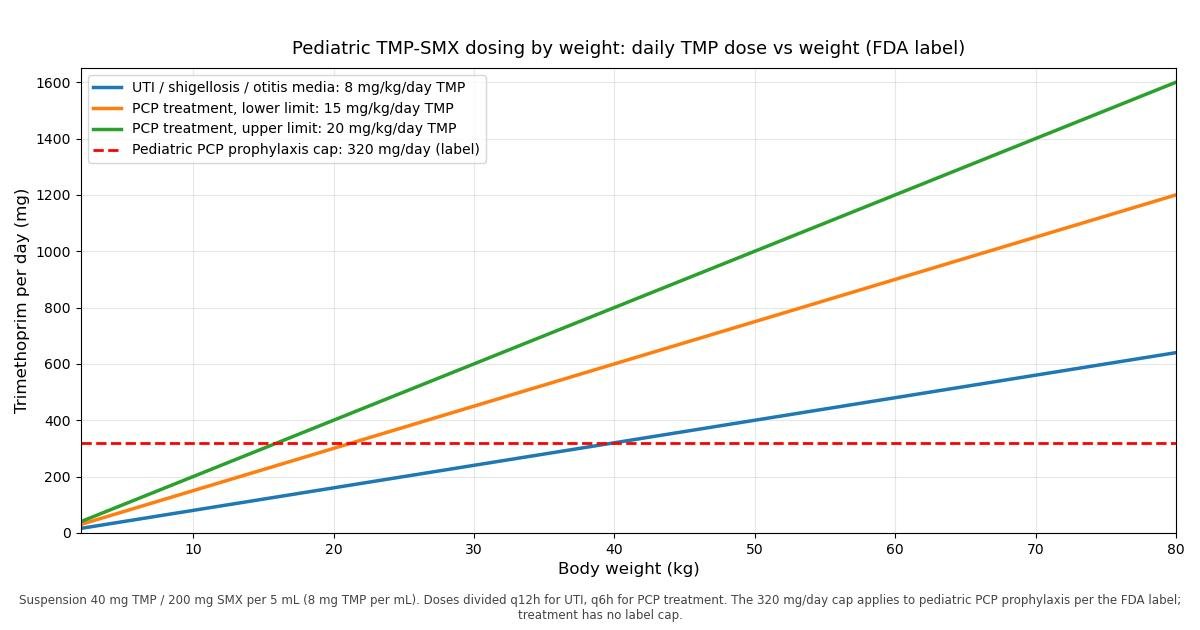
PCP prophylaxis: BSA-based dosing on three days per week
For children, PCP prophylaxis follows a different logic from treatment: it is dosed by body surface area, not by weight. The label dose is 750 mg/m2/day of sulfamethoxazole plus 150 mg/m2/day of trimethoprim, given orally in equally divided doses twice a day, on 3 consecutive days per week, and the total daily dose should not exceed 1600 mg of sulfamethoxazole and 320 mg of trimethoprim. Surface area predicts how the body clears this drug more closely than weight does, which is why the label uses it here. The calculator implements the standard Mosteller formula: BSA in m2 equals the square root of (height in cm times weight in kg divided by 3600). If the child's BSA is already known from the clinic, it can be typed in directly instead.
Worked example: a child 100 cm tall weighing 16 kg has a BSA of about 0.67 m2. The daily dose is 150 times 0.67, about 100 mg of trimethoprim, plus 750 times 0.67, about 500 mg of sulfamethoxazole, divided into two doses of 50 mg / 250 mg, which is about 6.3 mL of suspension every 12 hours on three consecutive days each week. The label's own BSA table agrees: a BSA of 0.53 m2 takes 1 teaspoonful (5 mL) every 12 hours, and 1.06 m2 takes 2 teaspoonfuls (10 mL). Larger children hit the ceiling: at a BSA of 2.13 m2 the trimethoprim dose reaches 320 mg per day, so any larger BSA is capped at 320 mg / 1600 mg per day, which is 20 mL of suspension twice daily. That cap equals exactly the adult prophylaxis dose of 4 teaspoonfuls (20 mL) daily, or one double-strength tablet daily.
Formulations and measuring the liquid correctly
Most dosing errors with TMP-SMX in children are measuring errors, not prescribing errors. The standard oral suspension contains 40 mg of trimethoprim and 200 mg of sulfamethoxazole in each 5 mL, which works out to 8 mg of trimethoprim per millilitre. To convert any per-dose result on this page, divide the trimethoprim milligrams by 8. A 10 kg child with a urinary tract infection needs 5 mL every 12 hours; the same child treated for PCP at the upper limit needs 6.25 mL every 6 hours. Always measure with an oral syringe marked in 0.1 mL increments, and never with a kitchen teaspoon or tablespoon, which can vary by 50 percent or more.
Before measuring, read the concentration printed on your own bottle, because not every product matches the standard. For older children who can swallow tablets, the single-strength tablet (80 mg TMP / 400 mg SMX) and the double-strength tablet (160 mg / 800 mg) give exact doses without any liquid: one double-strength tablet twice daily is the standard adult PCP prophylaxis dose. The calculator's tablet equivalents are rounded to the nearest half tablet, since the tablets are scored, but the suspension remains the more precise option for small children because it can be measured to the millilitre.
Kidney function, hydration, and laboratory monitoring
Both trimethoprim and sulfamethoxazole leave the body mainly through the kidneys, so impaired kidney function raises their blood levels and the risk of toxicity. The label gives a simple three-band rule: creatinine clearance above 30 mL/min uses the usual standard regimen, 15 to 30 mL/min uses half the usual regimen, and below 15 mL/min the drug is not recommended. The calculator applies this rule automatically from the creatinine clearance band you select, and it refuses to calculate a dose in the below-15 band, because the label advises against it rather than suggesting a smaller dose.
Hydration is a separate, parallel requirement at every kidney band. Sulfonamides can crystallize in the urine, so the label directs that adequate fluid intake and urinary output be ensured during treatment to prevent crystalluria, and patients are counseled to maintain an adequate fluid intake to prevent crystalluria and stone formation. Laboratory monitoring is also specified: complete blood counts should be done frequently during therapy, and the drug should be discontinued if a significant reduction in the count of any formed blood element is noted; urinalysis with careful microscopic examination and renal function tests should be performed during therapy, particularly in patients with impaired renal function. Serum potassium deserves its own line in the monitoring plan: trimethoprim raises potassium, progressively but reversibly at the high doses used for PCP, and even recommended doses can cause hyperkalemia in patients with underlying disorders of potassium metabolism, renal insufficiency, or concomitant drugs that raise potassium. If bone marrow depression occurs, the label advises leucovorin 5 to 15 mg daily until normal hematopoiesis is restored.
Who must not take it: contraindications and key warnings
The label lists further contraindications: known hypersensitivity to trimethoprim or sulfonamides, a history of drug-induced immune thrombocytopenia with trimethoprim or sulfonamides, documented megaloblastic anemia due to folate deficiency, marked hepatic damage, and severe renal insufficiency when renal function status cannot be monitored. Any of these means the drug should not be started at all.
Beyond the contraindications, the warnings section describes rare but fatal reactions: Stevens-Johnson syndrome, toxic epidermal necrolysis, fulminant hepatic necrosis, agranulocytosis, aplastic anemia, and other blood dyscrasias. The label's instruction is unambiguous: sulfonamides should be discontinued at the first appearance of skin rash or any sign of adverse reaction, because a rash can be followed by a more severe reaction. Early warning signs listed in the label include sore throat, fever, arthralgia, pallor, purpura, and jaundice. Two special cautions from the precautions section deserve emphasis for families: in glucose-6-phosphate dehydrogenase deficient individuals, hemolysis may occur, and this reaction is frequently dose-related; and severe, symptomatic hyponatremia can occur, particularly during treatment of PCP. The calculator shows a prominent warning when G6PD deficiency is ticked.
Drug interactions to know about
TMP-SMX interacts with several common medicines, and the label names them directly. It can prolong the prothrombin time in patients taking warfarin, so coagulation time should be reassessed. It inhibits the hepatic metabolism of phenytoin: at a common clinical dosage it increased the phenytoin half-life by 39 percent and decreased the phenytoin metabolic clearance rate by 27 percent, so prescribers watch for excessive phenytoin effect. Sulfonamides can displace methotrexate from plasma protein binding sites and compete with its renal transport, raising free methotrexate concentrations. The combination potentiates oral hypoglycemics metabolized by CYP2C8 or CYP2C9 (such as pioglitazone, repaglinide, glipizide, and glyburide) or eliminated via OCT2 (such as metformin), so extra blood glucose monitoring may be warranted. Concomitant use with ACE inhibitors has produced reported cases of hyperkalemia in elderly patients, which connects back to the potassium monitoring above. There have been reports of marked but reversible nephrotoxicity when TMP-SMX is given with cyclosporine in renal transplant recipients, and increased digoxin blood levels can occur, especially in elderly patients. Families should give the prescriber the child's complete medicine list, including over-the-counter products, before the first dose.
When to seek medical care promptly
Seek urgent care if the child develops any skin rash while taking TMP-SMX, since the label directs stopping the drug at the first appearance of rash. Also seek prompt care for sore throat, fever, unusual bruising or bleeding, or pallor (possible blood dyscrasias); jaundice or dark urine; markedly reduced urine output or flank pain (possible crystalluria or stone formation); muscle weakness, irregular heartbeat, or numbness that could suggest high potassium; severe or bloody diarrhea during or after the course (possible Clostridioides difficile associated diarrhea, which the label notes can occur up to two months after antibiotics); or any sign of an allergic reaction such as swelling of the face or lips or difficulty breathing. As with every medicine on this site, this page is informational: it explains what the FDA label says so families can follow the care plan with confidence, but it does not replace the prescribing clinician.