Padua VTE Risk Score Calculator
In short: Free Padua Prediction Score calculator for hospitalized medical patients: answer the 11 verified risk-factor questions, get the 0 to 20 score, the low/high risk band (cutoff 4), and guideline-based prophylaxis considerations. Medically reviewed. Use the calculator above, then read the guide below to interpret your result and its limitations.
Estimate the risk of venous thromboembolism (VTE) in hospitalized medical patients with the Padua Prediction Score. Answer the questions below and the tool adds up the 11 verified risk factors into a 0 to 20 total: a score of 4 or more means high VTE risk and the need to consider thromboprophylaxis, while a score below 4 means low risk.
The calculator
The 90-day VTE rate by risk band
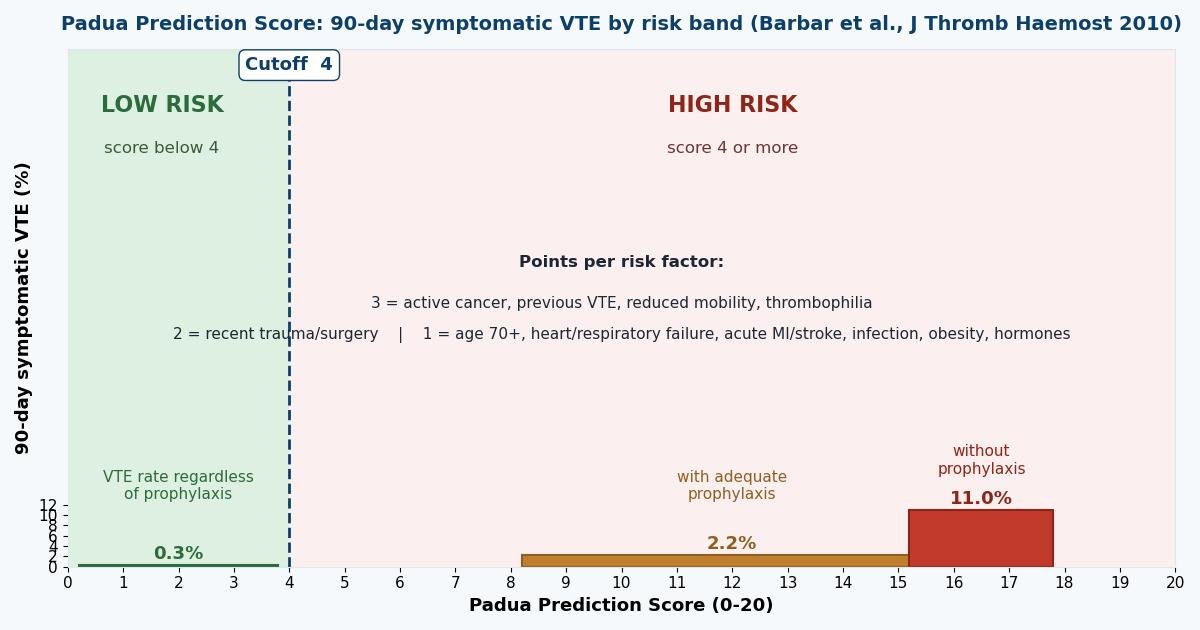
Observed rates from the original Barbar et al. 2010 derivation and validation cohort (1,180 acutely ill medical inpatients, Padua, Italy).
Why hospitalized medical patients face VTE risk
A hospital stay creates almost ideal conditions for blood clots. Venous thromboembolism, the umbrella term for deep vein thrombosis (DVT) and pulmonary embolism (PE), forms when the three elements of Virchow's triad come together: sluggish blood flow, injury or irritation of the vessel wall, and blood that clots too readily. An acutely ill medical patient often has all three at once. Bed rest and limited mobility slow venous return from the legs, infections and heart or respiratory failure inflame the endothelium and activate the clotting cascade, and cancers or inherited clotting disorders add a hypercoagulable state. That is why medical inpatients, who may never see an operating room, still develop DVT and PE at clinically important rates, and why guidelines since the late 2000s have pushed for systematic risk assessment on admission rather than relying on clinical impression.
The difficulty is that clot risk is unevenly distributed. Most medical inpatients are at low risk and gain little from prophylactic anticoagulation, which carries its own bleeding hazard. A minority are at high risk and benefit substantially. Clinicians therefore need a reproducible way to sort the two groups. The Padua Prediction Score was designed for exactly this job: a simple bedside checklist of 11 weighted risk factors that classifies acutely ill medical patients as low risk or high risk for symptomatic VTE.
The Padua Prediction Score: how it was developed
Barbar and colleagues at the University of Padua developed the score in a prospective cohort of 1,180 acutely ill medical inpatients and published it in the Journal of Thrombosis and Haemostasis in 2010. Each patient was scored on 11 clinical risk factors, and the cohort was followed for 90 days for symptomatic VTE events. The scoring was deliberately simple: each factor contributes 1, 2, or 3 points toward a maximum total of 20, and the threshold that best separated patients was 4. A total of 4 or more was labeled high risk; anything below 4 was low risk.
The separation the score achieved was striking. In the validation cohort, high-risk patients who did not receive adequate thromboprophylaxis developed symptomatic VTE at a rate of 11.0 percent during the 90-day follow-up, compared with only 2.2 percent in high-risk patients who did receive prophylaxis. Low-risk patients had a 0.3 percent rate regardless of prophylaxis status. The original authors reported that the VTE rate in unprotected high-risk patients was more than 30 times the rate in low-risk patients, and that adequate in-hospital prophylaxis cut VTE events in the high-risk group by almost 90 percent with an acceptably low bleeding risk. Those figures are the reason the score has since been incorporated into institutional protocols and endorsed in guideline discussions such as the ACCP antithrombotic guidelines for medical patients. The score has also been externally validated in multiple independent cohorts, although validation results are heterogeneous across very different populations, as discussed in the limitations section below.
The 11 risk factors and their point values
| Risk factor | Points |
|---|---|
| Active cancer (local or distant metastases, or chemo/radiotherapy in the last 6 months) | 3 |
| Previous VTE (documented DVT or PE, excluding superficial vein thrombosis) | 3 |
| Reduced mobility (bed rest with bathroom privileges for at least 3 days) | 3 |
| Known thrombophilic condition (e.g. antithrombin, protein C or S deficiency, factor V Leiden, prothrombin G20210A, antiphospholipid syndrome) | 3 |
| Recent trauma and/or surgery (within the last month) | 2 |
| Elderly age (70 years or older) | 1 |
| Heart and/or respiratory failure | 1 |
| Acute myocardial infarction or ischemic stroke | 1 |
| Acute infection and/or rheumatologic disorder | 1 |
| Obesity (BMI 30 kg/m2 or greater) | 1 |
| Ongoing hormonal treatment | 1 |
The weighting reflects how strongly each factor was associated with VTE in the derivation study. The four 3-point factors are the heavy hitters, each powerful enough that two of them alone, or one of them plus a 1-point factor, push the patient into the high-risk band. Active cancer combines tumor-driven hypercoagulability with the immobility and treatment toxicity that often accompany it, and the definition is deliberately narrow: only metastatic disease or cancer therapy within the last 6 months counts. A previous DVT or PE is one of the strongest predictors of a future event in any population, which is why superficial vein thrombosis is explicitly excluded; it does not carry the same recurrence risk. Reduced mobility captures the stasis limb of Virchow's triad and is defined precisely as bed rest with bathroom privileges for at least 3 days, so a patient who is up and walking does not qualify. A known thrombophilic condition reflects an inherited or acquired tendency to clot, including deficiencies of the natural anticoagulants (antithrombin, protein C, protein S), factor V Leiden, the prothrombin G20210A mutation, and the antiphospholipid syndrome.
Recent trauma and/or surgery within the last month earns 2 points because tissue injury and the inflammatory response to it activate clotting, and the immobilization that follows trauma compounds the risk. The six 1-point factors are individually weaker but clinically common: age 70 or older, heart and/or respiratory failure, an acute myocardial infarction or ischemic stroke, an acute infection or rheumatologic flare, obesity defined by a BMI of 30 or more, and ongoing hormonal treatment such as systemic estrogen therapy or oral contraceptives. In a typical elderly medical inpatient, three or four of these modest factors accumulate quickly, which is how a patient with no dramatic single risk factor still reaches the high-risk threshold. Note that the calculator above detects the age and BMI factors automatically from the numbers you enter, so they are not listed as tick boxes.
How to use your result
A total below 4 places the patient in the low-risk group. In the Barbar cohort the 90-day symptomatic VTE rate in this group was 0.3 percent whether or not prophylaxis was given, so routine pharmacologic prophylaxis is generally not recommended; early and frequent mobilization, hydration, and avoidance of unnecessary venous catheters are the sensible measures. A total of 4 or more places the patient in the high-risk group. Guideline consensus from the ACCP and ASH favors pharmacologic prophylaxis for such patients, usually a low-molecular-weight heparin or fondaparinux, whenever the bleeding risk is acceptable. When the bleeding risk is high, or pharmacologic prophylaxis is otherwise contraindicated, mechanical prophylaxis with intermittent pneumatic compression or graduated compression stockings is the recommended alternative.
Two cautions are essential. First, the Padua score says nothing about bleeding risk, and bleeding risk must be assessed separately before any anticoagulant is started; a high VTE risk and a high bleeding risk can coexist, and that combination calls for mechanical prophylaxis, not for ignoring the clot risk. Second, VTE risk is not static. The score should be recalculated whenever the patient's clinical status changes during the admission, because a new infection, a new cancer diagnosis, a fall in mobility, or the start of hormonal therapy can move a patient across the cutoff within days.
Padua score versus the Caprini score
The two best-known VTE risk tools serve different populations and should not be swapped. The Padua Prediction Score has 11 factors, was derived in acutely ill medical inpatients, and gives a binary output: low (below 4) or high (4 or more). The Caprini risk assessment model has roughly 40 factors weighted at 1, 2, 3, or 5 points, was derived in surgical patients, and produces several risk tiers from very low to highest. Use Padua for medical admissions and Caprini for surgical admissions. Applying Padua to a postoperative patient is off-label because the surgical setting has its own thrombotic and bleeding dynamics that the Padua derivation cohort never captured; our own Caprini score calculator is the appropriate tool for surgical patients. Similarly, the ARISCAT score estimates postoperative pulmonary complications, a different outcome entirely, and the Apfel score estimates postoperative nausea and vomiting risk.
Limitations
The Padua score is a group-level risk tool, not a personal guarantee: even in the high-risk group most patients do not develop VTE, and a low score does not make clots impossible. The original cohort was a single-center European study, and external validations have produced mixed results, particularly in populations far removed from the derivation setting such as obstetric patients, in whom the score performs poorly. The score does not incorporate bleeding risk, so it cannot by itself justify starting an anticoagulant. It also does not cover every plausible risk factor, and clinical judgment remains necessary for patients whose risk comes from conditions the 11 factors miss. Used with those limits in mind, it is a well validated and widely endorsed way to make VTE prophylaxis decisions in medical inpatients reproducible rather than impressionistic.
Key takeaways
- A Padua Prediction Score of 4 or more classifies a hospitalized medical patient as high risk, and this is the group for whom the guidelines recommend considering pharmacologic thromboprophylaxis, provided the bleeding risk is acceptable.
- The Padua score was built for hospitalized medical (non-surgical) patients and uses only 11 risk factors, while the Caprini score was built for surgical patients and evaluates about 40 factors with weights of 1, 2, 3 or 5 points.
- No.
- Guideline consensus (ACCP and ASH guidance) favors pharmacologic prophylaxis, typically a low-molecular-weight heparin or fondaparinux, for high-risk medical patients whose bleeding risk is low.
Frequently asked questions
What Padua score means the patient needs VTE prophylaxis?
A Padua Prediction Score of 4 or more classifies a hospitalized medical patient as high risk, and this is the group for whom the guidelines recommend considering pharmacologic thromboprophylaxis, provided the bleeding risk is acceptable. Scores below 4 are low risk, and routine pharmacologic prophylaxis is generally not recommended for them. The bleeding risk must be assessed separately before starting any anticoagulant.
How is the Padua score different from the Caprini score?
The Padua score was built for hospitalized medical (non-surgical) patients and uses only 11 risk factors, while the Caprini score was built for surgical patients and evaluates about 40 factors with weights of 1, 2, 3 or 5 points. Use Padua for acutely ill medical inpatients and Caprini for surgical patients; neither is validated for the other's population.
Can the Padua score be used in surgical patients?
No. The Padua Prediction Score was derived and validated in acutely ill hospitalized medical patients in Padua, Italy, and it is not validated for postoperative patients. For surgical patients the Caprini risk assessment model is the appropriate validated tool. Using Padua after surgery can misclassify risk because the operative setting carries its own thrombotic and bleeding considerations.
What should be done for a high Padua score of 4 or more?
Guideline consensus (ACCP and ASH guidance) favors pharmacologic prophylaxis, typically a low-molecular-weight heparin or fondaparinux, for high-risk medical patients whose bleeding risk is low. If the bleeding risk is high or pharmacologic prophylaxis is contraindicated, mechanical prophylaxis such as intermittent pneumatic compression is recommended instead. The exact choice is a clinical decision made by the treating team.
Does the Padua score apply to a patient already on therapeutic anticoagulation?
A patient already receiving full therapeutic anticoagulation for another indication is already protected against VTE in the usual sense, so the score's prophylaxis recommendation is moot for them. The score is meant to identify patients who are not anticoagulated and need a decision about starting prophylaxis. It should not be used to interrupt or adjust therapeutic anticoagulation.
How often should the Padua score be reassessed during admission?
The score should be reassessed whenever the patient's clinical status changes, for example after a new infection, a fall in mobility, a new cancer diagnosis, or a change in bleeding risk. VTE risk is dynamic during a hospital stay, and a patient who was low risk on admission can move into the high-risk band within days.
Sources
- Barbar S, Noventa F, Rossetto V, Ferrari A, Brandolin B, Perlati M, De Bon E, Tormene D, Pagnan A, Prandoni P. A risk assessment model for the identification of hospitalized medical patients at risk for venous thromboembolism: the Padua Prediction Score. J Thromb Haemost. 2010;8(11):2450-7. doi: 10.1111/j.1538-7836.2010.04044.x (PubMed 20738765).
- Queensland Health. Padua Prediction Score for risk of VTE in hospitalised medical patients (score card and prophylaxis table). PDF.
- A comprehensive review of venous thromboembolism risk assessment models for hospitalized medical patients: comparative evidence, implementation challenges, and future directions. PMC12833051.