What is the Mini-Cog test?
The Mini-Cog is a brief cognitive screening instrument designed to detect possible cognitive impairment and dementia in older adults. It was developed by Borson, Scanlan, Brush, Vitaliano and Dokmak and published in the International Journal of Geriatric Psychiatry in 2000 as a cognitive "vital signs" measure for dementia screening in multilingual elderly people. The test takes about three minutes, which is why it is widely used in primary care and other busy clinical settings where a longer assessment is not practical.
The Mini-Cog has only two components. The first is a three-word delayed recall task, which tests short-term memory. The second is a clock drawing test, which tests executive function, planning and visuospatial skills. Together these two tasks capture different cognitive abilities that are often affected early in the course of cognitive decline. The total score ranges from 0 to 5, and the result is read as a positive screen (possible cognitive impairment, further evaluation recommended) or a negative screen (lower likelihood of dementia).
It is important to understand what the Mini-Cog is and is not. It is a screening tool, not a diagnostic test. A positive screen does not mean a person has dementia, just as a negative screen does not guarantee that cognition is fully normal. Screening instruments are the first step in a pathway: they identify people who should go on to have a fuller clinical assessment. The calculator on this page applies the published scoring algorithm exactly, so the number you get is the same number a clinician would record.
How the Mini-Cog is administered
The test begins with word registration. The examiner reads three unrelated words aloud and asks the person to repeat them immediately. Any three unrelated words can be used; commonly used example sets include apple, table, penny or banana, sunrise, chair. The immediate repetition is not scored. Its purpose is to make sure the person has registered the words and to check that hearing and language comprehension are adequate for the test.
Next comes the clock drawing test. The person is given a blank sheet of paper and asked to draw a clock, put in all the numbers, and set the hands to a specified time. A commonly used time is 10 past 11, because it requires placing both hands correctly in a way that distinguishes careful planning from guesswork. The clock drawing is scored as normal or abnormal. A clock is judged normal when the person draws a recognizable clock face, places the numbers in roughly the correct positions, and sets the hands to the requested time. Missing numbers, badly misplaced hands, or a drawing that does not resemble a clock is judged abnormal.
After the clock is drawn, the examiner asks the person to recall the three words from the beginning of the test. This is the delayed recall, and it is scored strictly: one point for each word recalled, for a total of 0 to 3 points. Small variations in wording are generally accepted as correct if the meaning is the same, but the standard is one point per word remembered. The delay between registration and recall is short, but it is enough to separate people whose short-term memory is intact from those for whom the words have already faded.
The order matters. The clock drawing task sits between word registration and word recall so that it serves as a distractor, preventing simple rehearsal of the words. This is what makes the recall a genuine test of delayed memory rather than immediate repetition. In practice the whole sequence feels conversational and low pressure, which helps older adults perform at their best.
How the Mini-Cog is scored
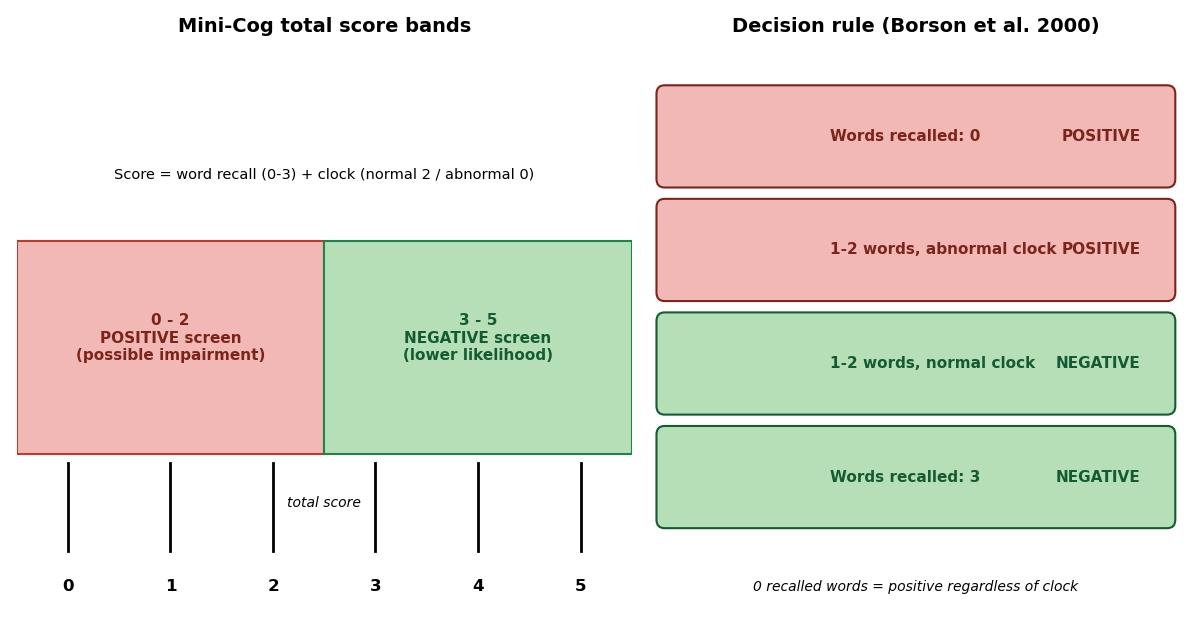
The Mini-Cog score is built from two numbers. The delayed word recall contributes 0 to 3 points, one for each word recalled. The clock drawing test contributes 2 points if the clock is normal and 0 points if it is abnormal. Adding them gives a total score from 0 to 5. This numeric total is then converted into a screening result using the decision rule from the original publication.
The rule is based on the word recall first. If the person recalls zero words, the screen is positive for possible cognitive impairment, regardless of how the clock was drawn. A complete failure of delayed recall is itself enough to warrant further evaluation. If the person recalls all three words, the screen is negative, and the clock drawing result does not change that reading.
The clock drawing decides the middle cases. When one or two words are recalled, the screen is positive if the clock drawing is abnormal, and negative if the clock drawing is normal. This is the key contribution of the clock: it sorts the borderline recall performances into those more and less likely to reflect real impairment. A person who remembers only one or two words but draws a perfectly normal clock is read as a negative screen, while the same recall with an abnormal clock is read as a positive screen.
Expressed as score bands, the rule works out to this: total scores of 0 to 2 indicate a positive screen for possible cognitive impairment, and total scores of 3 to 5 indicate a negative screen with a lower likelihood of dementia. Every combination of recall and clock result falls on one side of this line in agreement with the word-recall-first rule, so the bands and the rule always agree. For example, recalling two words with an abnormal clock gives a total of 2, a positive screen, while recalling one word with a normal clock gives a total of 3, a negative screen.
What your result means
A positive screen on the Mini-Cog means that possible cognitive impairment has been detected and that a clinical evaluation is recommended. It does not diagnose dementia or mild cognitive impairment. Many conditions other than dementia can affect performance on the test, including depression, delirium, poor sleep, certain medications, hearing or vision problems, low literacy, and testing in a second language. A clinician sorts through these possibilities during the follow-up assessment.
A negative screen means a lower likelihood of dementia, which is reassuring but not a clean bill of cognitive health. The Mini-Cog is a brief screen and can miss mild or very early impairment, particularly in people with high education or strong test-taking skills. If memory concerns persist despite a negative screen, it is still worth discussing them with a doctor. Screening instruments trade some sensitivity for speed, and clinical judgment remains the final authority.
It also helps to keep the result in perspective. The Mini-Cog was designed as a first filter, like a blood pressure check, and it performs that role well: quick, acceptable to patients, and able to pick out the people who most need the longer workup. Neither a positive nor a negative result should be treated as the last word on the matter.
Why the clock drawing test works
At first glance, drawing a clock seems like a strange way to test the brain. In practice it is one of the most information-dense tasks in cognitive screening. To draw a clock showing 10 past 11, a person must understand the instruction, plan the layout, retrieve the visual concept of a clock face, place twelve numbers in the correct positions, and set two hands to different lengths and angles. This single task touches language comprehension, planning, visual and spatial processing, numerical knowledge and fine motor control.
Executive function, the set of abilities that lets people plan, organize and carry out multi-step tasks, is often among the earliest casualties of cognitive decline. A person may still recall words reasonably well yet produce a disorganized clock with numbers bunched on one side or hands pointing at random positions. That is why the Mini-Cog pairs the two tasks: the word recall tests memory, while the clock tests the higher-order abilities that memory testing alone can miss. Giving the clock two points, equal to recalling two words, reflects how seriously the test designers weighed it.
The clock drawing test also has a practical advantage. It does not depend on the person's education level or language background as heavily as many verbal tests do. Borson and colleagues specifically developed the Mini-Cog for screening in multilingual elderly populations, and the relative language-independence of the clock task is part of what makes the instrument usable across different communities.
Strengths and limitations of the Mini-Cog
The Mini-Cog's greatest strength is its brevity. At about three minutes, it fits into a routine primary care visit, and patients generally find it acceptable rather than stressful. It requires no special equipment beyond paper and a pen, and it can be administered by physicians, nurses and other trained staff without specialist training in neuropsychology. The scoring is simple and leaves little room for examiner disagreement on the word recall portion.
Another strength is that the Mini-Cog covers more than one cognitive domain. Many very brief screens test only memory, but the addition of the clock drawing means executive and visuospatial function are represented too. Subsequent research, including a population-based validation by Borson, Scanlan, Chen and Ganguli published in the Journal of the American Geriatrics Society, and a systematic review and meta-analysis in PLOS ONE, has examined the Mini-Cog's accuracy as a dementia screening tool across settings. Clinicians value it as a practical front-line screen rather than a substitute for detailed assessment.
The limitations deserve equal attention. The clock drawing judgment of normal versus abnormal involves some examiner interpretation, and different raters can disagree on borderline drawings. Cultural familiarity with analog clocks varies, and younger or less formally educated people may draw unfamiliar clocks for reasons unrelated to cognition. Hearing impairment can affect word registration, and depression can suppress effort on both tasks, producing a positive screen without any underlying dementia.
Finally, like all brief screens, the Mini-Cog is less sensitive to mild cognitive impairment than to established dementia. A person in the early stages of decline may still score in the negative range. This is a known property of short screening instruments, not a flaw unique to the Mini-Cog, but it means the test should never be used to dismiss genuine concerns on its own.
What happens after a positive screen
A positive Mini-Cog screen leads to a fuller clinical evaluation, and it helps to know what that usually involves. The clinician takes a detailed history, including the timeline of any memory changes and reports from family members, reviews all medications and supplements, and asks about mood, sleep, alcohol use and recent illnesses. A physical and neurological examination follows, along with blood tests to check for reversible contributors such as thyroid problems or vitamin B12 deficiency.
Further cognitive testing is usually broader than the Mini-Cog. Instruments such as the MMSE or MoCA examine more domains in more depth, and the results are interpreted alongside the person's education, language and baseline abilities. If the clinical picture suggests dementia, brain imaging may be arranged and the person may be referred to a memory clinic or neurologist for a definitive assessment and care planning.
Families sometimes worry that a positive screen is the beginning of bad news. In reality it is the beginning of clarity. Some causes of poor test performance are fully reversible, and even when a progressive condition is found, early recognition allows better planning, earlier access to support services and treatments, and more time for the person and family to make decisions. A positive screen is a prompt to look closer, nothing more and nothing less.
Key takeaways
- A score of 3 to 5 is a negative screen, meaning a lower likelihood of dementia.
- No.
- The Mini-Cog takes about three minutes to administer, which is why it is popular in primary care where visit time is limited.
- Any three unrelated words work.
Frequently asked questions
What is a good Mini-Cog score?
A score of 3 to 5 is a negative screen, meaning a lower likelihood of dementia. A score of 0 to 2 is a positive screen for possible cognitive impairment and should prompt further clinical evaluation. Remember that the score depends on the combination of word recall and the clock drawing result.
Can the Mini-Cog diagnose dementia?
No. The Mini-Cog is a brief screening instrument, not a diagnostic test. A positive screen means possible cognitive impairment that needs a full clinical assessment. Only a qualified clinician, after ruling out other causes, can make a diagnosis of dementia or mild cognitive impairment.
How long does the Mini-Cog test take?
The Mini-Cog takes about three minutes to administer. The examiner reads three words, asks for a clock drawing, then asks the person to recall the three words. Its speed is the main reason it is used in primary care settings.
What words are used in the Mini-Cog?
Any three unrelated words can be used. Commonly cited example sets include apple, table, penny or banana, sunrise, chair. The examiner reads them aloud, asks the person to repeat them immediately, and then tests delayed recall after the clock drawing task.
Why does the clock drawing test matter?
Drawing a clock to a specified time tests executive function, planning, visuospatial skills and the ability to follow instructions. These abilities often decline early in cognitive impairment, so the clock adds information that word recall alone does not capture. A normal clock is worth 2 points in the total score.
What should I do after a positive Mini-Cog screen?
Arrange a clinical evaluation with the person's doctor. A full assessment usually covers medical history, medications, mood, hearing and vision, and further cognitive testing, because many treatable conditions can affect test performance.
Medical disclaimer
This calculator is for educational and informational purposes only. It is not medical advice and does not diagnose any condition. A Mini-Cog result should be interpreted by a qualified clinician as part of a full assessment. If you have concerns about memory or thinking, please see a healthcare professional.
Sources
- Borson S, Scanlan J, Brush M, Vitaliano P, Dokmak A. The Mini-Cog: a cognitive "vital signs" measure for dementia screening in multilingual elderly. Int J Geriatr Psychiatry. 2000;15(11):1021-1027. (Source of the three-word recall plus clock drawing algorithm and the positive/negative decision rule used in this calculator.)
- Borson S, Scanlan JM, Chen P, Ganguli M. The Mini-Cog as a screen for dementia: validation in a population-based sample. J Am Geriatr Soc.
- Chan CCH, et al. Mini-Cog for the detection of dementia within a secondary care setting. Cochrane Database Syst Rev. 2021. (Summary of the standard Mini-Cog scoring and decision rule.)