Mixed Amphetamine Salts (Adderall) Pediatric Dosing Guide and Dose Lookup
In short: Label-verified pediatric dosing for mixed amphetamine salts (Adderall, Adderall XR): starting doses, weekly titration steps, maxima, boxed warning, and safety monitoring. Free dose lookup by formulation and age. Use the calculator above, then read the guide below to interpret your result and its limitations.
Label-verified starting doses, weekly titration steps, and safety monitoring for mixed amphetamine salts (Adderall immediate release and Adderall XR extended release) in children and adolescents with ADHD. Use the lookup below, then read the full guide. Medically reviewed by Dr. Taimoor Asghar.
Dose lookup: labeled starting dose by formulation and age
Reference only. Every number comes from the FDA prescribing information for Adderall (immediate release) and Adderall XR (extended release), checked 2026-10-05. Prescribing and titration are clinician-directed; this lookup does not replace the prescriber. Doses are fixed by age band and response, not by weight, which is why the lookup does not ask for weight.
Titration ladders: how the weekly steps reach the label maxima
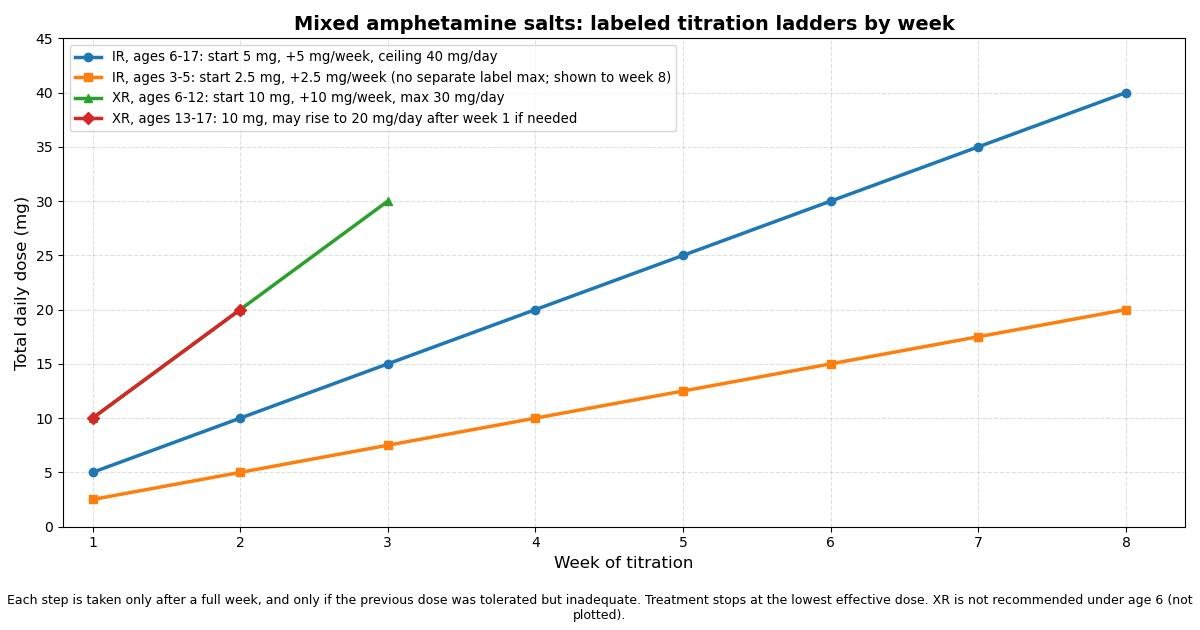
Each ladder shows the labeled weekly increments up to the label maximum. Every step is taken only after a full week at the previous dose, and only if that dose was tolerated but the response was inadequate. Treatment stops at the lowest effective dose, which for most children is well below the ceiling. Adderall XR is not recommended under age 6, so no under-6 XR ladder is plotted.
What mixed amphetamine salts are
Mixed amphetamine salts are a central nervous system stimulant made from four amphetamine salts: dextroamphetamine saccharate, amphetamine aspartate, dextroamphetamine sulfate, and amphetamine sulfate. The two brand names most people know are Adderall, the immediate-release tablet taken in divided daily doses, and Adderall XR, the extended-release capsule taken once each morning. Generic versions contain the same active mixture. It is a Schedule II controlled medicine in the United States, which reflects its high potential for abuse and misuse, and it is available only by prescription.
The drug is indicated, as part of a total treatment program for attention deficit hyperactivity disorder (ADHD), for children and adolescents whose diagnosis has been established by a clinician. The labels stress the "total treatment program" point deliberately: the medicine is one component alongside behavioral, educational, and social measures, not a standalone fix. It works by increasing signaling of the brain chemicals dopamine and norepinephrine, which improves attention and reduces hyperactivity and impulsivity in children with ADHD. The immediate-release form acts for a few hours per dose, which is why it is given in divided doses, while the XR capsule uses a beaded delivery system that releases the medicine in two waves so that one morning capsule covers the day.
Parents sometimes encounter the word "amphetamine" and worry that this is the same as illicit stimulants. The active chemistry is related, which is exactly why the medicine carries a boxed warning about abuse, misuse, and addiction and why it is a controlled substance. But the labeled pediatric use is a measured, clinician-supervised treatment with fixed starting doses, weekly titration, defined maxima, and structured safety monitoring, which is what the rest of this page describes.
Who this page is for
This page covers children and adolescents from 3 to 17 years of age with clinician-diagnosed ADHD who have been prescribed, or are being considered for, mixed amphetamine salts. The immediate-release label includes dosing from age 3 (with a lower starting schedule for ages 3 to 5) and states that use is not recommended for children under 3. The extended-release label covers ages 6 and older and does not recommend use under 6, because younger children had higher plasma exposure and more adverse reactions at the same dosage.
The intended reader is a parent, caregiver, or clinician who wants to understand what the label actually says about starting doses, how increases are scheduled, where the ceilings sit, and what safety checks surround treatment. It is not written for adults starting treatment themselves, and it does not cover the separate labeled indication of narcolepsy, for which the immediate-release label gives different adult-oriented dosing. Every dose on this page traces to the FDA prescribing information for the two formulations, checked on 2026-10-05; anything that could not be verified against the labels was left out rather than estimated.
Immediate-release dosing by age band
The immediate-release label groups children into two bands. Children 3 to 5 years start at 2.5 mg once daily, and the daily dose may be raised in increments of 2.5 mg at weekly intervals until the optimal response is obtained. Children 6 years and older, which includes all adolescents, start at 5 mg once or twice daily, and the daily dose may be raised in increments of 5 mg at weekly intervals until the optimal response is obtained. The first dose is given on awakening, and any additional doses (one or two) are given at intervals of 4 to 6 hours. The label sets the ceiling plainly: only in rare cases will it be necessary to exceed a total of 40 mg per day.
| Age band | Starting dose | Titration step | Labeled maximum | Timing |
|---|---|---|---|---|
| 3 to 5 years | 2.5 mg once daily | Raise by 2.5 mg at weekly intervals | No separate 3 to 5 maximum in the label; the 6-plus ceiling below applies as the rarely-exceeded total | First dose on awakening (morning); avoid late-evening doses (insomnia) |
| 6 to 12 years | 5 mg once or twice daily | Raise by 5 mg at weekly intervals | 40 mg per day total; only in rare cases exceeded | First dose on awakening; additional doses at 4 to 6 hour intervals; avoid late-evening doses (insomnia) |
| 13 to 17 years | 5 mg once or twice daily | Raise by 5 mg at weekly intervals | 40 mg per day total; only in rare cases exceeded | First dose on awakening; additional doses at 4 to 6 hour intervals; avoid late-evening doses (insomnia) |
Source for all rows: FDA prescribing information for Adderall (immediate release), Dosage and Administration, checked 2026-10-05. The label directs the lowest effective dosage, individually adjusted to the patient's therapeutic needs and response.
Two details in this table deserve emphasis. First, the label does not split 6 to 12 from 13 to 17 for immediate release: everyone 6 and older follows the same schedule. Second, the 40 mg per day figure is not a target but a rarely-exceeded ceiling. The label's instruction is to administer the lowest effective dosage and adjust to the individual child's response, so most children stabilize well below 40 mg per day, and the dose is reduced if bothersome adverse reactions such as insomnia or loss of appetite appear.
Extended-release dosing by age band
The extended-release label is stricter about ages. It covers patients 6 years and older and states plainly that use is not recommended under 6. For children 6 to 12 who are starting treatment for the first time or switching from another medicine, the starting dose is 10 mg once daily in the morning, with 5 mg once daily in the morning as the lower start when the clinician judges it appropriate. The daily dose may then be adjusted in increments of 5 mg or 10 mg at weekly intervals. The maximum recommended dose for children 6 to 12 is 30 mg per day, and the label notes that doses greater than 30 mg per day have not been studied in children. For adolescents 13 to 17, the recommended starting dose is 10 mg per day, and the dose may be increased to 20 mg per day after one week if symptoms are not adequately controlled.
| Age band | Starting dose | Titration step | Labeled maximum | Timing |
|---|---|---|---|---|
| 3 to 5 years | Not recommended under 6 years: higher plasma exposure and a higher incidence of adverse reactions (for example weight loss) than in patients 6 and older at the same dosage. | |||
| 6 to 12 years | 10 mg once daily in the morning (5 mg if a lower start is judged appropriate) | Adjust by 5 mg or 10 mg at weekly intervals | 30 mg per day; doses above this have not been studied in children | Give upon awakening in the morning; afternoon doses avoided (insomnia) |
| 13 to 17 years | 10 mg once daily in the morning | May be increased to 20 mg per day after one week if symptoms are not adequately controlled | No separate adolescent maximum in the label; the studied pediatric ceiling shown is 30 mg per day | Give upon awakening in the morning; afternoon doses avoided (insomnia) |
Source for all rows: FDA prescribing information for Adderall XR, Dosage and Administration and Limitations of Use, checked 2026-10-05.
The extended-release capsule may be taken with or without food, and it should be given upon awakening because afternoon doses risk insomnia. The capsule may be taken whole, or it may be opened and its entire contents sprinkled on a spoonful of applesauce and taken immediately; the mixture must not be stored for later, and the capsule and its beads must not be chewed or crushed. These administration details matter because crushing the beads destroys the extended-release mechanism and changes the dose the child actually receives.
How titration works, step by step
Titration is the process of finding the child's individual dose, and the labels describe it as a slow, deliberate sequence. The prescriber starts at the labeled starting dose for the child's age band and formulation, then waits a full week before judging the result. Only if the current dose was tolerated but the response was inadequate does the dose move up by one labeled increment: 5 mg for immediate release in children 6 and older, 2.5 mg for immediate release in ages 3 to 5, or 5 to 10 mg for extended release in ages 6 to 12. Each new dose then gets its own full week of observation. This weekly rhythm is not arbitrary: it gives the child's body time to settle at each level and gives parents and teachers time to observe both benefit and side effects across school days and weekends.
The goal of titration is the lowest effective dose, which the label states as a standing principle: regardless of indication, amphetamines should be administered at the lowest effective dosage, with the dose individually adjusted to the patient's therapeutic needs and response. In practice this means the increases stop as soon as symptoms are adequately controlled, even if the dose is far below the labeled maximum. If bothersome adverse reactions appear, such as insomnia or loss of appetite, the label directs that the dosage be reduced rather than pushed through. The ceilings in the tables are safety boundaries, not targets, and most children never approach them.
Two longer-term label instructions complete the picture. First, where possible, drug administration should be interrupted occasionally to determine whether there is a recurrence of behavioral symptoms sufficient to require continued therapy. These planned breaks, sometimes called drug holidays and often scheduled over school holidays, test whether the child still needs the medicine and can also give appetite and growth a chance to recover. Second, the prescriber reassesses the need for ongoing treatment at regular visits, because ADHD treatment plans evolve as children grow and their school demands change.
Why the dose is not based on weight
This is the misconception this page most wants to correct, so it gets its own section. Many parents reasonably assume that because antibiotics, paracetamol, and ibuprofen are dosed in milligrams per kilogram, a stimulant for ADHD must work the same way, and that a heavier child automatically needs a larger dose. For mixed amphetamine salts, that is not how the labels work. The FDA prescribing information sets fixed starting doses and fixed titration steps by age band and formulation, with no weight term anywhere in the calculation. The lookup tool at the top of this page deliberately has no weight field: entering one would imply a calculation the label does not support.
The reason is that stimulant response is individual rather than size-driven. Two children of the same age can need quite different doses because of differences in individual sensitivity, metabolism, and how their brains respond to dopamine and norepinephrine signaling, while a heavier child does not systematically need more medicine than a lighter one. The prescriber therefore titrates to the child's observed response: attention and behavior at school and home, weighed against appetite, sleep, mood, and heart rate. A small 8-year-old may stabilize on 15 mg of extended release while a larger 8-year-old does well on 10 mg, and neither outcome contradicts the label, because the label never promised a weight-proportional dose.
Weight still matters in stimulant treatment, but in the opposite role: as something to monitor, not as a dosing input. The labels warn about appetite suppression, weight loss, and suppression of growth, which is why the prescriber records height and weight at baseline and at follow-up visits. If a child's growth curve falters, the response is a clinical review of whether the dose, the timing, or continued treatment needs adjusting, not a recalculation from kilograms. The extended-release label's under-6 restriction illustrates the same principle from another angle: younger children had higher plasma exposure and more adverse reactions at the same dosage, an age-and-development effect that a weight formula would not have captured. The practical rule for parents is simple: never scale the dose up or down with the child's weight, and bring any weight or growth concern to the prescriber instead.
Contraindications: when it must not be used
The labels list situations in which mixed amphetamine salts must not be used at all. These are absolute, not matters of dose adjustment, and the prescriber checks them before the first prescription.
| Contraindication | Why the label lists it |
|---|---|
| Use of monoamine oxidase inhibitors (MAOIs), or use within 14 days of stopping one | Hypertensive crises may result from the interaction. |
| Symptomatic cardiovascular disease, including advanced arteriosclerosis | Stimulants stress the cardiovascular system; serious events including sudden death have been reported in susceptible patients. |
| Moderate to severe hypertension | Stimulants raise blood pressure and heart rate. |
| Hyperthyroidism | Thyroid excess already stimulates the cardiovascular system and metabolism. |
| Glaucoma | Listed as a contraindication in the immediate-release label. |
| Agitated states | Stimulants can worsen agitation. |
| Known hypersensitivity or idiosyncrasy to amphetamine or to sympathomimetic amines | Allergic or idiosyncratic reactions to the drug class. |
Source: FDA prescribing information for Adderall (immediate release) and Adderall XR, Contraindications, checked 2026-10-05.
Parents should volunteer the relevant history rather than waiting to be asked: any heart condition, high blood pressure, thyroid disease, glaucoma, or unusual agitation or anxiety in the child, plus the full list of the child's medicines including any antidepressant, because MAOIs are not always recognized by their class name. The 14-day MAOI rule applies in both directions: the stimulant must not be started until 14 days after the MAOI is stopped.
Cardiac screening before starting
Before the first prescription, the immediate-release label directs the clinician to assess for the presence of cardiac disease through a careful history, a family history of sudden death or ventricular arrhythmia, and a physical exam. The extended-release label adds an explicit avoidance list: do not use the medicine in patients with known structural cardiac abnormalities, cardiomyopathy, serious cardiac arrhythmia, coronary artery disease, or other serious cardiac disease. The reason given is the risk of serious cardiovascular events, including sudden death, in susceptible patients.
In practical terms, the prescriber will ask about the child's own heart history (murmurs, chest pain, fainting, palpitations, shortness of breath with exercise), about close relatives with heart disease or sudden unexplained death, and will examine the child including blood pressure and pulse. If any red flag appears, the child is referred for cardiac evaluation before any stimulant is considered, and in some cases the cardiac specialist will advise against stimulant treatment entirely. This screening is repeated in spirit at follow-up visits: new chest pain, fainting, or a persistently fast or irregular heartbeat during treatment needs prompt medical attention, not watchful waiting at home.
Monitoring during treatment
Starting the medicine is the beginning of monitoring, not the end of it. The labels name several things the prescriber watches over time. Growth comes first for children: height and weight are recorded at baseline and at follow-up visits because stimulants can suppress appetite and growth, and the growth chart is the objective record of whether this is happening. If growth slows meaningfully, the prescriber reviews the dose, the timing, and whether a planned break from the medicine is appropriate.
Blood pressure and pulse are monitored at appropriate intervals because stimulants increase both; the extended-release label states this as a direct instruction. Families can help by reporting headaches, chest discomfort, or a heartbeat that feels unusually fast or forceful. Tics are the next watch item: the immediate-release label directs the clinician to take the family history and clinically evaluate the patient for motor or verbal tics or Tourette's syndrome before initiating treatment, and stimulants can unmask or worsen tics, so new repetitive movements or sounds should be reported. Finally, psychiatric monitoring: the extended-release label directs screening for risk factors for a manic episode before starting, and says that if new psychotic or manic symptoms occur, discontinuing the medicine should be considered. Sudden severe mood changes, hallucinations, or unusually grandiose or risky behavior during treatment are reasons to contact the prescriber promptly.
How to give each formulation
Immediate release can be taken with or without food. The first dose is given on awakening in the morning, and any additional doses are spaced 4 to 6 hours apart, with late-evening doses avoided because the resulting insomnia defeats the purpose of treatment. Because the effect of each tablet lasts only a few hours, the divided schedule is what keeps cover across the school day, and the prescriber sets the number of daily doses (one or two at the start) based on how long the child needs cover.
Extended release is simpler in schedule but stricter in technique. It is given once daily upon awakening in the morning, with or without food, and afternoon doses are avoided because of the potential for insomnia. The capsule may be swallowed whole, or it may be opened and its entire contents sprinkled onto a spoonful of applesauce and swallowed immediately; the sprinkled mixture must not be stored for later use. The capsule and its beads must never be chewed or crushed, because that destroys the extended-release mechanism and delivers the whole day's medicine at once. For children who cannot swallow capsules, the applesauce method is the labeled alternative, not crushing.
If a dose is missed
The labels do not give a specific missed-dose instruction, so the guidance here is built only from what the labels do say about timing. Both labels warn against afternoon and late-evening doses because of insomnia, and that warning is the basis for the cautious approach: if the missed dose is remembered early in the day, it can still be taken, keeping the usual spacing from any remaining doses. If it is already afternoon or evening, the safer choice is to skip the missed dose and resume the normal schedule the next morning. Never give two doses at once to make up for a missed one, and never give a late dose that will keep the child awake half the night. When in doubt, or if missed doses are happening often, the prescriber should be asked for a plan, because frequent missed doses can also signal that the dosing schedule no longer fits the family's day.
Side effects
The reactions the extended-release label reports most often in children include decreased appetite and weight loss, difficulty sleeping, abdominal pain, headache, nausea or vomiting, dizziness, dry mouth, nervousness or anxiety, and emotional lability (unusually strong or shifting moods). These are dose-related for many children: they are more noticeable after a dose increase and often ease as the child settles at a stable dose, and the prescriber may lower the dose if they are bothersome. Appetite effects deserve special attention at mealtimes: offering a good breakfast before the morning dose and a substantial evening meal as the medicine wears off are practical strategies families use, alongside the growth monitoring described above.
Some effects need prompt medical contact rather than patience. These include chest pain, fainting, shortness of breath, or a very fast or irregular heartbeat; new or worsening tics; severe mood changes, aggression, hallucinations, or signs of mania; and any allergic reaction such as rash, hives, or swelling of the face or lips. The boxed warning's risks are the most serious of all: signs of misuse, such as missing tablets, requests for early refills, or marked personality changes, should be raised with the prescriber at once. As with any medicine, the full adverse-reaction list is in the prescribing information, and the prescriber is the right person to judge whether a new symptom is related to treatment.
Key takeaways
- For a 7-year-old, the FDA labels give two options depending on the formulation the prescriber chooses.
- The labels specify weekly intervals between increases: the clinician waits a full week at each dose before judging the response.
- Because mixed amphetamine salts are not dosed by weight.
- The FDA label does not recommend it.
Frequently asked questions
What is the starting dose of Adderall for a 7-year-old with ADHD?
For a 7-year-old, the FDA labels give two options depending on the formulation the prescriber chooses. Immediate-release Adderall starts at 5 mg once or twice daily, with the first dose given on awakening and any additional doses at 4 to 6 hour intervals. Adderall XR starts at 10 mg once daily in the morning. The prescriber picks the formulation, and the starting dose is the same for every 7-year-old: weight does not enter the calculation. Increases happen at weekly intervals, in 5 mg steps for immediate release and in 5 or 10 mg steps for XR in the 6 to 12 age group, and only if the current dose was tolerated but the response was inadequate.
How quickly can the dose of mixed amphetamine salts be increased in children?
The labels specify weekly intervals between increases: the clinician waits a full week at each dose before judging the response. Immediate release is raised in 5 mg increments at weekly intervals for children 6 and older (2.5 mg increments for ages 3 to 5). Adderall XR in ages 6 to 12 is adjusted in 5 or 10 mg increments at weekly intervals; in ages 13 to 17 the label describes an increase from 10 to 20 mg per day after one week if symptoms are not adequately controlled. The labeled maxima are 40 mg per day for immediate release (the label says only in rare cases will it be necessary to exceed 40 mg per day) and 30 mg per day for Adderall XR in ages 6 to 12, a range above which doses have not been studied in children. Treatment always aims for the lowest effective dose, not the maximum.
Why is the dose the same for a 25 kg child and a 45 kg child?
Because mixed amphetamine salts are not dosed by weight. The FDA labels set fixed starting doses and fixed titration steps by age band and formulation, and the prescriber adjusts based on the individual child's response and tolerability, not on kilograms. This surprises many parents because antibiotics and many other pediatric medicines are weight-based, but stimulant dosing is response-driven: two children of the same age can need quite different doses because of differences in individual sensitivity and metabolism, while a heavier child does not automatically need more. Weight still matters, but for safety monitoring rather than for setting the dose: the prescriber tracks height and weight because stimulants can suppress appetite and growth.
Can Adderall XR be given to a 4-year-old?
The FDA label does not recommend it. Adderall XR is not recommended in patients younger than 6 years of age because they had higher plasma exposure and a higher incidence of adverse reactions, such as weight loss, than patients 6 and older at the same dosage. The immediate-release label, by contrast, includes dosing from age 3: children 3 to 5 years start at 2.5 mg daily, raised in 2.5 mg increments at weekly intervals. Neither formulation is recommended for children under 3. The lookup tool on this page returns a named not-recommended result for the XR plus under-6 combination rather than a dose.
What heart checks are needed before a child starts mixed amphetamine salts?
Before prescribing, the labels direct the clinician to assess for cardiac disease with a careful history, a family history of sudden death or ventricular arrhythmia, and a physical exam. The extended-release label goes further and says to avoid use in patients with known structural cardiac abnormalities, cardiomyopathy, serious cardiac arrhythmia, coronary artery disease, or other serious cardiac disease, because stimulants carry risks of serious cardiovascular events including sudden death in susceptible patients. Blood pressure and pulse are then monitored at appropriate intervals during treatment. Any chest pain, fainting, or unusually fast or irregular heartbeat during treatment needs prompt medical attention.
Can I use this page to set or change my child's dose on my own?
No. This page is a reference for understanding prescriptions and the labeled dosing ranges, not a tool for self-dosing. Mixed amphetamine salts are Schedule II controlled medicines with a boxed warning for abuse, misuse, and addiction, and every dose decision belongs to the prescriber, who weighs the child's cardiac history, growth, blood pressure, tics, mood, and response. Never start, raise, lower, or stop a child's stimulant based on this page alone, and never share the medicine with anyone else: sharing a Schedule II stimulant is both dangerous and illegal.
References
1. U.S. Food and Drug Administration prescribing information for Adderall (dextroamphetamine saccharate, amphetamine aspartate, dextroamphetamine sulfate, and amphetamine sulfate tablets), Dosage and Administration, Warnings, Contraindications. DailyMed. Available at: dailymed.nlm.nih.gov/dailymed/drugInfo.cfm?setid=f22635fe-821d-4cde-aa12-419f8b53db81 (accessed 2026-10-05). Source for all immediate-release starting doses, titration steps, the 40 mg per day rarely-exceeded ceiling, timing, cardiac screening, tics evaluation, drug-holiday guidance, and contraindications.
2. U.S. Food and Drug Administration prescribing information for Adderall XR (mixed salts of a single-entity amphetamine product) extended-release capsules, Dosage and Administration, Limitations of Use, Warnings and Precautions, Contraindications. DailyMed. Available at: dailymed.nlm.nih.gov/dailymed/getFile.cfm?setid=aff45863-ffe1-4d4f-8acf-c7081512a6c0&type=pdf (accessed 2026-10-05). Source for all extended-release starting doses, titration steps, the 30 mg per day maximum for ages 6 to 12, the under-6 limitation, morning administration, applesauce administration, blood pressure and pulse monitoring, psychiatric screening, and serious cardiac disease avoidance.
3. FDA.report mirror of the Adderall (immediate release) DailyMed record. Available at: fda.report/DailyMed/f22635fe-821d-4cde-aa12-419f8b53db81 (accessed 2026-10-05). Secondary access point for the same FDA label text.
Further reading
Related pediatric dosing guides
More ADHD and pediatric dosing references in this series: methylphenidate pediatric dosing info and atomoxetine pediatric dosing info.