What methylphenidate is
Methylphenidate is a central nervous system (CNS) stimulant. It is the active ingredient in a family of prescription medicines that includes Ritalin, Ritalin-SR, Ritalin LA, Concerta, Metadate, Methylin, Quillivant XR, and Daytrana, among others. The FDA-approved indication for these products is the treatment of Attention Deficit Hyperactivity Disorder (ADHD); Ritalin is also indicated for narcolepsy. This guide covers the two formulations most commonly encountered in pediatric practice: immediate-release methylphenidate (Ritalin) and the extended-release osmotic tablet Concerta.
Methylphenidate is a Schedule II controlled substance, and every methylphenidate label carries a boxed warning about abuse and dependence. The boxed warning states that CNS stimulants, including methylphenidate products, have a high potential for abuse and dependence, and directs prescribers to assess the risk of abuse prior to prescribing and to monitor for signs of abuse and dependence during therapy. In practical terms, this means the medicine is kept locked away, doses are given exactly as prescribed, and the prescribing team watches for misuse at every visit. The boxed warning is the single most prominent safety statement in the label, and families starting the medicine should understand what it means before the first dose is given.
The medicine works by increasing signaling activity in brain circuits that regulate attention and impulse control. For families, the key point is not the receptor pharmacology but the clinical pattern the label describes: the effect begins within the dosing interval, wears off, and is then re-established by the next dose. That on-and-off pattern is exactly why immediate-release products are dosed twice daily and why the extended-release tablet is designed to release medicine gradually across the day.
The two formulations in this guide
Ritalin immediate-release (IR)
Ritalin tablets are the immediate-release form of methylphenidate. The full dose is absorbed and acts over several hours, which is why the label divides the daily dose into two administrations, one before breakfast and one before lunch. Taking the second dose before lunch rather than later in the day matters: a late dose can push the stimulant effect into the evening and cause insomnia, one of the most common adverse reactions.
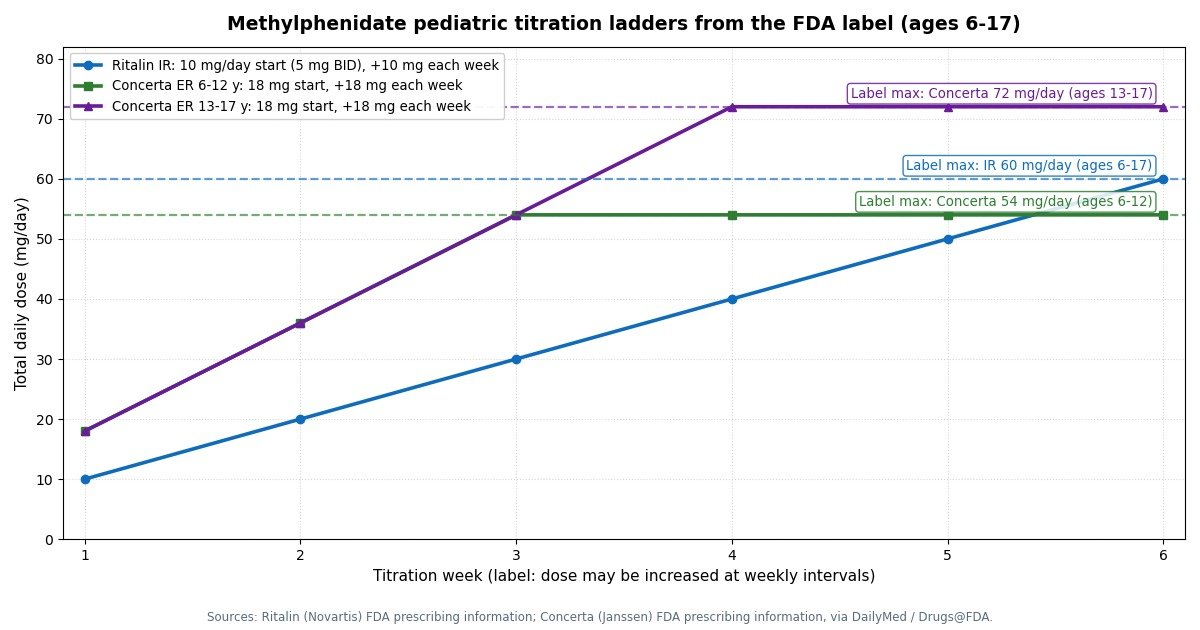
The IR tablets come in 5, 10, and 20 mg strengths. The pediatric label rule is short and precise: pediatric patients 6 years and older start with 5 mg twice daily, before breakfast and lunch, and the dose is titrated weekly in 5 to 10 mg increments. Dosages above 60 mg per day are not recommended. Those three numbers. 5 mg twice daily, 5 to 10 mg weekly increments, 60 mg per day. Are the entire IR titration scheme, and the widget at the top of this page reproduces them exactly.
Concerta extended-release (ER)
Concerta is an extended-release tablet that uses an osmotic delivery system: an inner core releases methylphenidate gradually while an outer overcoat provides an immediate initial dose, so a single morning tablet covers the day. The tablet has a distinctive administration rule that the label states twice: the tablets must be swallowed whole with the aid of liquids and must not be chewed, divided, or crushed. Chewing or cutting destroys the extended-release mechanism and would dump the full day's dose at once, which is dangerous.
Concerta comes in 18, 27, 36, and 54 mg strengths. For children and adolescents who have not taken methylphenidate before, the label recommends starting at 18 mg once daily in the morning, increasing by 18 mg at weekly intervals. The maximum differs by age band: 54 mg once daily for children 6 to 12 years, and 72 mg once daily for adolescents 13 to 17 years. The 27 mg strength exists for slower, finer titration: the label notes that if slower titration is recommended for patients not achieving an optimal response on 18 mg once daily, the dose can be increased to 27 mg once daily instead of jumping straight to 36 mg.
One practical detail families often notice: the Concerta tablet shell does not dissolve and may occasionally be observed in the stool. The label advises patients about this, and it is normal. The medicine has already been released from the shell as it passed through the gut. A related stimulant guide on this site covers pediatric dosing information for amphetamine salts, the other major stimulant family used in ADHD.
Age rules: who these doses apply to
Both labels draw the same line at age 6. For Ritalin, safety and efficacy in children below 6 years have not been established. For Concerta, the label states that use in children under 6 years has not been studied. The dose lookup widget on this page enforces that boundary: entering an age under 6 produces a hard stop explaining that dosing in this age group is a specialist decision, not something to calculate at home.
At the other end, this guide covers ages 6 through 17. Adult methylphenidate dosing follows different rules. For example, the average adult Ritalin daily dosage is 20 to 30 mg administered 2 or 3 times daily, with the same 60 mg maximum. So the widget also gates ages above 17 and directs those users to the prescribing clinician. The Concerta label's two pediatric age bands, 6 to 12 years and 13 to 17 years, exist because the adolescent maximum (72 mg/day) is higher than the child maximum (54 mg/day); the widget selects the correct ceiling from the entered age.
Ritalin immediate-release titration ladder
The IR titration ladder follows directly from the label's three numbers. Each week the total daily dose may rise by 5 to 10 mg, divided into the two daily doses, until symptoms are controlled or the 60 mg per day ceiling is reached. Showing the ladder in 10 mg weekly steps:
| Week | Total daily dose | How taken |
|---|---|---|
| 1 | 10 mg | 5 mg before breakfast and 5 mg before lunch |
| 2 | 20 mg | 10 mg before breakfast and 10 mg before lunch |
| 3 | 30 mg | 15 mg before breakfast and 15 mg before lunch |
| 4 | 40 mg | 20 mg before breakfast and 20 mg before lunch |
| 5 | 50 mg | 25 mg before breakfast and 25 mg before lunch |
| 6 | 60 mg | 30 mg before breakfast and 30 mg before lunch (label maximum) |
Two label details qualify this ladder. First, the weekly increment is 5 to 10 mg, not always 10 mg: the prescribing team may use smaller 5 mg steps for a child who is responding partially or showing side effects, and the widget's ladder uses the standard 10 mg steps while the team individualizes. Second, titration is response-driven and stops at the lowest effective dose. Many children never approach the 60 mg ceiling, and reaching the maximum is not the goal. The label's titration language is conditional throughout: doses are increased only when the response to the current dose is not satisfactory.
Concerta titration ladders by age band
Concerta titration is simpler because each step is a single morning tablet. The label schedule increases the dose by 18 mg at weekly intervals:
| Week | Ages 6-12 (mg once daily) | Ages 13-17 (mg once daily) |
|---|---|---|
| 1 | 18 | 18 |
| 2 | 36 | 36 |
| 3 | 54 (label maximum) | 54 |
| 4 | - | 72 (label maximum) |
For children who are switching from another methylphenidate product rather than starting fresh, the Concerta label gives a conversion table based on the previous total daily methylphenidate dose: 5 mg twice daily of IR converts to 18 mg Concerta once daily; 10 mg twice daily converts to 36 mg; 15 mg twice daily converts to 54 mg; and 20 mg twice daily converts to 72 mg. The 27 mg strength sits between 18 mg and 36 mg for the slower-titration scenario the label describes. As with IR, the goal is the lowest dose that controls symptoms, and the prescribing team reassesses at each step.
Why titration is slow and response-driven
The weekly interval in both labels is deliberate. Each dose level needs about a week of observation before the team can judge it: how the child's attention and behavior look across the school day, whether side effects such as appetite loss or trouble falling asleep appear, and whether blood pressure and heart rate stay stable. Increasing faster than the label allows would stack an unevaluated dose on top of another, making it impossible to tell which level caused a side effect and risking overshoot past the child's optimal dose.
The clinical team titrates against a target that only they can set with the family and school: adequate symptom control through the hours that matter (school, homework, structured activities) with side effects the child can tolerate. Appetite and sleep are watched especially closely in the first weeks, because decreased appetite and insomnia are among the most common reasons a dose is held rather than increased. Weight and height enter the growth charts at intervals, because long-term suppression of growth is a labeled warning and the label directs monitoring of height and weight at appropriate intervals in pediatric patients.
The boxed warning: abuse and dependence
The boxed warning is the label's strongest safety statement and it applies to every methylphenidate product, IR and ER alike. For families, its practical meaning is straightforward: this is a controlled medicine with street value, so storage matters as much as dosing. Pills are counted, bottles are kept out of reach and ideally locked, and school nurses. Where the midday IR dose is given at school. Store and dispense it under controlled-medicine procedures.
Monitoring for misuse is part of routine care. The prescribing team asks at visits whether doses are ever taken differently from prescribed, whether anyone else has access to the medicine, and whether the child shows signs of dependence. If methylphenidate is stopped after prolonged use, the team watches for withdrawal-type symptoms such as severe fatigue and depression; any dose reduction or discontinuation is clinician-directed, not abrupt.
Cardiac and other label warnings the team must review
The cardiac assessment the label calls for covers the child's own history (any known heart condition, heart surgery, chest pain or fainting with exertion, unexplained shortness of breath, palpitations) and the family history (sudden cardiac death or serious heart rhythm problems in close relatives). When any of these are present, the prescribing team evaluates further. Often with cardiology input and an ECG. Before deciding whether a stimulant is appropriate at all. Methylphenidate also raises blood pressure and heart rate on average, so both are measured at baseline and monitored during treatment.
Beyond the heart, the label lists further cautions that the prescribing team reviews before starting. Marked anxiety, tension, and agitation are listed as reasons not to use methylphenidate, because stimulants can worsen them. Glaucoma is listed for the same reason. Tics, or a family history or diagnosis of Tourette syndrome, are listed because stimulants can bring out or worsen tics. Severe hypertension, and hyperthyroidism or thyrotoxicosis, are listed because the drug's cardiovascular effects compound those conditions. Concomitant treatment with monoamine oxidase inhibitors, or MAOI use within the preceding 14 days, is an absolute contraindication: the combination can precipitate hypertensive crisis. The widget's warning checklist reproduces exactly these items as flags for the prescribing clinician. They are label statements about the medicine, not diagnoses of the child.
Administration: how and when each dose is given
Ritalin IR is taken 30 to 45 minutes before breakfast and lunch, per the adult label wording that the pediatric section references. The morning timing serves the school day, and the lunch timing keeps the effect from running into the evening. Food is not prohibited, but the before-meal convention helps absorption stay consistent from day to day. If a dose is missed, the label convention is not to double up: the missed dose is skipped if it is too late in the day, and the regular schedule resumes the next morning. Families should confirm the exact missed-dose instruction with their prescribing team, since it depends on the formulation and the time.
Concerta is taken once daily in the morning with the aid of liquids, swallowed whole. The tablet must not be chewed, divided, or crushed. Because the morning dose covers the day, a missed Concerta dose is handled the same conservative way: late-day dosing risks insomnia, so the team usually advises skipping a dose missed past the morning and resuming the next day. Alcohol is avoided with Concerta because it can alter the release characteristics of the tablet.
Day-to-day consistency matters more than most families expect. Giving the dose at the same time each day, keeping sleep and meal routines stable, and reporting appetite or sleep changes at the titration visits all help the team find the lowest effective dose faster. Growth, blood pressure, and heart rate checks are part of those visits by label direction.
Side effects the label lists as common
The FDA label's adverse reactions section for methylphenidate products lists the reactions families are most likely to encounter. The common ones are: tachycardia and palpitations, headache, insomnia, anxiety, hyperhidrosis (excessive sweating), weight loss, decreased appetite, dry mouth, nausea, and abdominal pain. Decreased appetite deserves emphasis because it is the most visible day-to-day effect: children may eat little at lunch while the medicine is active and then eat heavily in the evening as it wears off, a pattern families can plan around with a good breakfast and an evening meal.
Less common but labeled warnings include new or worsening psychiatric symptoms: the label warns that stimulants can exacerbate pre-existing psychotic or manic symptoms and can induce new psychotic or manic symptoms in children and adolescents without prior history, so unusual suspiciousness, hallucinations, or mania are reported promptly. Other labeled warnings include seizures (stimulants may lower the convulsive threshold), priapism (prolonged painful erection requiring immediate medical attention), and peripheral vasculopathy including Raynaud phenomenon (numb, pale, or painful fingers or toes). None of these are reasons to panic, but they are reasons to know what to report and to report it quickly.
Monitoring during treatment
The label's monitoring directions for pediatric methylphenidate therapy form a short, repeatable checklist that the prescribing team follows at each visit. Height and weight are measured at appropriate intervals because of the long-term growth-suppression warning. Blood pressure and heart rate are checked because stimulants raise both on average. The team asks about appetite, sleep, mood, tics, and any new psychiatric symptoms, and examines for signs of peripheral circulation problems in the fingers and toes.
School feedback closes the loop: teachers report whether attention and behavior during the covered hours have improved, which tells the team whether the current dose is doing its job. If symptoms are controlled, the dose stays where it is; the label's titration logic never increases a dose that is already working. Periodically, the team also reassesses whether the medicine is still needed at all, because ADHD treatment plans evolve as children grow.
Interactions the label calls out
The single interaction that is an absolute contraindication is the MAOI rule: no methylphenidate with a monoamine oxidase inhibitor, and not within 14 days of stopping one, because of hypertensive crisis risk. Beyond that, the label advises monitoring blood pressure and adjusting antihypertensive dosage as needed, since methylphenidate can blunt the effect of blood-pressure medicines. Halogenated anesthetics are to be avoided on the day of surgery: the label directs avoiding methylphenidate on the day of surgery with these agents because of the risk of sudden blood pressure increase during surgery.
The label also notes that methylphenidate may inhibit the metabolism of coumarin anticoagulants, anticonvulsants such as phenobarbital, phenytoin, and primidone, and tricyclic antidepressants, so downward dose adjustments of those drugs and monitoring of their blood levels may be needed when methylphenidate is started or stopped. As with every interaction on this page, combinations are decisions for the prescribing team, made with full knowledge of the child's medicine list.
Storage and handling
Methylphenidate is stored at room temperature, protected from moisture and light, and. Because of the boxed warning. Locked away from children, teenagers, and visitors. The medicine is never shared, even with another child who has ADHD: the dose is individualized, and sharing a controlled substance is illegal. Expired or discontinued tablets are returned through a pharmacy or authorized take-back program rather than thrown in the household trash or flushed, unless the local guidance specifically directs otherwise.