Ceftriaxone Pediatric Dosing Guide and Dose Lookup
In short: Label-verified pediatric ceftriaxone (Rocephin) dosing: serious infections 50-75 mg/kg/day, meningitis loading 100 mg/kg then 100 mg/kg/day, acute otitis media single 50 mg/kg IM, plus the neonatal calcium contraindication. Free dose lookup by indication and weight. Use the calculator above, then read the guide below to interpret your result and its limitations.
Label-verified pediatric dosing for ceftriaxone (Rocephin): serious bacterial infections, bacterial meningitis, and acute otitis media, with labeled maxima, IV and IM administration, and the neonatal calcium contraindication explained. Use the lookup below, then read the full guide. Medically reviewed by Dr. Taimoor Asghar.
Dose lookup: labeled pediatric dose by indication and weight
Reference only. Every number comes from the FDA prescribing information for Rocephin (ceftriaxone for injection), checked 2026-10-05. The lookup covers children 5 to 70 kg and 28 days and older; for neonates under 28 days it returns a critical safety warning instead of a dose, because ceftriaxone is contraindicated in neonates who require calcium-containing IV solutions. Prescribing, preparation, and administration are clinician-directed; this lookup does not replace the prescriber.
Daily dose by weight: the three labeled indications and where the caps bind
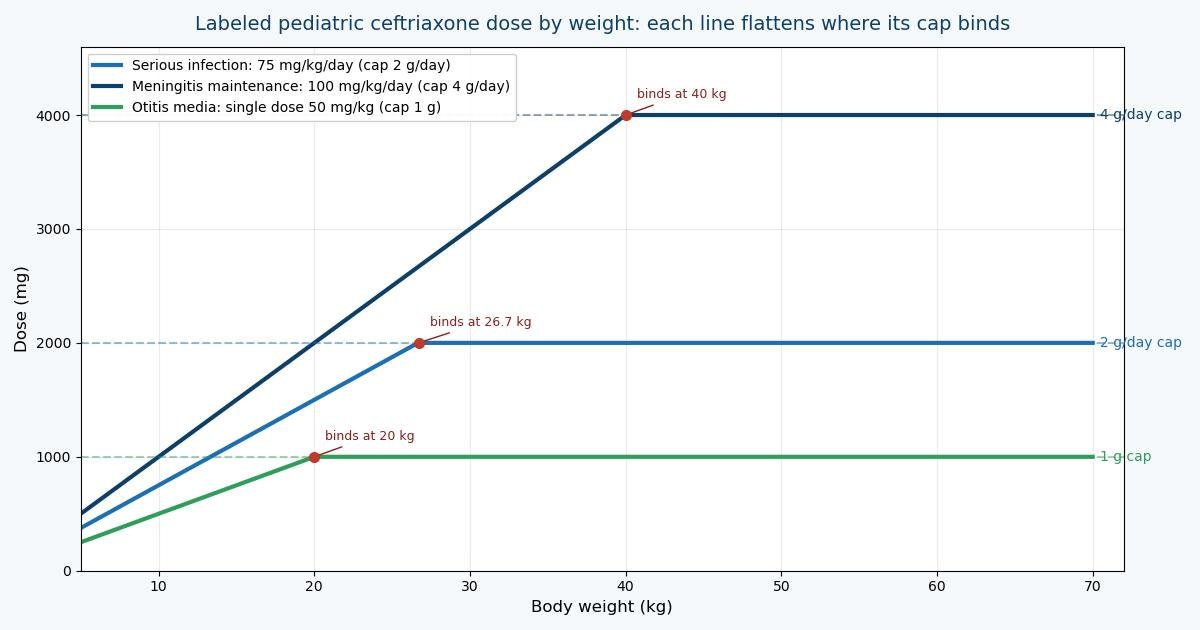
Each line follows the labeled weight-based rate until it meets its labeled maximum, then runs flat: the ceiling, not the weight, sets the dose from that point on. The otitis media line is a single dose rather than a daily amount. Caps: 2 g per day for serious infections, 4 g per day for meningitis maintenance (and 4 g for the meningitis loading dose), 1 g for the single otitis media dose.
What ceftriaxone is and why it is hospital-grade
Ceftriaxone, sold under the brand name Rocephin, is a third-generation cephalosporin antibiotic. Like other beta-lactam antibiotics, it kills bacteria by interfering with the construction of the bacterial cell wall, which makes it bactericidal: it destroys the organisms rather than merely slowing their growth. Parents usually meet ceftriaxone in the emergency department or on the hospital ward rather than at the pharmacy counter, and that setting is no accident. There is no oral form of the drug. Every dose is given by injection, either into a muscle (intramuscular) or into a vein (intravenous), drawn up and administered by a clinician. An antibiotic that can only be given by injection is, almost by definition, reserved for infections serious enough to justify that route, and that is the first reason clinicians describe ceftriaxone as hospital-grade.
The second reason is its spectrum. Ceftriaxone covers the gram-negative organisms responsible for the most feared invasive infections of childhood, including Neisseria meningitidis, Haemophilus influenzae, and drug-susceptible Streptococcus pneumoniae, which together are the classic causes of bacterial meningitis beyond the newborn period. It also covers many of the gram-negative bacteria behind serious urinary, abdominal, bloodstream, bone, and joint infections, as well as common skin and soft-tissue pathogens. This breadth is what makes it a workhorse for serious bacterial infections in children: when a child is sick enough to need admission and the likely organisms are within its reach, a single agent can cover the field while cultures are pending.
The third reason is its long half-life. In children past the newborn period, ceftriaxone persists in the blood long enough that once- or twice-daily dosing keeps concentrations above the levels needed to kill the target bacteria. That is why the pediatric label uses divided doses every 12 hours rather than the every-6- or every-8-hour schedules of older injectable antibiotics. A 12-hourly schedule is easier on the child, easier on the nursing staff, and easier to complete, and fewer infusions mean fewer chances for line complications. Convenience never makes the drug casual, though: it is a broad-spectrum agent, and the label confines it to infections where that breadth is genuinely needed, because every unnecessary broad-spectrum course contributes to antimicrobial resistance and exposes the child to side effects without benefit.
What ceftriaxone does not cover matters as much as what it does, and this is where parental expectations sometimes need correcting. It has no useful activity against methicillin-resistant Staphylococcus aureus (MRSA) or against enterococci, so a prescriber who suspects those organisms will choose something else or add a second agent. It is not an antiviral and does nothing for colds, influenza, or most sore throats, which are viral. And it is not a first choice for simple infections that an oral antibiotic handles well: the label's place for ceftriaxone is serious bacterial disease, bacterial meningitis, and the specific single-dose indication of acute otitis media described below. When a clinician reaches for it, the choice reflects a judgment that the likely bacteria fall within its spectrum and that the severity of the illness justifies an injectable, broad-spectrum drug.
Indication dosing tables: the labeled bands and their ceilings
The pediatric label does not give one ceftriaxone dose. It organizes dosing by indication, and each indication carries its own rate and its own ceiling. All pediatric doses are weight-based, in milligrams per kilogram, and every ceiling is a hard maximum rather than a suggestion. The three tables below reproduce the labeled bands exactly, with the source noted under each.
Serious bacterial infections, including skin and soft-tissue infections
| Indication | Labeled dose | Schedule and route | Maximum |
|---|---|---|---|
| Serious bacterial infections | 50 to 75 mg/kg/day | Divided doses every 12 hours, IM or IV | 2 g per day |
| Skin and soft-tissue infections | 50 to 75 mg/kg/day | Divided doses every 12 hours, IM or IV | 2 g per day |
Source: FDA prescribing information for Rocephin (ceftriaxone for injection), Dosage and Administration, checked 2026-10-05.
The lookup tool at the top of this page uses 75 mg/kg/day, the top of the labeled range, which is the standard labeled approach for serious infections; the prescriber may use the lower end of the range for less severe infections within this band. To see what the range means in practice, take a 20 kg child at 75 mg/kg/day: 1,500 mg per day, given as 750 mg every 12 hours, which sits comfortably under the 2 g ceiling. The ceiling starts to matter as weight rises: at 75 mg/kg/day, the weight-based amount reaches 2,000 mg at about 26.7 kg, so from that weight upward the label's 2 g maximum binds and the child receives 2 g per day regardless of further weight. This is the general principle behind every cap on this page: the weight-based rate sets the dose until the ceiling is reached, and then the ceiling sets the dose.
Bacterial meningitis
| Phase | Labeled dose | Schedule and route | Maximum | Duration |
|---|---|---|---|---|
| Loading dose (day 1) | 100 mg/kg, single dose | Once, IV | 4 g | Day 1 only |
| Maintenance (day 2 onward) | 100 mg/kg/day | Divided doses every 12 hours, IV | 4 g per day | 7 to 14 days total |
Source: FDA prescribing information for Rocephin (ceftriaxone for injection), Dosage and Administration, checked 2026-10-05.
Meningitis is the one indication with two phases, and confusing them is the most consequential dosing error this page guards against, so the distinction is stated plainly. The loading dose is a single 100 mg/kg dose given once on day 1 (maximum 4 g); its purpose is to drive drug levels up rapidly in a life-threatening infection. From day 2, the child moves to the maintenance schedule: 100 mg/kg/day divided every 12 hours (maximum 4 g per day), given intravenously, for a total labeled course of 7 to 14 days. The loading dose is not repeated, and it is not added on top of the maintenance doses on the same day. For a 20 kg child the arithmetic is: 2,000 mg once on day 1, then 2,000 mg per day as 1,000 mg every 12 hours from day 2. The 4 g ceiling binds at 40 kg for both the loading dose and the maintenance day. Meningitis dosing is intravenous throughout; this is not an indication treated by intramuscular injection.
Acute otitis media
| Indication | Labeled dose | Route | Maximum | Schedule |
|---|---|---|---|---|
| Acute otitis media | 50 mg/kg | Intramuscular | 1 g | Single dose |
Source: FDA prescribing information for Rocephin (ceftriaxone for injection), Dosage and Administration, checked 2026-10-05.
The otitis media regimen is deliberately minimal: one intramuscular injection, and then the course is finished. The 1 g ceiling binds unusually early here. Because the rate is 50 mg/kg, a 20 kg child reaches the maximum exactly (20 times 50 equals 1,000 mg), so every child weighing 20 kg or more receives the 1 g maximum rather than a larger weight-scaled amount. A 10 kg child, by contrast, receives 500 mg. This single-dose design is specific to acute otitis media and must not be carried over to the other indications, which use multi-day divided dosing. Parents should also know what this regimen is not: it is not a standing prescription for every ear infection, most of which are viral or resolve without antibiotics, but a labeled option the prescriber uses in defined clinical situations.
The calcium contraindication, explained
This is the most important safety section on the page, and it is the reason the lookup tool refuses to return a dose for neonates. The chemistry is straightforward: ceftriaxone binds calcium ions, and the resulting ceftriaxone-calcium salt is insoluble. If ceftriaxone meets a calcium-containing intravenous solution in the same infusion line, or the two are given at the same time, the salt can precipitate out of solution. In neonates, precipitates of this kind have been found in the lungs and kidneys after fatal reactions. Because the consequence is death rather than a manageable side effect, the FDA label does not merely warn about this interaction in newborns; it makes it a contraindication. Ceftriaxone is contraindicated in neonates who require, or are expected to require, treatment with calcium-containing IV solutions, including continuous calcium-containing infusions such as parenteral nutrition.
The practical consequences spread wider than the neonatal ward. Calcium-containing diluents such as Ringer's solution or Hartmann's solution must never be used to reconstitute ceftriaxone vials, and they must not be used to further dilute a reconstituted vial for IV administration, because the precipitate can form in the vial or the line before it ever reaches the patient. This rule applies at every age, not just in neonates: the precipitation chemistry does not care how old the patient is. What differs by age is the regulatory consequence. In patients other than neonates, ceftriaxone and calcium-containing solutions may be given sequentially, one after the other, but only if the infusion line is thoroughly flushed with a compatible fluid between the two. In neonates who need calcium-containing fluids, there is no sequential workaround in the label; the drug is contraindicated.
Why does the lookup on this page take the hardest possible line and return a critical warning instead of a dose for any neonate under 28 days? Because almost every sick neonate, the only kind who would be considered for ceftriaxone, receives calcium-containing intravenous fluids as a matter of routine care. Computing a routine weight-based dose for a population in which the contraindication applies by default would be actively unsafe. Neonatal antibiotic choices involve the bilirubin caution described below, immature kidney and liver handling of the drug, and fluid regimens the prescriber is already managing, so the decision belongs to the neonatal team, which will either choose an alternative antibiotic or manage the incompatibility directly. The page's hard stop is a deliberate design choice, not a gap in the table.
Administration: IV infusion over 30 minutes and IM injection
Intravenous ceftriaxone is given as a slow infusion over 30 minutes. It is not given as a rapid IV push. The 30-minute infusion is the labeled administration, and it is part of what makes the drug well tolerated intravenously: a controlled infusion avoids the concentration spikes of a bolus. The infusion runs through a line flushed with a compatible fluid, which, as the previous section explains, must not be a calcium-containing one. Nurses time the infusion and monitor the child during it, which is another reason this drug lives in supervised settings rather than at home.
Intramuscular doses are injected deep into a large muscle mass, which in practice means the thigh or buttock depending on the child's age and the local protocol. The IM injection of ceftriaxone is known to be painful, and the label offers a specific remedy: the vial may be reconstituted with 1% lidocaine solution to reduce the pain of the injection. Two points about the lidocaine option are non-negotiable. First, it is for intramuscular use only; a lidocaine-prepared ceftriaxone solution must never be given intravenously. Second, the lidocaine used is plain 1% lidocaine, without epinephrine. Doses are prepared by the pharmacist or nurse from the vial using the diluent volumes in the label's reconstitution table. Ceftriaxone is not a medicine parents reconstitute or inject at home, and no part of this page should be read as instructions for doing so.
Safety: jaundiced newborns, gallbladder, allergy, and other label warnings
Hyperbilirubinemic neonates deserve their own caution, separate from the calcium contraindication. Laboratory studies have shown that ceftriaxone can displace bilirubin from its binding to serum albumin. In a jaundiced neonate, especially a premature one, bilirubin freed from albumin can cross into the brain, where it risks bilirubin encephalopathy. The label therefore directs caution when ceftriaxone is considered in hyperbilirubinemic neonates. This is a second, independent reason that neonatal ceftriaxone decisions belong to specialists: even where calcium fluids are not the issue, the bilirubin interaction may steer the team to a different antibiotic.
The gallbladder warning is less alarming but worth knowing because it can cause a scare on imaging. The same ceftriaxone-calcium salt that makes the calcium interaction dangerous can precipitate in the gallbladder, producing sludge or shadows on ultrasound that look like gallstones. The label calls this pseudolithiasis: stone-like findings without true stones. It is usually without symptoms and it reverses after the drug is stopped, but a family told mid-treatment that an ultrasound "shows gallstones" should know that ceftriaxone is a recognized cause and that the finding typically resolves once treatment ends.
Hypersensitivity is the absolute contraindication that applies at every age. Ceftriaxone must not be given to anyone with a known allergy to ceftriaxone or to the cephalosporin class, and as with other beta-lactam antibiotics, severe reactions including anaphylaxis can occur. A history of penicillin allergy should always be disclosed before the first dose, because cross-reactivity between penicillins and cephalosporins is possible and the prescriber needs that history to judge the risk. Any sign of an allergic reaction during treatment, such as rash, hives, swelling of the face or lips, or breathing difficulty, needs urgent medical attention.
Two further label warnings complete the safety picture. Immune-mediated hemolytic anemia has been reported with ceftriaxone, including severe cases; if anemia develops during treatment, the label's direction is to consider the drug as a cause and stop it. And as with nearly all antibacterial drugs, treatment can disturb the gut flora enough to allow Clostridioides difficile to overgrow, producing diarrhea that can range from mild to severe and can appear during treatment or in the weeks after it. Bloody or watery diarrhea during or after a ceftriaxone course should be reported to the prescriber rather than treated with an over-the-counter anti-diarrheal on the family's own initiative. Dose adjustments for kidney or liver impairment are prescriber decisions guided by the label; the lookup on this page covers standard pediatric dosing only.
Key takeaways
- The FDA Rocephin label gives 50 to 75 mg/kg/day, given intramuscularly or intravenously in divided doses every 12 hours, with a maximum of 2 g per day.
- Meningitis dosing has two phases that must not be confused.
- Ceftriaxone binds calcium ions to form an insoluble ceftriaxone-calcium salt.
- For acute otitis media the FDA label gives a single intramuscular dose of 50 mg/kg, with a maximum of 1 g.
Frequently asked questions
What is the pediatric dose of ceftriaxone for a serious bacterial infection?
The FDA Rocephin label gives 50 to 75 mg/kg/day, given intramuscularly or intravenously in divided doses every 12 hours, with a maximum of 2 g per day. The dose lookup on this page uses 75 mg/kg/day, the top of the labeled range, which is the standard labeled approach for serious infections; the prescriber may choose the lower end of the range for less severe infections within this band. The same 50 to 75 mg/kg/day band covers skin and soft-tissue infections. Once the weight-based amount reaches 2 g per day (at about 26.7 kg), the 2 g ceiling binds and heavier children receive 2 g per day, not more.
How is ceftriaxone dosed for bacterial meningitis in children?
Meningitis dosing has two phases that must not be confused. On day 1 the child receives a single loading dose of 100 mg/kg (maximum 4 g). From day 2 the maintenance schedule is 100 mg/kg/day divided every 12 hours (maximum 4 g per day), given intravenously, for a total labeled duration of 7 to 14 days. The loading dose and the maintenance doses are separate: the loading dose is given once on day 1 only, and it is not added on top of the maintenance doses on the same day. For a 20 kg child this works out to a 2,000 mg loading dose on day 1, then 2,000 mg per day (1,000 mg every 12 hours) from day 2.
Why must ceftriaxone not be mixed with calcium-containing IV fluids in newborns?
Ceftriaxone binds calcium ions to form an insoluble ceftriaxone-calcium salt. If it meets a calcium-containing intravenous solution in the same line or at the same time, the salt can precipitate, and fatal cases with precipitates found in the lungs and kidneys of neonates have been reported. The FDA label therefore makes ceftriaxone contraindicated in neonates who require, or are expected to require, calcium-containing IV solutions, including continuous infusions such as parenteral nutrition. Calcium-containing diluents such as Ringer's solution or Hartmann's solution must never be used to reconstitute ceftriaxone or to dilute it for IV use. In patients other than neonates, ceftriaxone and calcium-containing solutions may be given sequentially only if the infusion line is thoroughly flushed with a compatible fluid between them. The lookup tool on this page returns a critical warning instead of a dose for neonates under 28 days.
What is the single-dose ceftriaxone treatment for acute otitis media?
For acute otitis media the FDA label gives a single intramuscular dose of 50 mg/kg, with a maximum of 1 g. The 1 g ceiling binds early: a 20 kg child reaches it exactly at 50 mg/kg, so any child weighing 20 kg or more receives the 1 g maximum rather than a larger weight-scaled amount. For example, a 20 kg child receives a single 1,000 mg IM injection. This single-dose regimen is specific to acute otitis media and does not apply to the other indications, which use multi-day divided dosing.
Is there an oral form of ceftriaxone, and how is the injection given?
There is no oral form of ceftriaxone; it is given only by intramuscular injection or intravenous infusion, which is part of why it is considered a hospital-grade antibiotic. Intravenous doses are given as a slow infusion over 30 minutes, not as a rapid push. Intramuscular doses are injected deep into a large muscle. Because the IM injection can be painful, the label permits reconstitution with 1% lidocaine solution to reduce the pain; lidocaine-prepared solutions are for intramuscular use only and must never be given intravenously. Doses are prepared by the pharmacist or nurse from the vial, and ceftriaxone is not a medicine parents prepare or give at home.
Can I use this page to work out my child's ceftriaxone dose myself?
No. This page is a reference for understanding prescriptions and the labeled dosing ranges, not a tool for self-dosing. Ceftriaxone is an injectable hospital antibiotic: every dose is ordered by a prescriber, prepared by a pharmacist or nurse, and given by a clinician, and the prescriber also judges the indication, the child's kidney and liver function, allergy history, and whether calcium-containing fluids are involved. Never start, change, or stop an antibiotic for a child based on this page alone. If a child develops rash, hives, swelling, breathing difficulty, or bloody diarrhea during treatment, seek urgent medical care.
References
1. U.S. Food and Drug Administration prescribing information for Rocephin (ceftriaxone for injection), Dosage and Administration, Contraindications, Warnings and Precautions. DailyMed. Available at: dailymed.nlm.nih.gov/dailymed/search.cfm?query=Rocephin (accessed 2026-10-05). Source for all pediatric dosing bands and maxima (serious infections 50 to 75 mg/kg/day, max 2 g/day; meningitis loading 100 mg/kg max 4 g then 100 mg/kg/day max 4 g/day for 7 to 14 days; acute otitis media single 50 mg/kg IM max 1 g), the 30-minute IV infusion, the neonatal calcium contraindication with fatal precipitation cases, the hyperbilirubinemic neonate caution, gallbladder pseudolithiasis, the 1% lidocaine IM reconstitution note, and the hypersensitivity contraindication.
Further reading
Related pediatric dosing guides
More pediatric antibiotic dosing references in this series: cefdinir dosage calculator for children and amoxicillin dosage calculator for children.