Erythromycin Dosage Calculator for Children
In short: Calculate pediatric erythromycin doses by weight: 30-50 mg/kg/day standard band, up to 100 mg/kg/day for severe infections, q6h or q8h dosing, mL volumes for 200 mg/5 mL and 400 mg/5 mL suspensions, and the 4 g daily ceiling with warnings. Use the calculator above, then read the guide below to interpret your result and its limitations.
Weight-based pediatric erythromycin dosing using the FDA label bands of 30-50 mg/kg/day for standard infections and up to 100 mg/kg/day for severe infections, split every 6 or 8 hours, with liquid volumes in milliliters and the 4 g daily ceiling enforced.
This pediatric erythromycin dosage calculator works out the dose from your child's weight. Choose the infection band the prescriber ordered, standard (30 to 50 mg/kg/day) or severe (up to 100 mg/kg/day), pick the position within the band, the interval (every 6 hours or every 8 hours), and the suspension strength printed on the bottle (200 mg per 5 mL or 400 mg per 5 mL). You get the milligrams per dose, the milliliters per dose to measure in the oral syringe, the total milligrams per day, and the mg/kg/day actually achieved. Every result follows the FDA erythromycin label: the usual pediatric dosage is 30 to 50 mg/kg/day in equally divided doses, doubled for more severe infections, with a hard ceiling of 4 g (4,000 mg) per day. When the weight-based arithmetic exceeds that ceiling, the calculator caps the total and shows a clear warning instead of a silently excessive dose.
Calculate the erythromycin dose
What erythromycin is and why children take it
Erythromycin is a macrolide antibiotic, one of the oldest members of that drug class and the prototype from which later macrolides such as azithromycin and clarithromycin were developed. It works by binding to the 50S subunit of bacterial ribosomes, the structures bacteria use to build proteins, which stops susceptible bacteria from growing and multiplying. Because it reaches useful concentrations in the respiratory tract, ears, and soft tissues, pediatricians prescribe it for respiratory infections, middle ear infections, and skin infections caused by susceptible bacteria. It is also an option for children who cannot take penicillin, and the FDA label specifically lists oral erythromycin suspension at 50 mg/kg/day in 4 divided doses for chlamydial conjunctivitis of the newborn (for at least 2 weeks) and chlamydial pneumonia of infancy (for at least 3 weeks), which shows how central this drug remains in pediatric infectious disease.
It helps to understand what erythromycin is not. Like every antibiotic, it has no effect on viruses: it will not shorten a cold, the flu, or most coughs, and giving it for a viral illness only exposes the child to side effects and encourages resistant bacteria. The decision that an infection is bacterial, and that erythromycin is the right drug for it, belongs to the clinician who examined the child. This page, and the calculator on it, handle only the arithmetic that follows: turning the child's weight into the correct number of milligrams and milliliters once the prescriber has ordered erythromycin and specified the severity band.
For children, erythromycin is almost always dispensed as a liquid suspension, because young children cannot swallow tablets and because a liquid allows the precise weight-based dosing that children need. The common suspension strength is 200 mg per 5 mL, and a 400 mg per 5 mL strength also exists. The calculator asks for the strength because the same milligram dose is a different milliliter volume in each strength, and mixing the two up is one of the most common dosing errors with pediatric liquids. Erythromycin for oral use comes in several salt forms, including the base, the stearate, the estolate, and the ethylsuccinate, and, as explained below, the salt form affects whether the medicine should be taken on an empty stomach, so keep the bottle and its pharmacy label where you can check them.
The two dose bands: 30-50 mg/kg/day standard, up to 100 mg/kg/day for severe infections
The FDA erythromycin label gives the pediatric rule in one sentence: age, weight, and severity of the infection are important factors in determining the proper dosage; the usual dosage is 30 to 50 mg/kg/day, in equally divided doses; for more severe infections this dose may be doubled, but it should not exceed 4 g per day. That sentence is the entire basis of this calculator. The standard band covers ordinary infections at 30, 40, or 50 mg/kg/day. The severe band covers serious infections at 30, 65, or 100 mg/kg/day, because doubling the usual range gives 60 to 100, and the calculator spreads the three positions evenly across the full 30-to-100 range the label permits.
The choice between bands is the prescriber's, not the caregiver's. Do not move a child from the standard band to the severe band because the fever is high or the cough sounds bad: severity in the label's sense is a clinical judgment about the infection, and more drug is not always better. The 100 mg/kg/day position exists for genuinely severe infections and carries the dose-dependent gastrointestinal side effects of erythromycin at their most likely, which is why the prescriber's explicit order is the only authority for it. The calculator simply presents the positions; the clinician selects them.
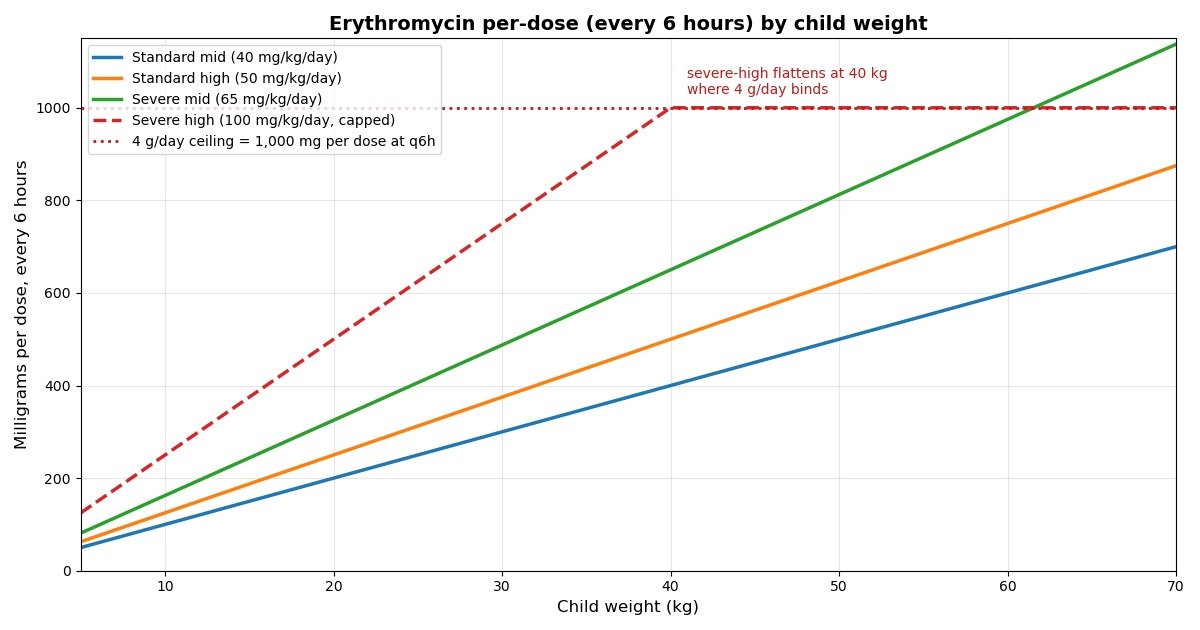
The 4 g (4,000 mg) daily ceiling is a hard limit that applies at every position. The table below shows where the ceiling starts to bind, because knowing this helps you read a capped result correctly rather than mistrusting the arithmetic.
| Band position | mg/kg/day | Weight where 4 g/day binds |
|---|---|---|
| Standard low | 30 | Above 70 kg (never binds in this calculator's 5-70 kg range) |
| Standard mid | 40 | Above 70 kg (never binds in this calculator's 5-70 kg range) |
| Standard high | 50 | Above 70 kg (never binds in this calculator's 5-70 kg range) |
| Severe low | 30 | Above 70 kg (never binds in this calculator's 5-70 kg range) |
| Severe mid | 65 | About 61.5 kg (a 65 kg child is capped) |
| Severe high | 100 | 40 kg (a 50 kg child is capped) |
When the calculator shows a cap warning, the weight-based arithmetic wanted more drug than the label allows, and the result is the capped 4,000 mg daily total with the achieved mg/kg/day shown underneath. For a 50 kg child at the severe-high position, for example, the raw arithmetic gives 5,000 mg per day, the calculator limits it to 4,000 mg with a warning, and the achieved figure reads 80 mg/kg/day instead of 100. That is the documented trade-off the label's ceiling imposes at higher weights. A capped dose is a signal to double-check the order with the prescriber, not an invitation to override the cap by rounding up or switching strengths: neither changes the milligram total.
One duration note from the label is worth knowing up front. In the treatment of streptococcal infections of the upper respiratory tract, such as tonsillitis or pharyngitis, the label says the therapeutic dosage of erythromycin should be administered for at least ten days. The course length is the prescriber's decision, but ten days is the floor for those infections, and stopping early because the sore throat is gone is how streptococcal infections return.
Every 6 hours or every 8 hours: splitting the daily total
The label says the daily total is given in equally divided doses, and in practice prescribers split it every 6 hours (four doses per day) or every 8 hours (three doses per day). The calculator offers both, and the daily total in milligrams is identical either way: only the size of each single dose changes. A 20 kg child at the standard-mid position (40 mg/kg/day) gets 800 mg per day whether that is 200 mg four times a day or about 267 mg three times a day. The interval on the prescription is the one that counts; if the bottle label says every 6 hours, do not re-split it into three doses because the syringe volumes look rounder.
Even spacing is the point of the interval. Keeping the doses roughly 6 or 8 hours apart around the clock holds the drug concentration in the body above the level that inhibits the bacteria for as much of the day as possible. "Four sometime during the day" with the doses bunched together leaves a long unprotected gap overnight, which is the worst pattern for an antibiotic that works best when levels stay steady. Set alarms if you need to; overnight doses are part of the treatment.
For a missed dose, the standard rule applies: give it when remembered unless the next scheduled dose is nearly due, in which case skip the missed one and continue the schedule. Never give a double dose to make up for a missed one. And keep the full course going even when the child starts feeling better: stopping a course early because the symptoms resolved leaves the most resistant bacteria alive and invites the infection to return in a form that may no longer respond to the same antibiotic. If the child is vomiting and cannot keep the medicine down, or shows no improvement within 48 to 72 hours, call the prescriber rather than adjusting the schedule yourself.
Food and the salt forms: empty stomach for the base, with food for the ethylsuccinate
Erythromycin comes in several salt forms, and food instructions differ between them, so this section is worth reading with the bottle in hand. For erythromycin base tablets, the FDA label says that optimal blood levels are obtained when the tablets are given in the fasting state, at least half an hour and preferably 2 hours before meals, even though the delayed-release tablets may be given without regard to meals. The base is acid-sensitive: stomach acid breaks it down, and food increases stomach acid, so an empty stomach genuinely improves how much active drug reaches the bloodstream.
The suspension most children receive is usually erythromycin ethylsuccinate, a different salt form designed to survive the stomach better and to be more palatable. Ethylsuccinate may generally be given without regard to meals, which is one reason it became the standard pediatric form. The estolate and stearate forms have their own instructions. The practical rule is simple: follow what the bottle and prescription label say, because the pharmacy labels the product according to its own salt form's label, and that overrides any general statement. If the bottle says to take it on an empty stomach, keep doses at least half an hour before or two hours after food; if it says it may be taken with food, do not force an empty stomach on a child who feels nauseated.
Whatever the food instructions, two administration points apply to every form. First, shake the suspension well before every dose, because the drug particles settle between doses and an unshaken bottle gives a weak dose from the top and an overly strong dose from the bottom. Second, if the child vomits shortly after a dose, do not simply repeat the full dose: call the pharmacist or prescriber, because repeating a dose that was partially absorbed can push the daily total above the intended amount.
Measuring the suspension accurately
Correct measurement starts at the pharmacy counter: confirm which strength, 200 mg per 5 mL or 400 mg per 5 mL, is printed on your bottle, and set the calculator to match. A 400 mg dose is 10.0 mL of the 200 mg/5 mL suspension but only 5.0 mL of the 400 mg/5 mL suspension; measuring the 200 mg/5 mL volume from the stronger bottle would give double the intended dose, and the reverse would give half. If the bottle is ever replaced mid-course with the other strength, recalculate the milliliters before giving another dose.
Use the oral syringe supplied with the medicine, never a kitchen spoon. Household teaspoons and tablespoons vary widely in actual volume, and repeated studies of household spoons have shown they can deliver anywhere from half to double the intended dose. An oral syringe with milliliter markings removes that guesswork, and the calculator reports the volume to 0.1 mL, which any oral syringe can measure. Shake the bottle well before every dose. Measure at eye level on a flat surface, and squirt the liquid slowly toward the inside of the child's cheek rather than the back of the throat, to reduce gagging and spitting out.
The calculator keeps the exact weight-based milligrams to one decimal place and reports the milliliter volume to 0.1 mL. Because 0.1 mL rounding is a practical measurement rounding, the milligrams actually delivered can differ from the displayed milligrams by a tiny amount; that is within normal pediatric liquid dosing tolerance and is not a reason to chase extra decimal places. Store the reconstituted suspension as the label directs, note the discard date printed on the bottle, and do not save leftover suspension for a future illness: it will have expired, and the next illness may need a different drug or dose anyway.
Safety first: QT prolongation, the liver, and the common side effects
Erythromycin carries one warning that caregivers should take especially seriously. The FDA label associates erythromycin with prolongation of the QT interval, the electrical recovery phase of the heartbeat, and reports cases of torsades de pointes, a dangerous ventricular arrhythmia, during postmarketing surveillance. The risk rises in children with known QT prolongation, children taking other drugs known to prolong the QT interval, children with low potassium or magnesium, and children with significant bradycardia (slow heart rate). Erythromycin is also contraindicated with certain drugs for exactly this reason, including cisapride and pimozide, which must not be combined with it. The practical consequence is plain: tell the prescriber about every medicine the child takes, including over-the-counter products and supplements, before erythromycin is started, and do not start or stop any other medicine during the course without checking.
The liver needs attention too. Erythromycin is cleared principally by the liver, and the label advises caution in administering the antibiotic to patients with impaired hepatic function. The label also warns of hepatic dysfunction, including increased liver enzymes and hepatocellular or cholestatic hepatitis with or without jaundice, in patients receiving oral erythromycin products. If the child has a liver condition, the prescriber needs to know before the first dose. Stop the drug and seek care if signs of liver problems appear, such as yellowing of the skin or eyes, dark urine, pale stools, or persistent abdominal pain.
The side effects most families actually encounter are the gastrointestinal ones, and the label is explicit that they are the most frequent adverse effects of oral erythromycin and are dose related. Abdominal cramping and discomfort lead the list, with nausea, vomiting, and diarrhea occurring especially in the early hours of treatment. These effects are one reason the severe band is a prescriber decision: at 100 mg/kg/day the stomach effects are at their most likely. Giving the dose with a small amount of food helps some children, but only when the bottle's own instructions permit food with that salt form; never trade absorption for comfort without checking. Diarrhea that is severe, bloody, or continues after the course ends deserves a call to the doctor, because antibiotic-associated colitis can appear during or after treatment.
Two more groups deserve a mention. Children with a known allergy to erythromycin or to any macrolide should not receive it, and a history of liver problems with erythromycin is itself a reason to avoid it. The label also notes that erythromycin can interact with drugs cleared through the same liver enzyme pathways, raising their blood levels; the prescriber or pharmacist should review the child's full medicine list rather than relying on memory. When in doubt about any symptom during the course, the pharmacist is the fastest source of advice.
Antibiotic stewardship: when erythromycin is not the answer
Good antibiotic stewardship is part of safe pediatric care, and it starts with knowing when not to reach for the bottle. Erythromycin does nothing for colds, flu, most coughs, or any other viral illness, and a large share of pediatric antibiotic courses are still written for viral infections where they cannot help. Each unnecessary course carries real costs for the child: the cramping, nausea, and diarrhea that top the label's adverse-reaction list, plus the rarer but serious risks of liver injury and dangerous heart rhythm, all for zero benefit against a virus.
Finishing the full course matters as much as getting the dose right. Stopping a ten-day course on day six because the ear pain is gone leaves the most resistant bacteria alive and invites the infection to return, sometimes in a form that no longer responds to the same antibiotic. Do not save the leftover suspension "for next time": it will have expired by its discard date, and the next illness may need a different drug or a different dose. And do not share the prescription with a sibling who has similar symptoms: the sibling's weight, infection, and medicine list are different, and the dose on this bottle was calculated for one specific child.
The most responsible thing a caregiver can do with this page is to use it exactly as intended: as the arithmetic behind a prescription that a clinician has already written for the right child, the right infection, the right band, and the right duration. If any of those are uncertain, if the child has a heart condition, takes interacting medicines, has kidney or liver problems, or has ever reacted badly to a macrolide, the prescriber or pharmacist should hear about it before the first dose goes in.
What this calculator does and does not do
This calculator converts a child's weight, the prescriber's severity band and position, the dosing interval, and the bottle's suspension strength into a per-dose amount in milligrams and milliliters, shows the total milligrams per day and the mg/kg/day actually achieved, and enforces the label's 4 g (4,000 mg) daily ceiling with a visible warning whenever the cap binds. It keeps the exact weight-based milligrams to one decimal place, and it reports volumes to 0.1 mL.
What it does not do is choose erythromycin, choose the band or position, choose the interval or duration, adjust for liver or kidney impairment, screen for QT risk or drug interactions, or pick the salt form. It also does not replace the prescription label: if the label on your bottle says something different from the calculator result, follow the label and ask the pharmacist or prescriber about the discrepancy. A dosing tool supports the prescription; it never overrides it.
Sources
- U.S. Food and Drug Administration. ERY-TAB (erythromycin delayed-release tablets) prescribing information: pediatric patients 30 to 50 mg/kg/day in equally divided doses, doubled for more severe infections, not to exceed 4 g per day; at least ten days for streptococcal upper respiratory tract infections; newborn chlamydial indications 50 mg/kg/day in 4 divided doses; optimal blood levels in the fasting state; QT prolongation and torsades de pointes reports; caution in hepatic impairment; gastrointestinal adverse effects most frequent and dose related. Available via DailyMed.
- U.S. Food and Drug Administration. Erythromycin tablets prescribing information: usual pediatric dosage 30 to 50 mg/kg/day in equally divided doses, doubled for more severe infections, not to exceed 4 g per day; adult dosing up to 4 g per day; contraindication with cisapride and pimozide; hepatic dysfunction warnings. Available via DailyMed.
Key takeaways
- The FDA erythromycin label gives the usual pediatric dosage as 30 to 50 mg per kg per day, in equally divided doses, chosen according to the child's age, weight, and the severity of the infection.
- The label says the daily total is given in equally divided doses, and prescribers usually split it every 6 hours (4 doses per day) or every 8 hours (3 doses per day).
- It depends on the salt form.
- Pediatric erythromycin suspension is commonly supplied as 200 mg per 5 mL, with a 400 mg per 5 mL strength also available.
Frequently asked questions
What is the recommended pediatric dose of erythromycin?
The FDA erythromycin label gives the usual pediatric dosage as 30 to 50 mg per kg per day, in equally divided doses, chosen according to the child's age, weight, and the severity of the infection. For more severe infections the label allows this dose to be doubled, but the total must not exceed 4 g (4,000 mg) per day. For streptococcal infections of the upper respiratory tract, the therapeutic dosage should be given for at least ten days. Confirm the band and duration with your child's prescriber.
Should erythromycin be given every 6 hours or every 8 hours?
The label says the daily total is given in equally divided doses, and prescribers usually split it every 6 hours (4 doses per day) or every 8 hours (3 doses per day). The milligram total per day is the same either way; only the single-dose size changes. Keep doses evenly spaced around the clock, give a missed dose when remembered unless the next one is nearly due, and never double up.
Should erythromycin be taken on an empty stomach?
It depends on the salt form. Optimal blood levels of erythromycin base tablets are obtained in the fasting state, at least half an hour and preferably 2 hours before meals, even though delayed-release tablets may be given without regard to meals. Erythromycin ethylsuccinate, the form used in most pediatric suspensions, is generally given without regard to meals. Check the bottle or prescription label and follow what it says.
How do I measure the erythromycin suspension dose in mL?
Check whether your bottle is 200 mg per 5 mL or 400 mg per 5 mL, because the milliliter volume differs between the two. Shake the bottle well before each dose, use the supplied oral syringe, and measure to 0.1 mL. Never use a kitchen spoon. If the bottle is replaced mid-course with the other strength, recalculate the milliliters before the next dose.
What are the important safety warnings for erythromycin in children?
The FDA label associates erythromycin with prolongation of the QT interval and reports of torsades de pointes, a dangerous heart rhythm, so the prescriber must know about every medicine the child takes. Erythromycin is cleared principally by the liver, so caution is needed with liver impairment, and the label warns of hepatic dysfunction including hepatitis. The most frequent side effects are gastrointestinal and dose related: abdominal cramping, nausea, vomiting, and diarrhea.
When should I call the doctor during erythromycin treatment?
Call the prescriber if the child shows no improvement within 48 to 72 hours, if symptoms worsen, or if the child cannot keep the medicine down. Seek urgent care for signs of an allergic reaction (rash, hives, swelling, trouble breathing), signs of liver problems (yellowing of skin or eyes, dark urine, persistent abdominal pain), fainting or palpitations, or severe or bloody diarrhea. Finish the full prescribed course even if the child feels better early.
Clinical sources: U.S. Food and Drug Administration, ERY-TAB (erythromycin delayed-release tablets) prescribing information (pediatric 30-50 mg/kg/day in equally divided doses, doubled for severe infections, 4 g/day ceiling; at least ten days for streptococcal upper respiratory tract infections; fasting-state absorption for the base; QT prolongation and torsades reports; hepatic caution; via DailyMed).