Calculator
What famotidine is
Famotidine, sold under the brand name Pepcid among others, is a histamine-2 (H2) receptor blocker. Histamine-2 receptors sit on the acid-producing parietal cells of the stomach lining, and when histamine binds them, the cells are told to make acid. Famotidine occupies those receptors so histamine cannot deliver its message, and acid production falls. This is fundamentally different from how antacids work: an antacid neutralizes acid that is already sitting in the stomach, while famotidine reduces the amount of new acid the stomach produces. That distinction explains both the drug's strengths and its limits, which are covered in detail below.
Doctors have used famotidine in both adults and children for decades. The FDA-approved prescribing information lists several adult indications: active duodenal ulcer, active gastric ulcer, symptomatic nonerosive gastroesophageal reflux disease (GERD), erosive esophagitis due to GERD diagnosed by biopsy, pathological hypersecretory conditions such as Zollinger-Ellison syndrome, and reduction of the risk of duodenal ulcer recurrence. In children, the labeled indications are narrower and age-specific: peptic ulcer disease and GERD with or without esophagitis and ulcerations in patients 1 year to under 17 years of age, and GERD alone in infants from birth to under 1 year of age. This calculator implements the childhood GERD regimen for ages 1 to under 17 years, which is the regimen most families encounter.
Famotidine for children is most commonly dispensed as an oral suspension that the pharmacist prepares from a powder. When constituted as directed, the suspension contains 40 mg of famotidine per 5 mL, which is the same as 8 mg per mL, and it has a cherry-banana-mint flavor. Because the drug is in liquid form, every dose must be measured in milliliters, and the calculator converts the weight-based milligram dose into that volume. Tablets exist too, but the suspension is the formulation the pediatric dosing table on the label is written around, and it is what this page assumes.
GERD in children, and where famotidine fits
Gastroesophageal reflux disease, universally shortened to GERD, is what happens when stomach contents flow backward into the esophagus often enough to cause symptoms or injury. Occasional spit-up in a baby is normal and not GERD; the disease label applies when reflux produces troublesome symptoms such as frequent vomiting, poor feeding or poor weight gain, irritability during feeds, chronic cough, or, in older children, heartburn and regurgitation. In some children the refluxed acid inflames or erodes the esophageal lining, which is the esophagitis the label refers to, and in a smaller number it is associated with ulcerations.
Treatment of childhood GERD is stepwise, and medicine is not the first step. For infants, the label itself pairs famotidine with conservative measures such as thickened feedings, and pediatric practice more broadly starts with positioning, feeding adjustments, and other non-drug measures before any prescription. When those measures are not enough and the prescriber decides an acid-reducing medicine is warranted, an H2 blocker like famotidine is one of the options, chosen because it meaningfully lowers acid exposure while having a long and well-documented safety record in children. Proton pump inhibitors are a separate class with their own labeled pediatric dosing, and the choice between the classes is a prescriber decision based on the child's age, the severity of disease, and how the child has responded before.
It is worth stating plainly what famotidine does not do for GERD. It does not tighten the valve between the stomach and the esophagus, it does not speed up how fast the stomach empties, and it does not repair an esophagus that is already eroded; it lowers the acidity of whatever refluxes, which reduces the chemical injury each reflux episode can cause and gives inflamed tissue a chance to heal. That is why the label pairs the medicine with ongoing clinical judgment: the dose and duration are individualized based on clinical response, pH measurements, and endoscopy findings, and the treatment course is measured in weeks, not days.
The labeled pediatric GERD dosing: 0.5 mg per kg, twice daily
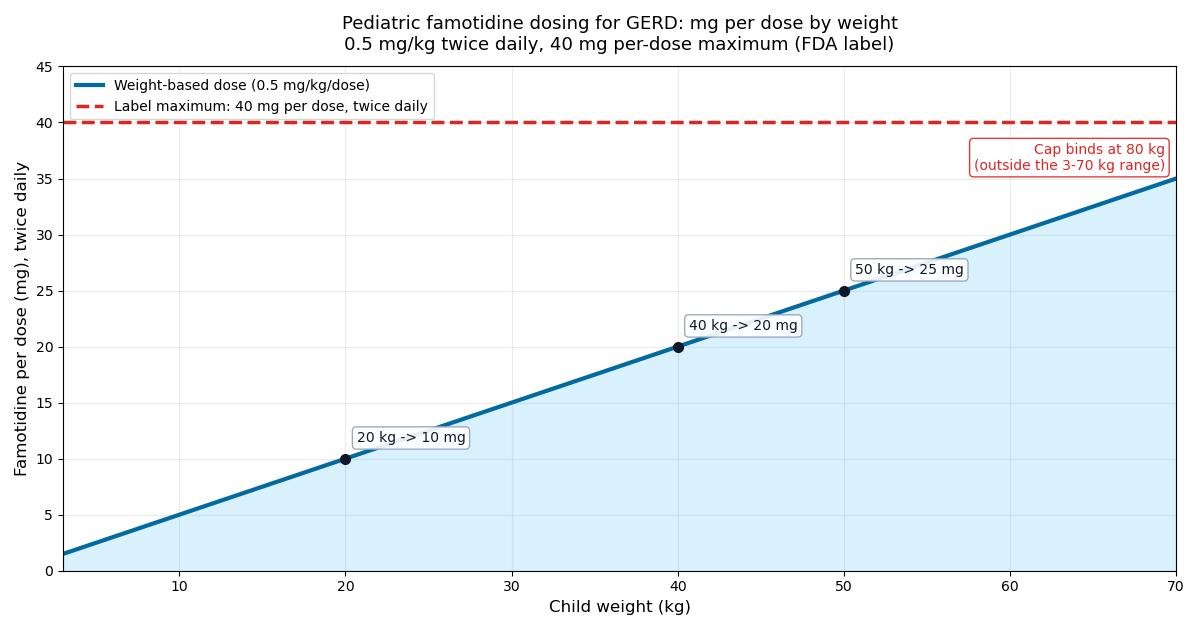
The FDA-approved dosing table for PEPCID for oral suspension gives a single, unambiguous regimen for GERD with or without esophagitis and ulcerations in children 1 year to under 17 years of age: 0.5 mg per kg of body weight, twice daily, for 6 to 12 weeks. There is no low, middle, or high selector on this label, unlike some antibiotic labels that define bands. The arithmetic is one multiplication: weight in kilograms times 0.5 gives the milligrams per dose, and that dose is given twice a day, in the morning and before bedtime, as the label's administration instructions describe. A 20 kg child, for example, receives 10 mg per dose twice daily, which measures 1.25 mL of the 40 mg per 5 mL suspension before syringe-graduation rounding.
The label maximum for this regimen is 40 mg per dose, twice daily, which is 80 mg per day in total. In practice this means the 0.5 mg per kg rule governs every child up to 80 kg, and only at or above 80 kg would the cap bind. Within the ordinary pediatric weight range, the cap is therefore a safety backstop rather than a number families will hit: a 40 kg child receives 20 mg per dose, a 50 kg child receives 25 mg per dose, and a 70 kg adolescent receives 35 mg per dose, all below the 40 mg ceiling. The calculator applies the cap automatically and displays a clear warning on the rare occasion it engages, because a capped dose is information the prescriber must confirm.
Duration matters as much as dose. The label specifies 6 to 12 weeks for this indication, which reflects the time inflamed esophageal tissue needs to heal under reduced acid exposure. This is not a medicine to stop the day symptoms ease, and it is not a medicine to continue indefinitely without review either. The prescriber sets the course length within that window based on how the child responds, and the label's footnotes explicitly call for individualizing the dose and duration using clinical response, gastric or esophageal pH determinations, and endoscopy. If symptoms persist despite the full course, that is a signal for re-evaluation, not for the family to extend treatment on its own.
A note on the 20 mg figure you may see elsewhere
Some dosing summaries quote 20 mg twice daily as a pediatric famotidine maximum. On the current FDA label, 20 mg twice daily is the adult dose for symptomatic nonerosive GERD, not the pediatric maximum. The pediatric maximum for GERD with or without esophagitis and ulcerations in children 1 year to under 17 years is 40 mg twice daily, stated directly in the label's pediatric dosing table. This calculator follows the current label. If a prescriber has written a lower maximum for a particular child, for example to match the adult symptomatic GERD dose in an older adolescent, the prescription on the bottle is what governs, and the calculator is only a check of the arithmetic behind it.
Measuring the suspension correctly
The calculator's milliliter output is only as good as the measurement that follows it, so technique deserves the same attention as the arithmetic. Always use the oral syringe or dosing cup the pharmacy provided, never a kitchen teaspoon or tablespoon. Kitchen spoons are not standardized and are a leading cause of home dosing errors, and with a medicine dosed in fractions of a milliliter, a spoon's error can easily exceed the entire dose. The suspension strength is 40 mg per 5 mL, so each milliliter contains 8 mg; a 10 mg dose is 1.25 mL and a 25 mg dose is 3.125 mL, and the calculator rounds these volumes to the nearest 0.1 mL, the smallest graduation most oral syringes show reliably. That is why the 20 kg example displays 1.3 mL rather than the exact 1.25 mL: the syringe cannot measure the extra 0.05 mL, and the rounding difference amounts to less than half a milligram.
Shake the bottle vigorously for 5 to 10 seconds before every dose, exactly as the label directs. The drug particles settle between doses, and an unshaken bottle gives a weak dose from the top and a concentrated dose from the bottom. Read the syringe at eye level, confirm the number against the prescription label before the medicine goes near the child, and give the dose in the morning and before bedtime, with or without food, since the label states food does not matter for this medicine. If the child spits out part of a dose, do not top it up by guessing; note what happened and ask the pharmacist or prescriber how to handle it.
Storage and shelf life close the loop. The constituted suspension is stored at room temperature, protected from freezing, and any unused portion is discarded after 30 days, per the label. Write the discard date on the bottle the day it comes home from the pharmacy. A half-used bottle from a previous illness is not a head start on the next course: after 30 days its potency is unknown, and guessing at potency is the opposite of weight-based dosing. Keep the medicine, like all medicines, where children cannot reach it.
What famotidine does and does not do
Famotidine reduces the stomach's acid production; it does not neutralize acid that is already there. That single fact explains the most common misunderstanding families bring to this medicine. An antacid, the chalky liquid or chewable tablet kind, works within minutes because it chemically neutralizes acid on contact, but its effect is brief. Famotidine works upstream, lowering how much acid the stomach makes over the following hours, which is why it is taken on a schedule, morning and bedtime, rather than when symptoms spike. Expecting instant relief from famotidine is expecting it to be a drug it is not.
The label anticipates this gap directly: famotidine may be given with antacids. In practice this means a prescriber can pair the scheduled H2 blocker, which controls acid production across the day, with an antacid for breakthrough symptoms, which handles acid already present. Whether a particular child needs that combination, and which antacid is appropriate at that age, are prescriber and pharmacist questions, not decisions for a dosing calculator. But families should know the pairing is label-sanctioned, so they do not have to choose between the two approaches in confusion.
Two more limits deserve emphasis. First, symptom relief does not rule out other problems. The label carries a specific warning for adults that a symptomatic response to famotidine does not preclude gastric malignancy, and while malignancy is rare in children, the principle generalizes: if reflux symptoms persist, worsen, or return quickly after treatment, the child needs re-evaluation rather than a higher dose or a longer course decided at home. Second, famotidine treats acid, not the reflux itself. Measures that reduce how often stomach contents come up, from feeding adjustments in infants to the lifestyle steps a pediatrician recommends for older children, remain part of the plan alongside the medicine.
Kidney caution and nervous system effects
Famotidine leaves the body largely through the kidneys, so kidney function shapes how long the drug stays in the blood. For adults with moderate to severe renal impairment, the label gives explicit reduced maximum doses. For children with renal impairment, the label is more cautious still: it states that a safe and effective dosage has not been established in pediatric patients with renal impairment. This calculator's numbers assume normal kidney function. A child with known kidney disease, or a child taking other medicines that affect the kidneys, needs prescriber-set dosing, and this tool should not be used to derive it.
The reason for that caution is spelled out in the label's warnings. Central nervous system adverse reactions, including confusion, delirium, hallucinations, disorientation, agitation, seizures, and lethargy, have been reported in elderly patients and in patients with moderate and severe renal impairment treated with famotidine. Blood levels of the drug run higher when the kidneys cannot clear it normally, which is why the label directs dose adjustments in renal impairment. Any unusual drowsiness, confusion, agitation, or seizure-like activity in a child taking famotidine deserves prompt medical attention, and families of children with kidney problems should discuss the warning signs with the prescriber before the first dose.
This is also the right place to note the contraindication. Famotidine is contraindicated in patients with a history of serious hypersensitivity reactions, such as anaphylaxis, to famotidine or to other H2 receptor blockers. A previous serious allergic reaction to any H2 blocker must be disclosed to the prescriber before famotidine is started, and the decision in that situation belongs to the prescriber, not to a calculator.
Dosing for infants and for ulcers: what the label says
This calculator covers only the 1 year to under 17 years GERD regimen, but families often ask about the neighboring rows of the same label table, so they are summarized here for information only. For infants from birth to under 3 months with GERD, the label suggests a starting dose of 0.5 mg per kg once daily, which may be increased to 1 mg per kg once daily, for up to 8 weeks, alongside conservative measures such as thickened feedings, with re-evaluation after 4 weeks. For infants 3 months to under 1 year, the suggested starting dose is 0.5 mg per kg twice daily, which may be increased to 1 mg per kg twice daily, with a maximum of 40 mg per day. Infant dosing is never a do-it-yourself calculation: newborns and young infants have immature kidney function and different drug handling, and the prescriber individualizes every infant dose.
For peptic ulcer disease in children 1 year to under 17 years, the label gives a different regimen: a starting dose of 0.5 mg per kg once daily, or 0.25 mg per kg twice daily, which may be increased to 1 mg per kg once daily at bedtime or 0.5 mg per kg twice daily, with a maximum of 40 mg per day, for 8 weeks. Note the difference from the GERD regimen: ulcer dosing starts lower and caps the day at 40 mg total, while the GERD regimen with or without esophagitis and ulcerations allows up to 40 mg per dose twice daily. The indication on the prescription determines which row of the table applies, which is another reason the calculator asks for nothing beyond weight: it implements one labeled regimen, and the prescriber selects the regimen.
Side effects and interactions from the label
In the clinical trials summarized on the label, the adverse reactions seen in at least 1 percent of famotidine-treated patients were headache, dizziness, and constipation. Less common reactions reported in trials included nausea, vomiting, abdominal discomfort, dry mouth, fatigue, rash, and insomnia, among others. In a study of 35 infants under 1 year of age with GERD symptoms, agitation was observed in 5 patients and resolved when famotidine was stopped, which is worth knowing for families of young babies even though this calculator does not dose infants. Postmarketing reports, which come from voluntary reporting and cannot establish reliable frequencies, include heart rhythm effects such as arrhythmia and QT prolongation, liver effects including cholestatic jaundice and hepatitis, blood count effects such as agranulocytosis and pancytopenia, and severe skin reactions. The postmarketing list is a watchlist, not a prediction; its purpose is to make sure unusual symptoms during treatment get reported rather than dismissed.
Interactions center on stomach acidity. Because famotidine lowers intragastric acidity, it can reduce the absorption of other medicines that need acid to be absorbed, and the label advises against combining it with dasatinib, delavirdine mesylate, cefditoren, and fosamprenavir, while pointing prescribers to the individual labels of other pH-dependent drugs such as atazanavir, erlotinib, ketoconazole, itraconazole, and rilpivirine. Famotidine is also considered a weak inhibitor of the liver enzyme CYP1A2 and may substantially raise blood levels of tizanidine, so the label says to avoid that combination or monitor closely for low blood pressure, slow heart rate, and excessive drowsiness if it is necessary. Families should keep a complete medicine list, including over-the-counter products, and review it with the pharmacist whenever a new prescription starts.
Sources
Every dose number on this page comes from the FDA-approved prescribing information for PEPCID (famotidine) for oral suspension, as published in the DailyMed database maintained by the U.S. National Library of Medicine: the pediatric GERD regimen of 0.5 mg per kg twice daily with a maximum of 40 mg twice daily for 6 to 12 weeks in children 1 year to under 17 years; the infant GERD starting doses of 0.5 mg per kg once daily under 3 months and twice daily from 3 months to under 1 year; the peptic ulcer regimen starting at 0.5 mg per kg once daily or 0.25 mg per kg twice daily with a 40 mg per day maximum for 8 weeks; the suspension strength of 40 mg per 5 mL (8 mg per mL); administration with or without food, morning and bedtime dosing, use with antacids, shaking 5 to 10 seconds before use, and discarding the constituted suspension after 30 days; the renal impairment statement that a safe and effective pediatric dosage has not been established; the central nervous system warning for renal impairment; the contraindication in serious hypersensitivity to famotidine or other H2 blockers; and the adverse reaction and interaction information summarized above. This page was medically reviewed by Dr. Taimoor Asghar. It is an educational aid for checking the arithmetic of a prescribed dose; it does not prescribe, diagnose, or replace the judgment of the child's doctor or pharmacist.
Key takeaways
- The FDA label gives 0.5 mg per kg of body weight per dose, twice daily, for GERD with or without esophagitis and ulcerations in children 1 year to under 17 years of age, for 6 to 12 weeks, with a maximum of 40 mg per dose.
- For the labeled GERD regimen in children 1 year to under 17 years, the maximum is 40 mg per dose, twice daily.
- Use only the oral syringe or dosing cup from the pharmacy.
- No.
Frequently asked questions
What is the pediatric famotidine dose for GERD?
The FDA label gives 0.5 mg per kg of body weight per dose, twice daily, for GERD with or without esophagitis and ulcerations in children 1 year to under 17 years of age, for 6 to 12 weeks. The calculator above implements exactly this: it multiplies the child's weight by 0.5, checks the 40 mg per-dose maximum, and converts the result to milliliters of the 40 mg per 5 mL suspension.
What is the maximum famotidine dose for a child?
For the labeled GERD regimen in children 1 year to under 17 years, the maximum is 40 mg per dose, twice daily. The 20 mg twice-daily figure sometimes quoted is the adult dose for symptomatic nonerosive GERD on the same label, not the pediatric maximum. The calculator enforces the 40 mg per-dose ceiling and warns whenever it applies.
How do I measure the famotidine suspension?
Use only the oral syringe or dosing cup from the pharmacy, never a kitchen spoon. Shake the bottle vigorously for 5 to 10 seconds before each dose, measure at eye level, and confirm the volume against the prescription label. The suspension is 40 mg per 5 mL (8 mg per mL), and the calculator rounds volumes to the nearest 0.1 mL, the smallest graduation on most syringes.
Does famotidine relieve heartburn right away like an antacid?
No. Famotidine is an H2 blocker that reduces how much acid the stomach produces; it does not neutralize acid already present the way antacids do, so it is taken on a schedule rather than for instant relief. The label notes that famotidine may be given with antacids, so a prescriber can pair the two approaches when breakthrough symptoms need covering.
Can a child with kidney problems take famotidine?
Only the prescriber can decide that. The label states that a safe and effective dosage has not been established in pediatric patients with renal impairment, and it warns that central nervous system effects including confusion, agitation, and seizures have been reported in patients with moderate to severe renal impairment because drug levels run higher. This calculator assumes normal kidney function.
How long does a child take famotidine for GERD?
The label specifies 6 to 12 weeks for GERD with or without esophagitis and ulcerations in children 1 year to under 17 years, with the exact length individualized by the prescriber based on clinical response and, where used, pH or endoscopy findings. For infants under 1 year the label suggests up to 8 weeks with re-evaluation after 4 weeks.