What omeprazole is
Omeprazole, sold under the brand name Prilosec, belongs to a group of medicines called proton pump inhibitors (PPIs). It works by blocking the proton pumps. The hydrogen-potassium ATPase enzymes. In the parietal cells of the stomach lining. These pumps are the final step in stomach acid production, so switching them off lowers the amount of acid the stomach makes each day. Because it acts on the acid-producing machinery itself rather than just neutralizing acid that is already there, a single daily dose keeps acid output down for many hours.
The Prilosec prescribing information covers omeprazole magnesium for delayed-release oral suspension. It is supplied in unit-dose packets containing 2.5 mg or 10 mg of omeprazole as a fine yellow powder, which is mixed with water before each dose. This powder-in-a-packet format is what makes pediatric dosing practical: a caregiver can measure out exactly 5 mg or 10 mg for a small child, which would be difficult with standard adult capsules. Generic omeprazole delayed-release capsules also exist, but the pediatric weight bands in the FDA label are written around once-daily dosing that the suspension packets deliver.
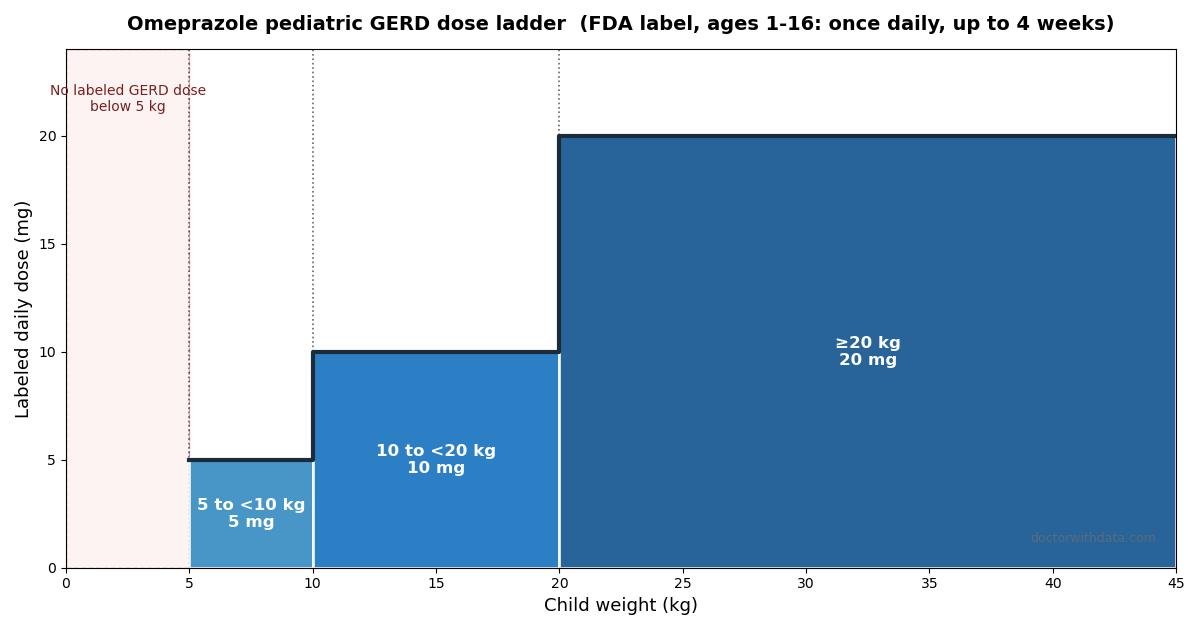
Omeprazole is one of the most widely used acid-suppressing medicines in the world, and its pediatric dosing is unusual in one respect: the label assigns a fixed milligram dose to each weight band instead of a milligrams-per-kilogram calculation. As the table below shows, every child between 5 and 10 kg receives 5 mg, every child between 10 and 20 kg receives 10 mg, and every child of 20 kg or more receives 20 mg. Understanding that band structure is the single most important thing on this page, because it is where most home-dosing mistakes would otherwise happen.
Why children take omeprazole
The pediatric indication covered by the dose lookup above is the treatment of symptomatic gastroesophageal reflux disease, or GERD. In GERD, stomach acid flows back up into the esophagus, the tube that carries food to the stomach. That backward flow irritates the esophageal lining and produces the symptoms families notice: heartburn or a burning feeling behind the breastbone, sour-tasting regurgitation, and in younger children, irritability during or after feeds, arching of the back, refusal to eat, or poor weight gain. The FDA label states that Prilosec is indicated for the treatment of heartburn and other symptoms associated with GERD for up to 4 weeks in patients 1 year of age and older.
A related but distinct condition is erosive esophagitis (EE) due to acid-mediated GERD, where the acid reflux has caused visible inflammation and erosions of the esophageal lining, diagnosed by endoscopy. Omeprazole is labeled for the short-term treatment of EE in children as well, with its own dosing rows and longer durations, which are described in the next sections. Reducing acid output gives the esophageal lining a chance to heal, which is why the EE regimens run longer than the plain symptomatic GERD course.
It is worth noting what omeprazole is not for. It is not an antacid for immediate relief. It takes time to reach its full effect because it must shut down the proton pumps progressively. The label notes that antacids may be used at the same time as Prilosec, which is how families handle breakthrough discomfort while the medicine builds up. And omeprazole does not fix the mechanical cause of reflux; it controls the acid damage and symptoms while the clinical team addresses feeding, positioning, and any underlying condition.
Pediatric GERD dosing by weight
The FDA label's pediatric dosing table gives three weight bands for the treatment of symptomatic GERD in children 1 to 16 years of age. Every dose is taken once daily, and the course runs for up to 4 weeks:
| Weight | Labeled dose | How often | How long |
|---|---|---|---|
| 5 to less than 10 kg | 5 mg | Once daily | Up to 4 weeks |
| 10 to less than 20 kg | 10 mg | Once daily | Up to 4 weeks |
| 20 kg and greater | 20 mg | Once daily | Up to 4 weeks |
Applied to real children, those bands give the following reference values, which match the widget's results exactly. An 8 kg toddler receives 5 mg once daily; a 15 kg child receives 10 mg once daily; a 25 kg child receives 20 mg once daily. The boundaries are inclusive on the lower side: a child weighing exactly 10 kg falls in the 10 mg band, and a child weighing exactly 20 kg falls in the 20 mg band. There is no per-kilogram arithmetic. A child of 11 kg and a child of 18 kg both receive the labeled 10 mg dose, and a teenager weighing 55 kg receives the same 20 mg as a 21 kg child, because the top band has no upper weight limit.
Two practical consequences follow. First, small errors in the home scale do not change the dose unless the child's true weight sits right on a band boundary, which is forgiving compared with mg/kg drugs. Second, the dose does not need recalculating as the child grows through a band. It only changes when the child crosses into the next band, and even then only the prescribing team makes that change. The dose lookup widget on this page flags weights below 5 kg and ages below 1 year as outside the labeled GERD regimen rather than guessing a dose, which is deliberate: the label simply does not define GERD bands for those children.
The other labeled pediatric uses
GERD symptom treatment is not the only pediatric indication. The same three weight bands apply to two further indications, with different durations:
| Indication | Age | Weight-based dose | Regimen and duration |
|---|---|---|---|
| Treatment of symptomatic GERD | 1 to 16 years | 5 to <10 kg: 5 mg 10 to <20 kg: 10 mg ≥20 kg: 20 mg | Once daily for up to 4 weeks |
| Treatment of EE due to acid-mediated GERD | 1 to 16 years | 5 to <10 kg: 5 mg 10 to <20 kg: 10 mg ≥20 kg: 20 mg | Once daily for 4 to 8 weeks |
| Maintenance of healing of EE due to acid-mediated GERD | 1 to 16 years | 5 to <10 kg: 5 mg 10 to <20 kg: 10 mg ≥20 kg: 20 mg | Once daily. Controlled studies do not extend beyond 12 months |
For erosive esophagitis in children 1 to 16 years, the label specifies once daily for 4 to 8 weeks. It adds that the efficacy of Prilosec used for longer than 8 weeks in EE has not been established; if a patient does not respond to 8 weeks of treatment, an additional 4 weeks may be given, and if EE or GERD symptoms recur, additional 4 to 8 week courses may be considered. Those decisions sit with the clinical team and the endoscopy findings, not with the calendar.
Infants 1 month to less than 1 year
Infants get their own table, and only for erosive esophagitis. Not for uncomplicated symptomatic GERD. The label indicates Prilosec for the short-term treatment (up to 6 weeks) of EE due to acid-mediated GERD in pediatric patients 1 month to less than 1 year of age, with these bands:
| Weight | Labeled dose | How often | How long |
|---|---|---|---|
| 3 to less than 5 kg | 2.5 mg | Once daily | Up to 6 weeks |
| 5 to less than 10 kg | 5 mg | Once daily | Up to 6 weeks |
| 10 kg and greater | 10 mg | Once daily | Up to 6 weeks |
Note the differences from the older-child table: the infant bands start lower (3 kg, with a 2.5 mg dose that matches the smallest packet size), top out at 10 mg instead of 20 mg, and run for up to 6 weeks. Because reflux-like symptoms in infants are extremely common and usually outgrown, the label's restriction of infant use to endoscopy-diagnosed erosive esophagitis is meaningful. It is a specialist decision, and the dose lookup widget on this page returns a named message for ages under 1 year rather than a dose.
How long treatment lasts, and what happens after
Duration is part of the prescription, not an afterthought. For symptomatic GERD the label says up to 4 weeks. That ceiling is the plan from day one, and the label's warnings section reinforces the principle behind it: patients should use the lowest dose and shortest duration of PPI therapy appropriate to the condition being treated. In practice, many children feel better well before the 4 weeks are up, and the medicine is stopped when the course ends rather than continued "just in case."
If symptoms persist when the 4 weeks end, the right move is a follow-up visit, not a home extension. Persistent symptoms can mean the diagnosis needs revisiting, the dose or timing needs adjusting, or a different condition is mimicking reflux. For erosive esophagitis the label builds the follow-up into the regimen: 4 to 8 weeks for the initial course, a possible additional 4 weeks if there is no response at 8 weeks, and 4 to 8 week repeat courses if symptoms recur. For maintenance of healing of EE, the label notes that controlled studies do not extend beyond 12 months, which sets the horizon for long-term use discussions with the clinical team.
Stopping omeprazole does not require tapering per the label's dosing section, but families should still stop on the schedule the prescriber gave and report what happens afterwards. If heartburn or regurgitation returns quickly after stopping, that information helps the clinician decide whether a repeat course, an investigation, or a different approach is needed.
How to give the dose
Timing matters with omeprazole. The label directs: take Prilosec before meals. Giving the dose before eating means the medicine is in place as the stomach's proton pumps switch on with the meal, which is how the drug achieves its best acid suppression. Families usually find that giving it 30 to 60 minutes before breakfast fits the day best, but the label's own wording is simply "before meals," and the prescriber's instruction is what the family follows.
Preparing the delayed-release oral suspension follows a fixed sequence in the label. Empty the contents of a 2.5 mg packet into a container with 5 mL of water, or a 10 mg packet into 15 mL of water. Stir, leave 2 to 3 minutes to thicken, then stir and drink within 30 minutes. If any material remains after drinking, add more water, stir, and drink immediately so the full dose is taken. For children with a nasogastric or gastric tube (size 6 or larger), the label gives a parallel method: add 5 mL of water to a catheter-tipped syringe, add the 2.5 mg packet (or 15 mL of water for the 10 mg packet), shake immediately, leave 2 to 3 minutes to thicken, shake again and inject through the tube into the stomach within 30 minutes, then refill the syringe with an equal amount of water and flush any remaining contents through.
Two everyday rules complete the picture. If a dose is missed, give it as soon as possible. But if the next scheduled dose is due, skip the missed one and take the next dose on time; never give two doses at once to make up for a missed dose. And antacids may be used at the same time as Prilosec, so breakthrough discomfort while the medicine takes effect can be handled the way the clinical team advises. Use an oral syringe to measure the water, give the mixture promptly once prepared, and keep the packets stored as directed on the packaging, out of children's reach.
Hepatic impairment and other label cautions
The reason is pharmacokinetic: omeprazole is cleared by the liver, and impaired liver function keeps the drug in the body longer, raising exposure from the same dose. The label's answer is a lower dose rather than a different schedule. Because the recommendation is written for the maintenance-of-healing indication, the prescribing team applies it to the child's specific situation. Which is exactly why the widget shows the standard band dose alongside the warning instead of silently substituting a different number.
Two more boundaries from the label are worth stating plainly. The pediatric GERD bands cover ages 1 to 16 years; the label defines no GERD dose for infants under 1 year and no pediatric band above 16 years (where the adult 20 mg once-daily GERD regimen applies). And the GERD bands start at 5 kg. A child under 5 kg has no labeled GERD dose, which is why the widget returns a named message directing the family to the clinical team rather than extrapolating downward.
Contraindications, warnings, and interactions
The label lists two hard contraindications. Prilosec is contraindicated in patients with known hypersensitivity to substituted benzimidazoles or to any component of the formulation. Hypersensitivity reactions named in the label include anaphylaxis, anaphylactic shock, angioedema, bronchospasm, acute tubulointerstitial nephritis, and urticaria. Proton pump inhibitors including Prilosec are also contraindicated in patients receiving rilpivirine-containing products. Any history of drug allergy should be discussed with the prescribing team before the first dose.
The warnings section carries several entries families should know by name. Acute tubulointerstitial nephritis. A kidney inflammation. Has been observed in patients taking PPIs and may occur at any point during therapy; the label says to discontinue Prilosec and evaluate patients with suspected acute TIN, and it can present with non-specific signs such as malaise, nausea, or loss of appetite rather than an obvious allergic picture. Published observational studies suggest PPI therapy may be associated with an increased risk of Clostridium difficile-associated diarrhea, especially in hospitalized patients; the label says this diagnosis should be considered for diarrhea that does not improve, and it is the source of the lowest-dose-shortest-duration principle quoted earlier. Several published observational studies also suggest an increased risk of osteoporosis-related fractures of the hip, wrist, or spine with PPI therapy, with the risk increased in patients receiving high-dose (defined as multiple daily doses) and long-term treatment.
On interactions, the label is direct about clopidogrel: avoid concomitant use of Prilosec with clopidogrel. Clopidogrel is a prodrug whose platelet-blocking effect depends on an active metabolite, and omeprazole inhibits CYP2C19, the enzyme that creates it. The label notes that concomitant use reduced the active metabolite's exposure even when the two drugs were given 12 hours apart, so separating the doses does not solve the problem. The patient counseling section also advises telling the healthcare provider before starting treatment with rilpivirine-containing products, clopidogrel, St. John's Wort, or rifampin, or when taking high-dose methotrexate. None of these entries is common in a child's medicine list, but the prescribing team checks every combination, and families should mention all prescription medicines, over-the-counter products, vitamins, and herbal supplements at each visit.
Side effects and when to call the doctor
Most children tolerate a short course of omeprazole without difficulty, but families should know what to watch for. Gastrointestinal effects such as abdominal pain, nausea, vomiting, or diarrhea are among the commonly reported adverse events with omeprazole; headache is also reported. These are usually mild and transient during a short GERD course, but anything severe or persistent deserves a call.
Certain symptoms should trigger prompt medical contact because they map to the label's warnings. Diarrhea that is watery, persistent, or does not improve should be reported, given the C. difficile warning. Signs of hypersensitivity. Rash, hives, swelling of the face or lips, wheezing, or breathing difficulty. Need urgent care. Non-specific signs such as unusual tiredness, nausea, loss of appetite, or a drop in urine output should be mentioned because kidney inflammation can present quietly. And if the child's reflux symptoms have not improved as the 4-week course ends, that is itself a reason to return: the label's duration limit exists precisely so that ongoing symptoms get re-evaluated rather than treated indefinitely.
Families sometimes ask about alternatives. Acid-suppressing options for children include H2 blockers such as famotidine, which work by a different mechanism and have their own pediatric dosing. Our famotidine pediatric dosage guide covers the label-based doses. Whether an H2 blocker, a PPI, or non-drug measures are appropriate for a given child is a clinical decision; this page exists so families understand the omeprazole option in full, not to steer the choice.