What levothyroxine is
Levothyroxine sodium is synthetic thyroxine, the T4 hormone that a healthy thyroid gland makes every day. Sold under brand names including Synthroid, it does not stimulate the thyroid or add anything foreign to the body: it replaces the hormone the gland is failing to produce. The prescribing information describes it as replacement therapy, and its patient counseling notes that replacement therapy is generally taken for life when the underlying thyroid failure is permanent.
In children this replacement carries unusual weight because thyroid hormone drives two processes that cannot wait: physical growth and brain development. The FDA's pediatric review of a levothyroxine product states plainly that rapid restoration of normal serum T4 concentrations is essential for preventing the adverse effects of congenital hypothyroidism on cognitive development as well as on overall physical growth and maturation. That sentence explains the urgency behind every number on this page: an undertreated infant does not just grow slowly, but can lose developmental ground that later treatment cannot fully recover.
Levothyroxine is not interchangeable with the older desiccated thyroid extracts and it is not a weight-loss drug. The label states that thyroid hormones, including levothyroxine, should not be used alone or with other drugs for obesity or weight loss, and that in people with normal thyroid levels, replacement doses are not helpful for weight loss while larger doses can cause serious or life-threatening events. In children the entire dosing framework below is replacement, calibrated to restore normal thyroid hormone levels, nothing more.
The label's age-banded dosing table
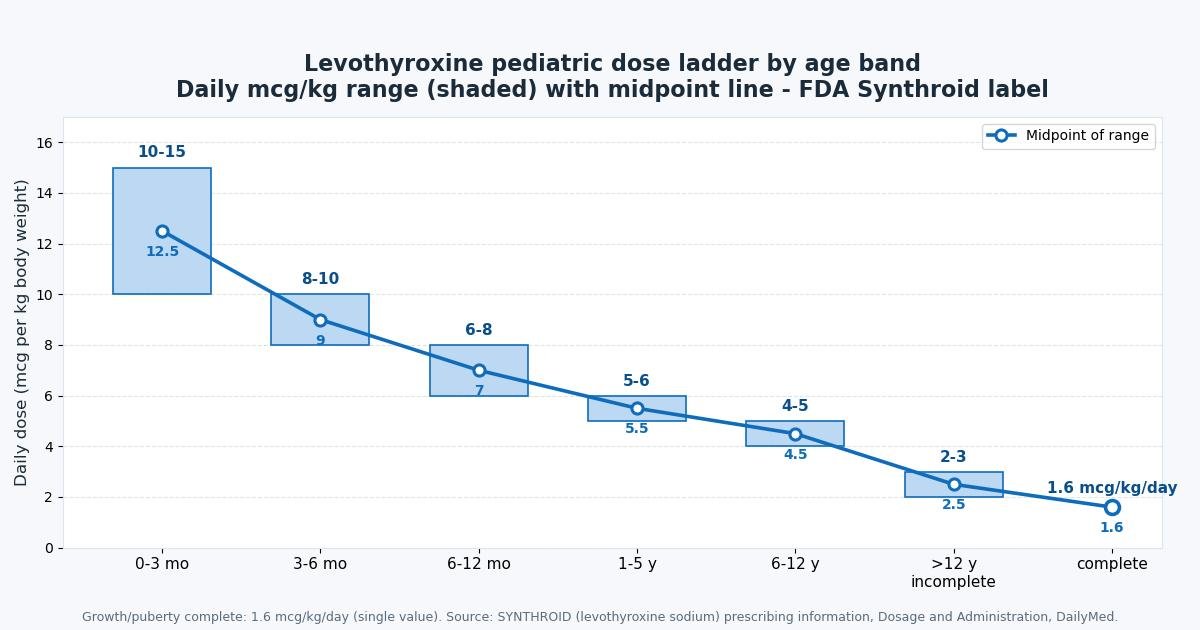
The FDA Synthroid label bases the pediatric dose on body weight and changes it with age, in the table reproduced here. Note the pattern before memorizing any number: the youngest infants receive the highest dose per kilogram, and the per-kilogram dose steps down as the child grows, ending at 1.6 mcg/kg/day once growth and puberty are complete, which is the same figure the label uses for full adult replacement.
| Age | Daily dose per kg body weight (label) |
|---|---|
| 0-3 months | 10-15 mcg/kg/day |
| 3-6 months | 8-10 mcg/kg/day |
| 6-12 months | 6-8 mcg/kg/day |
| 1-5 years | 5-6 mcg/kg/day |
| 6-12 years | 4-5 mcg/kg/day |
| Greater than 12 years, growth and puberty incomplete | 2-3 mcg/kg/day |
| Growth and puberty complete | 1.6 mcg/kg/day |
Applied to real weights, the table produces concrete starting ranges. A 4 kg two-month-old falls in the 0-3 month band: 40 to 60 mcg per day. A 15 kg three-year-old is in the 1-5 year band: 75 to 90 mcg per day. A 40 kg ten-year-old is in the 6-12 year band: 160 to 200 mcg per day. A 60 kg sixteen-year-old whose growth and puberty are still incomplete uses the 2-3 mcg/kg band: 120 to 180 mcg per day. The dose lookup widget above performs exactly this arithmetic for any weight and band, and also shows the practical tablet suggestion described below.
Two ceiling notes from the label belong with the table. Dosages greater than 200 mcg per day are seldom required in any patient, and an inadequate response to daily dosages greater than 300 mcg per day is rare and should prompt the clinical team to check compliance, absorption, and drug interactions, or a combination of these factors, before assuming the dose is simply too low. A child apparently "needing" very high doses is usually not absorbing the drug, not taking it, or taking it with something that blocks it.
Start at the full dose, then titrate
The label's default instruction is to start levothyroxine at the full daily dose in most pediatric patients, then adjust based on clinical response and laboratory parameters. Titration in pediatric patients is done every 2 weeks as needed, based on serum TSH or free-T4, until the patient is euthyroid. Families should know that the peak therapeutic effect of a given dose may not be attained for 4 to 6 weeks, which is why the team waits between adjustments rather than chasing each laboratory result with an immediate change.
Three groups start lower than the table, and the label names each explicitly. Newborns (0-3 months) at risk for cardiac failure should be considered for a lower starting dose, with the dose increased every 4 to 6 weeks as needed based on clinical and laboratory response. Children at risk for hyperactivity start at one-fourth of the recommended full replacement dose, increasing on a weekly basis by one-fourth of the full dose until the full recommended dose is reached. And the label directs a lower starting dose in patients with severe longstanding hypothyroidism or underlying cardiovascular disease. The widget surfaces the first two of these as named notes, NEONATAL_CARDIAC_RISK and HYPERACTIVITY_RISK, when the matching box is ticked or the newborn band is chosen.
How to give the dose: timing, food, and the 4-hour rule
Levothyroxine is given as a single daily dose, on an empty stomach, one-half to one hour before breakfast. That timing is not a suggestion: food in the stomach reduces how much of the tablet reaches the bloodstream, and the label directs evaluating the need for dosage adjustments when the drug is regularly given within one hour of foods that affect absorption.
For infants and children who cannot swallow intact tablets, the label gives exact preparation instructions: crush the tablet, suspend the freshly crushed tablet in a small amount of water (5 to 10 mL), and administer the suspension immediately by spoon or dropper, ensuring the child ingests the full amount. The suspension must not be stored, and it must not be given in foods that decrease absorption, such as soybean-based infant formula.
The best-known interaction rule is the 4-hour separation. The label directs administering levothyroxine at least 4 hours before or after drugs known to interfere with its absorption, and its interaction section names calcium carbonate and ferrous sulfate specifically: both decrease levothyroxine absorption. In a pediatric household this matters twice over, because iron supplements are common in childhood and calcium-fortified foods and antacids are everywhere. Our companion guide to pediatric ferrous sulfate dosing covers the iron side of that separation. Beyond drugs, the label warns that soybean flour, cottonseed meal, walnuts, and dietary fiber may bind levothyroxine and decrease absorption, so a child who starts eating these foods regularly may need a dose adjustment.
Monitoring: the TSH and free-T4 schedule
The label's monitoring section for pediatric patients is specific about both what to measure and when. In congenital hypothyroidism the adequacy of replacement is assessed by measuring both serum TSH and total or free-T4, on this schedule: 2 and 4 weeks after starting treatment, 2 weeks after any change in dosage, and then every 3 to 12 months after the dosage is stable, until growth is completed. Poor compliance or abnormal values call for more frequent monitoring, and routine clinical examination, including assessment of development, mental and physical growth, and bone maturation, happens at regular intervals alongside the blood work.
The label also defines what early success looks like, which gives families a concrete expectation for those first visits. Failure of the serum free-T4 to increase into the upper half of the normal range within 2 weeks of starting therapy, or of the serum TSH to decrease below 20 mU/L within 4 weeks, may indicate the patient is not receiving adequate therapy. When that happens the label directs the team to assess compliance, the dose actually administered, and the method of administration before increasing the dose, which is a reminder that a missed dose, a crushed tablet given in soy formula, or iron taken at breakfast can look exactly like an inadequate dose on paper.
The general aim of therapy is to normalize the serum TSH level, with one honest caveat the label includes: TSH may not normalize in some patients because hypothyroidism in utero can reset the pituitary-thyroid feedback set point. A TSH that stays slightly off despite a normal free-T4 and a thriving child is a known phenomenon, not automatically a dosing failure, and the clinical team interprets it in context.
Too much and too little: what the label warns about
Overtreatment has its own pediatric warning list, and it is sobering. The FDA's pediatric safety review notes that pseudotumor cerebri (raised pressure inside the skull) and slipped capital femoral epiphysis (a hip growth-plate injury) have been reported in pediatric patients receiving levothyroxine. Overtreatment may cause craniosynostosis in infants whose fontanelles have not yet closed, and premature closure of the epiphyses in children who are still growing, with resultant compromised adult height. These are the reasons the dose is titrated to the minimum that achieves normal labs, not pushed higher "to be safe."
The early signs of too much thyroid hormone are the symptoms of hyperthyroidism from overdosage: arrhythmias, nervousness, irritability, insomnia, tremors, muscle weakness, increased appetite with weight loss, diarrhea, and heat intolerance. Any of these after a dose increase should be reported promptly rather than waited out.
Undertreatment carries the opposite danger, and in infants it is the more feared error. As noted above, rapid restoration of normal T4 is essential to protect cognitive development and physical growth. The label's dosing table is deliberately generous in the youngest bands for exactly this reason: a newborn's brain is building itself now, and the cost of too little hormone in the first months is measured in developmental milestones, not just centimeters.
An alternative way to express the dose: body surface area
Some references express the pediatric maintenance dose per square meter of body surface area rather than per kilogram. A European regulatory assessment of pediatric levothyroxine states that the maintenance dose is generally 100 to 150 micrograms per m² of body surface area. The widget's second method uses that range with the Mosteller formula, the standard bedside equation: BSA (m²) = square root of (height in cm × weight in kg / 3600). For example, a child 120 cm tall weighing 25 kg has a Mosteller BSA of about 0.91 m², giving a range of roughly 91 to 137 mcg per day.
Two cautions belong with this method. First, it is an alternative reference, not the FDA label method: the US label doses strictly by age band and weight, and the two methods can disagree. Second, the European wording describes a maintenance dose, meaning the dose a child settles on after titration, not necessarily the starting dose. The widget shows both methods so families can see how they compare, but the label's weight-based table is the primary guide.
Preterm and low-birth-weight infants
Practical neonatal formularies add useful bedside detail for this group. The South Australian neonatal guideline doses congenital hypothyroidism at 8 to 15 microgram/kg once daily, advises that doses below 25 microgram per day are generally not recommended for practicality (doses are rounded to the nearest 25 microgram), and notes that 25 microgram every other day can substitute when about 12.5 microgram per day is intended. That is the basis for the widget's practical tablet suggestion and its 25 mcg floor: tiny calculated doses get rounded to something a real tablet can deliver, and the exact label range stays visible alongside the suggestion.
Preterm infants also illustrate why the administration instructions matter so much. A dose that is vomited, incompletely swallowed from a stored suspension, or given in soy-based formula is a dose the baby never received, and in a preterm infant the margin for that kind of loss is thinnest. The label's insistence on fresh suspension, full ingestion, and no soy formula is written for exactly these babies.
How long treatment lasts
For permanent congenital or acquired hypothyroidism, the label's patient counseling states that replacement therapy is generally taken for life. The thyroid gland that cannot make hormone in infancy does not learn to do so later, and stopping the drug returns the deficiency.
Not every newborn case is permanent, however. In a Paris newborn-screening cohort of 92 infants treated for congenital hypothyroidism, 54% turned out to have transient disease, with treatment discontinued at a median age of 1.5 years, and the levothyroxine dose still required at 6 months was one of the strongest predictors of whether the disease was permanent. That finding is why the clinical team reassesses the diagnosis over time rather than assuming lifelong therapy from day one. Any trial off the drug, and any dose change, is a medical decision made with laboratory monitoring, never an experiment at home.