What miconazole is and how it works
Miconazole is an imidazole antifungal. A medicine that kills or stops the growth of fungi. It works by blocking the synthesis of ergosterol, a fat-like molecule that fungal cells need to build their cell membranes. Without ergosterol, the fungal membrane becomes leaky and the organism cannot survive. Human cells do not use ergosterol (they use cholesterol instead), which is why miconazole can attack fungi while leaving human cells largely alone. This mechanism is the same across all the miconazole products; what changes from product to product is the formulation, the site of the body it is meant for, and the labeled age range.
The drug is old and well studied: miconazole has been in clinical use since the 1970s, and its various formulations are sold under brand names that many families already know. Monistat for the vaginal and some topical products, Daktarin for the oral gel, and Desenex, Micatin, and store-brand equivalents for the topical 2% cream. Because the same active ingredient is packaged so differently, the most common source of confusion is assuming one product can substitute for another. It cannot: the vaginal suppository is not interchangeable with the skin cream, the oral gel is not the same as the vaginal cream, and the diaper-area product (Vusion) is a distinct prescription ointment. Each section of this page treats one product on its own terms, quoting the exact directions from its FDA label.
A theme worth stating up front is that miconazole is a local drug with a local reach. Applied to skin, very little of it enters the bloodstream, which is why the topical cream has a short list of interactions and a long safety record. The vaginal products act where they are placed. The oral gel is designed to sit in the mouth and act on the mucosa there, and it is precisely because some of it is swallowed. The label directs that it eventually is. That it carries the interaction and liver warnings the skin cream does not. The dosing details below follow directly from this principle: the smaller the systemic exposure, the lighter the warning section; the greater the exposure, the stricter the rules.
The four pediatric-relevant miconazole forms at a glance
Before the detailed regimens, here is the map. Miconazole reaches children in four distinct products, each with its own labeled indication and its own minimum age. And the age floors differ for reasons explained later on this page:
| Product | Strength | Labeled use in children | Minimum labeled age |
|---|---|---|---|
| Miconazole nitrate cream (OTC) | 2% | Athlete's foot (tinea pedis), ringworm of the body (tinea corporis), jock itch (tinea cruris) | 2 years |
| Miconazole vaginal suppository / insert (OTC) | 100 mg, 200 mg, 1,200 mg | Vulvovaginal candidiasis | 12 years |
| Miconazole oral gel (Daktarin) | 20 mg per gram (2%) | Oropharyngeal candidiasis (oral thrush) | 4 months |
| Vusion ointment (prescription) | 0.25% miconazole nitrate / 15% zinc oxide / 81.35% white petrolatum | Diaper dermatitis complicated by documented candidiasis | 4 weeks |
Notice what is missing: there is no plain-cream indication for the diaper area and no oral-gel indication under 4 months. Both of those absences are deliberate label decisions, and both are enforced by the widget above as named errors. A caregiver who types in an age below the floor does not get a scaled-down dose; they get the refusal and the reason.
Miconazole 2% cream for tinea: ringworm, athlete's foot, jock itch
The workhorse product is the 2% cream. The FDA label lists its uses plainly: treatment of most athlete's foot (tinea pedis), jock itch (tinea cruris), and ringworm (tinea corporis), along with relief of the itching, scaling, burning, discomfort, and chafing that come with those infections. The directions are equally plain: clean the affected area and dry thoroughly, then apply a thin layer over the affected area twice daily (morning and night), or as directed by a doctor. Children should be supervised while using the product.
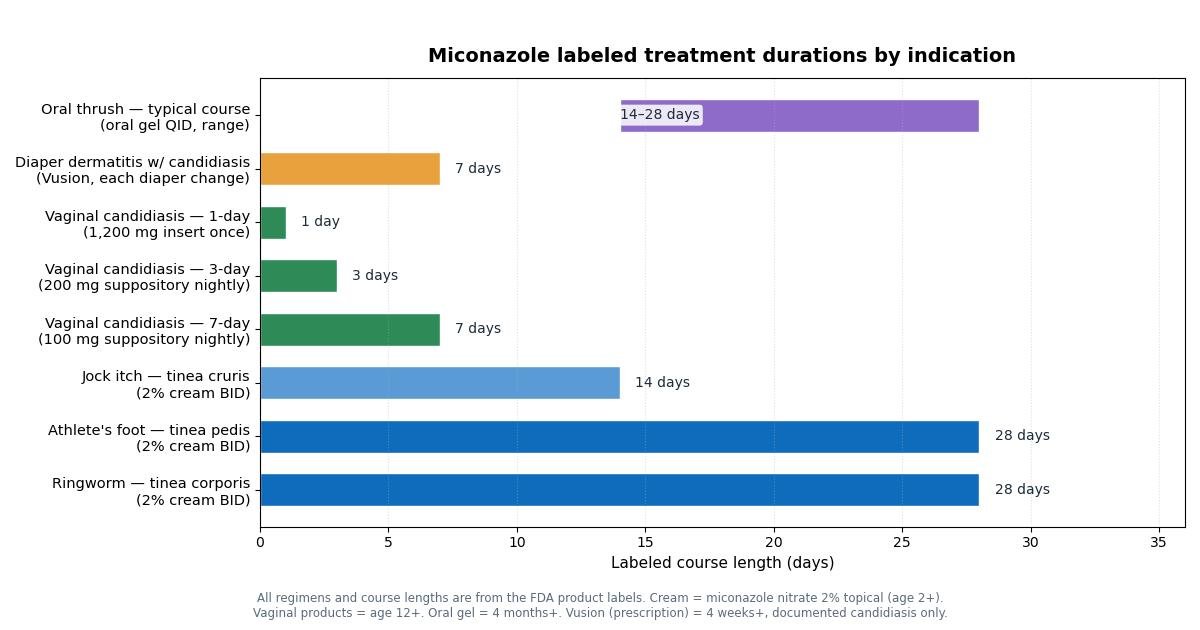
Where the label gets specific is the course length, and the three indications do not share one. For athlete's foot and ringworm, the label directs daily use for 4 weeks. For jock itch, it directs daily use for 2 weeks. If the condition persists longer, the label says to consult a doctor. And it pairs that with stop-use rules: stop use and ask a doctor if there is no improvement within 2 weeks when used for jock itch, or within 4 weeks when used for athlete's foot or ringworm. These time limits exist so that a misdiagnosed condition (eczema, psoriasis, bacterial infection) is not treated with an antifungal for months while the real diagnosis waits.
The age floor for the cream is 2 years: the label's "do not use" list includes children under 2 years of age unless directed by a doctor. Supervised use in children 2 and older is the labeled path. Two further boundaries complete the picture. First, the label states the product is not effective on the scalp or nails. Scalp ringworm (tinea capitis) and nail infections need different medicines, and the cream should not be wasted on them. Second, and relevant for the youngest children, the label states "do not use for diaper rash." The perineal and diaper area is explicitly excluded from the plain cream's labeling; the only miconazole product with a diaper-area indication is the prescription Vusion ointment covered in its own section below.
Storage is ordinary: room temperature, 15 to 30 degrees Celsius (59 to 86 degrees Fahrenheit), and keep out of reach of children. If swallowed, the label directs getting medical help or contacting a Poison Control Center right away.
Vaginal miconazole regimens for adolescents
Vulvovaginal candidiasis. The vaginal yeast infection. Is treated with intravaginal miconazole in three labeled course options that differ in duration but not in the age floor. The 7-day therapy is a 100 mg suppository inserted into the vagina at bedtime for 7 nights in a row. The 3-day therapy is a 200 mg suppository at bedtime for 3 nights. The 1-day therapy is a 1,200 mg vaginal insert placed once at bedtime, with the applicator thrown away after use. All three are labeled for adults and children 12 years of age and over; for children under 12 years of age the label says ask a doctor. The 1-day kit notes that most do not get complete relief in just 1 day. Most get some improvement in 1 day and complete relief by 7 days.
Alongside the internal products, the 1-day and 3-day kits include an external vulvar cream (miconazole nitrate 2%) for the itching and irritation outside the vagina: the label directs squeezing a small amount onto a fingertip and applying it to the itchy, irritated skin outside the vagina twice daily for up to 7 days, as needed. This external cream is an adjunct for symptom relief, not a substitute for the intravaginal course.
Technique matters: the suppository or insert is placed high into the vagina at bedtime while lying down, which keeps it in place overnight. The stop-use rules are the label's safety net: stop use and ask a doctor if symptoms do not get better in 3 days, if symptoms last more than 7 days, or if you develop a rash or hives, abdominal pain, fever, chills, nausea, vomiting, or foul-smelling vaginal discharge. Signs that the problem may not be a simple yeast infection or that an allergic reaction is developing. If pregnant or breast-feeding, the label directs asking a health professional before use.
Miconazole oral gel for oral thrush
Oropharyngeal candidiasis. Oral thrush, the white patches of Candida on the tongue and inner cheeks. Is treated with miconazole oral gel (the Daktarin product), a 20 mg-per-gram (2%) gel meant to be held in the mouth. The label divides pediatric dosing into two bands. Infants 4 to 24 months receive 1.25 mL (a quarter of the 5 mL measuring spoon) of gel, applied four times a day after meals. Children 2 years of age and older receive 2.5 mL (half of the 5 mL measuring spoon), applied four times a day after meals. The gel should not be swallowed immediately but kept in the mouth as long as possible, so it stays in contact with the affected mucosa. Treatment continues for at least a week after the symptoms have disappeared, and a typical course runs 2 to 4 weeks.
The administration technique is the most safety-critical part of this product, and the label is unusually explicit about it. Each dose should be divided into smaller portions and applied to the affected area or areas with a clean finger. Never the whole spoonful at once in an infant's mouth. The gel must not be applied to the back of the throat, because of possible choking. It should be placed at the front of the mouth. For infants 4 to 6 months old who are premature or have slow development, the label directs checking with a doctor before using the medicine. These precautions exist because a thick gel in a small airway is a choking hazard, and the swallowing reflex of a young infant is not reliable enough to manage it.
Oral thrush in infants is commonly treated with nystatin suspension as an alternative, and more extensive disease may be treated with oral fluconazole. Our fluconazole pediatric dosage calculator covers that drug's labeled pediatric dosing. The choice between topical oral antifungals and systemic therapy is a clinical decision based on the extent of the infection and the child's age.
Diaper dermatitis: the Vusion exception and the plain-cream warning
This is the section where the labels draw their sharpest line, and it is worth reading twice. The plain miconazole nitrate 2% cream. The tube used for athlete's foot and ringworm. Carries an explicit "do not use" instruction: do not use for diaper rash. That is not a suggestion; it is on the label's do-not-use list. No amount of reasoning about it being "the same antifungal" overrides that instruction, because the cream's vehicle, concentration, and safety data were never established for the diaper area.
The diaper area has its own product: Vusion ointment, a prescription combination of 0.25% miconazole nitrate, 15% zinc oxide, and 81.35% white petrolatum. Its FDA indication is narrow and conditional: the adjunctive treatment of diaper dermatitis only when complicated by documented candidiasis. Meaning microscopic evidence of pseudohyphae and/or budding yeast. In immunocompetent pediatric patients 4 weeks and older. A positive fungal culture for Candida albicans alone is not adequate evidence, because colonization can produce a positive culture without infection. In other words, the clinician must actually see the yeast under the microscope before this product is indicated, and most diaper rash does not have a yeast infection at all.
The labeled regimen is: before applying, gently cleanse the skin with lukewarm water and pat dry with a soft towel, avoiding scented soaps, shampoos, or lotions on the diaper area. Apply a thin layer to the affected area at each diaper change for 7 days. Continue treatment for the full 7 days even if there is improvement. Do not rub the ointment into the skin, as rubbing may cause additional irritation. Wash hands thoroughly after applying. The safety of Vusion used for longer than 7 days is not known, and it must not be used to prevent diaper rash. It is for skin use only. Not for oral, ophthalmic, or intravaginal use.
Practical care matters as much as the ointment: the label makes frequent diaper changes and gentle cleansing part of the treatment regimen. Vusion is described as adjunctive treatment. The underlying diaper dermatitis still needs the basic measures directed at it, including keeping the area clean and dry, because the rash will not clear while the skin sits in prolonged moisture.
Age floors: why each form starts where it does
The four minimum ages. 4 weeks, 4 months, 2 years, 12 years. Look arbitrary until you see the reasoning behind each one. The floors are not about the drug becoming toxic at a birthday; they are about what was studied, what the formulation demands of the patient, and what a wrong guess would cost:
| Product | Minimum labeled age | Why the floor sits there |
|---|---|---|
| Vusion ointment | 4 weeks | Studied in immunocompetent pediatric patients 4 weeks and older with microscopically documented candidiasis; safety below that age is not established, and the diagnosis itself requires a clinician's test. |
| Oral gel | 4 months | Below 4 months the swallowing reflex is not sufficiently developed and the gel is a choking hazard; the label makes this a contraindication, not a suggestion. |
| 2% cream | 2 years | Skin infections in younger infants are harder to diagnose correctly and the product was not labeled for that group; "children under 2 years of age: ask a doctor." |
| Vaginal suppository / insert | 12 years | Vulvovaginal candidiasis in prepubertal children is uncommon and raises different diagnostic considerations; "children under 12 years of age: ask a doctor." |
The practical upshot is that "pediatric miconazole" is not one thing with one age range. It is four products with four gates, and the widget enforces each gate separately. A 6-month-old qualifies for the oral gel but not the 2% cream; a 3-year-old qualifies for the cream but not the vaginal products; a 6-week-old with a yeasty diaper rash qualifies for Vusion (with a clinician's documented diagnosis) but for nothing else on this page.
How to apply each form, and duration discipline
Technique varies completely by product, which is why this section exists separately from the dosing numbers. For the 2% cream: wash and dry the area, apply a thin layer (not a thick one. More cream does not mean more cure), rub in gently, and keep applying twice daily for the full labeled course even after the itching fades. Stopping early because symptoms improved is the classic reason tinea recurs: the visible inflammation settles before the fungus is eradicated. For athlete's foot, the between-the-toes spaces need deliberate attention, and the footwear and sock habits in the callout above are part of the regimen, not optional extras.
For the vaginal products: insert at bedtime while lying down, high into the vagina, and finish the full course. 7, 3, or 1 night as chosen. Do not have vaginal intercourse during treatment per the kit instructions, and expect the 1-day insert to take up to 7 days for complete relief. For the oral gel: after meals, four times a day, in divided small portions with a clean finger, placed at the front of the mouth and kept there as long as possible. For Vusion: lukewarm-water cleansing, pat dry, thin layer at each diaper change, no rubbing, full 7 days even with early improvement, hands washed after.
The missed-dose discipline is the same across all of them: if a dose is missed, apply it when remembered unless it is nearly time for the next one. Then skip it and resume the schedule. Do not double up. The courses are short enough that doubling up adds irritation risk without adding cure.
Cautions, contraindications, and interactions
The contraindication list is short and product-specific. Hypersensitivity to miconazole, to other imidazole antifungals, or to any ingredient in the formulation is a contraindication for all forms. The oral gel adds: infants less than 4 months of age or those whose swallowing reflex is not yet sufficiently developed, patients with liver dysfunction, and concurrent use of several specific drugs. Substrates known to prolong the QT interval (such as astemizole, cisapride, dofetilide, mizolastine, pimozide, quinidine, sertindole, and terfenadine), ergot alkaloids, triazolam, oral midazolam, and HMG-CoA reductase inhibitors such as simvastatin and lovastatin. This is the longest interaction list of the four products, and it exists because the oral gel is the one form with meaningful swallowing and systemic exposure.
The topical 2% cream sits at the other end: systemic absorption through intact skin is minimal, so it carries no comparable interaction list, and its warnings are the practical ones. External use only, avoid contact with the eyes, stop if irritation occurs. The vaginal products sit in the middle: local action with the standard stop-use rules and the pregnancy and breast-feeding precaution (ask a health professional before use). Vusion's cautions are about correct use rather than interactions: do not use for prevention, do not use beyond 7 days, do not use without the documented candidiasis diagnosis, and do not share it with other children or family members.
One cross-cutting caution: miconazole is an imidazole, and a history of allergy to related antifungals (clotrimazole, ketoconazole, econazole) should be discussed with the clinician before any miconazole product is used, because cross-reactivity within the class is possible.
Side effects
Because each product acts locally, side effects are mostly local too. With the 2% cream, the label's stop-use trigger is irritation. Burning, stinging, or redness at the application site. And the general "if swallowed, get medical help" warning applies to the tube as a whole. With the vaginal products, a mild increase in vaginal burning, itching, or irritation may occur when the suppository is inserted, and abdominal cramping has been reported; severe vaginal burning, itching, irritation, or swelling, or systemic signs like hives or rash, mean stopping the product and consulting a doctor. With the oral gel, too much gel can cause vomiting and diarrhea, and the choking risk already covered is the serious one. With Vusion, the patient labeling warns to stop and call the doctor for severe discomfort, redness, or other irritation of the treated skin areas, and to get emergency help for signs of allergic reaction such as hives, difficult breathing, or swelling of the face, lips, tongue, or throat.
None of these lists is exhaustive, and a reaction that worries a caregiver should be reported to the clinician or pharmacist regardless of whether it appears in a label. For anything swallowed in quantity, the Poison Control Center number on every label is 1-800-222-1222.
When to see a doctor
The labels build the "see a doctor" triggers into every product, and they are worth collecting in one place. See a doctor or stop self-treatment when: a skin infection shows no improvement within the labeled course (2 weeks for jock itch, 4 weeks for athlete's foot and ringworm) or any irritation develops; vaginal symptoms do not improve within 3 days, last more than 7 days, recur within 2 months, or come with rash, hives, abdominal pain, fever, chills, nausea, vomiting, or foul-smelling discharge; oral thrush persists despite the gel, the infant is under 4 months, or the infant is 4 to 6 months and premature or slow in development; a diaper rash has not improved by day 7 of Vusion, the child is under 4 weeks old, or there is any doubt about whether a yeast infection is actually present. And as every section of this page has emphasized: any age below a product's labeled floor, any use of the plain cream on the diaper area, and any oral-gel use in an infant under 4 months are not "try a smaller dose" situations. They are "ask the clinician first" situations.