How medicines reach your baby through breast milk
Almost every drug a mother takes passes into breast milk to some degree, but in most cases the amount is tiny and carries no meaningful risk to the infant. The infant is what lactation pharmacologists call an innocent bystander: it gains no benefit from the exposure, but for most medicines the exposure is far below any dose that would cause an effect. Understanding why helps you read the checker's results with confidence.
Drug transfer from maternal blood into milk happens mainly by passive diffusion across the membranes of the milk-producing cells. Five drug properties control how much crosses. First, protein binding: drugs that are strongly bound to plasma proteins stay in the blood, so less free drug is available to cross. Ibuprofen, which is more than 99 percent protein bound, is a classic example and is rated Hale L1. Second, lipid solubility: fat-soluble drugs dissolve readily into the fat fraction of milk, especially the richer hindmilk at the end of a feed. Third, ionisation: breast milk is slightly more acidic than blood (about pH 7.2 versus 7.4), so weakly basic drugs can become ionised in milk and trapped there, a process called ion trapping. Fourth, molecular weight: very large molecules simply cannot cross membranes. Insulin and heparin are too large to pass into milk in meaningful amounts, and they are also destroyed in the infant's gut, so their oral bioavailability is effectively zero. Fifth, first-pass metabolism: drugs that are heavily metabolised on their first pass through the liver reach the infant's bloodstream in much smaller amounts. Morphine, for example, undergoes extensive first-pass metabolism, which is one reason it is considered acceptable during breastfeeding despite entering milk.
The drug's half-life also matters. Drugs with long half-lives can accumulate in the infant's blood, and this is especially important in newborns, whose kidneys and liver are not yet fully mature. Gardiner and Begg reported that within a few days of delivery, term infants have glomerular filtration rates about one-third of adult values adjusted for body surface area, and premature infants have even more impaired clearance: about 5 percent of adult clearance at 24 to 28 weeks post-conceptual age, 10 percent at 28 to 34 weeks, and 33 percent at 34 to 40 weeks. Adult clearance is generally reached only toward the end of the first year. This is why the checker asks about your infant's age and whether the birth was premature: a medicine rated L2 or L3 for a healthy six-month-old deserves much more caution in a two-week-old premature infant.
The relative infant dose: what it means and what it does not
The relative infant dose (RID) is the single most useful number in lactation pharmacology. It is calculated as the infant's weight-adjusted dose received through milk, in mg/kg/day, divided by the mother's weight-adjusted dose in mg/kg/day, multiplied by 100. The standard assumption is a milk intake of about 150 mL/kg/day. For example, if an infant receives 0.05 mg/kg/day through milk while the mother takes 5 mg/kg/day, the RID is (0.05 divided by 5) times 100, which equals 1.0 percent.
An RID under 10 percent is the widely used pragmatic cut-off for compatibility with breastfeeding. It is the most widely used indicator of compatibility among lactation and medication experts, and it appears in clinical guidelines from New Zealand's Medsafe, the Pharmaceutical Journal, and Hale's own tables. If the infant's dose is close to 1 percent, the drug can generally be considered safe regardless of infant age; as the RID approaches 10 percent, the infant's clearance must be weighed, and premature infants need particular caution.
The 10 percent line is a rule of thumb, not a guarantee. Two exceptions prove the point. Lithium transfers so freely that the infant dose can be as high as 80 percent of the mother's weight-adjusted dose, and the drug is considered too risky for breastfeeding mothers in most guidelines. In the opposite direction, methotrexate has an RID of roughly 0.1 percent, far below the cut-off, yet it is Hale L4 (possibly hazardous) because it is a cytotoxic drug that can suppress the infant's immune system and affect growth. For drugs with greater inherent toxicity, such as cytotoxic agents, ergotamine, and isotretinoin, the 10 percent cut-off is simply too high, and breastfeeding is contraindicated. This is why the checker shows the Hale category alongside the RID: the number alone never tells the whole story.
Hale's lactation risk categories L1 to L5
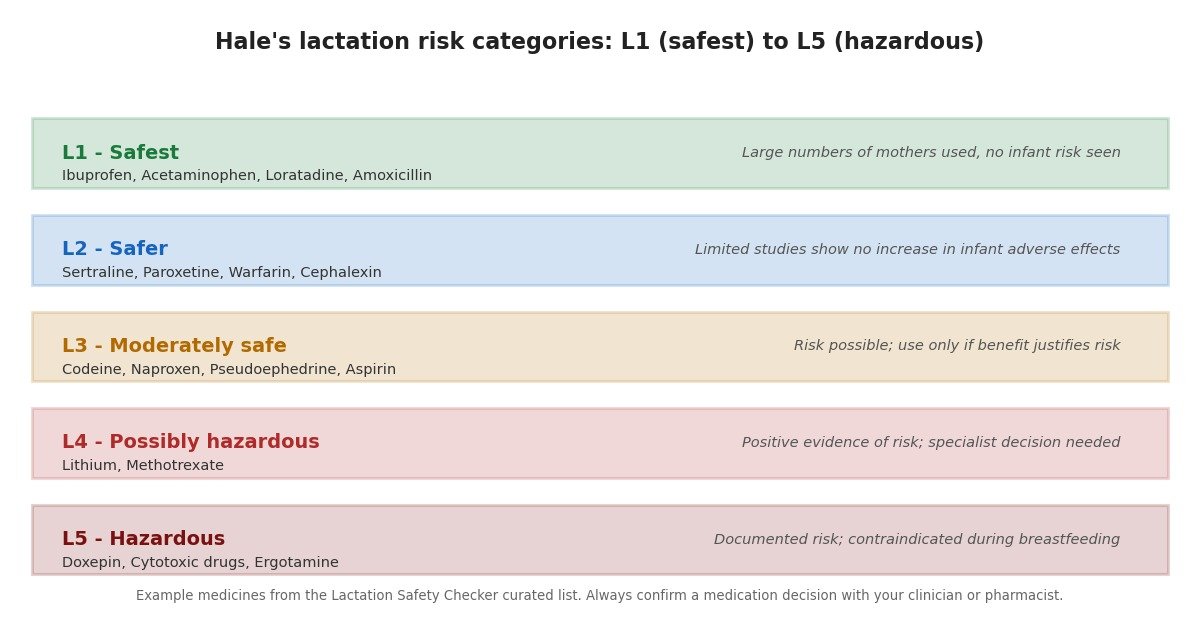
Thomas W. Hale's Medications and Mothers' Milk, updated biennially and currently covering about 1,300 drugs, is the standard reference for medication safety in lactation. Its five lactation risk categories compress the evidence into a single letter:
- L1, safest: taken by a large number of breastfeeding mothers with no observed increase in adverse effects in the infant; controlled studies in breastfeeding women fail to demonstrate risk, or the drug is not orally bioavailable to the infant.
- L2, safer: studied in a limited number of breastfeeding women without an increase in adverse effects; the evidence of risk following maternal use is remote.
- L3, moderately safe: no controlled studies in breastfeeding women, but the risk of untoward effects is possible, or studies show only minimal non-threatening effects. Use only if the potential benefit justifies the potential risk. New drugs with no published data are automatically placed here.
- L4, possibly hazardous: positive evidence of risk to the infant or to milk production, but use may be acceptable when the mother needs the drug and safer alternatives are ineffective or unavailable.
- L5, hazardous: studies show significant documented risk, or the drug has a high risk of causing significant harm. The risk clearly outweighs any benefit of breastfeeding, and the drug is contraindicated.
Categories are a guide to judgment, not a verdict. An L3 drug can be the right choice when the mother genuinely needs it and no safer alternative exists; an L1 drug can still cause problems at excessive doses. The checker always pairs the category with the RID and the specific cautions that apply.
What the 30 curated medicines show
The checker's list covers the medicines breastfeeding mothers ask about most: pain relievers, antibiotics, allergy and cold remedies, antidepressants, and a handful of chronic-disease drugs. All entries are drawn from published references; no category or RID value was invented.
Pain relievers
Ibuprofen (Hale L1, infant exposure under 0.6 percent of the maternal dose) and paracetamol or acetaminophen (Hale L1, 2.9 to 7.9 percent) are the first-line pain relievers for breastfeeding mothers (Gardiner and Begg, Prescriber Update 2001). Naproxen is Hale L3: acceptable for short courses, but its long half-life means it should be used cautiously in newborns. Aspirin is Hale L3 and is best avoided during breastfeeding because of the theoretical risk of Reye's syndrome. Codeine is Hale L3 and deserves special caution: about 1 to 28 percent of people, depending on ethnicity, are ultra-rapid CYP2D6 metabolizers who convert codeine to morphine much faster than normal, producing abnormally high morphine levels in milk. After the death of a 13-day-old breastfed infant in 2006, the FDA issued a public health advisory in 2007 recommending the lowest effective dose for the shortest time, and watching the infant for unusual sleepiness, limpness, or difficulty nursing or breathing. Morphine itself is Hale L3 and is generally considered acceptable because little transfers into milk and the infant's first-pass metabolism clears most of what is ingested; still, the infant should be watched for drowsiness. Sumatriptan (Hale L2, RID 0.3 to 6.7 percent) has a half-life of about two hours, and expressing and discarding milk for eight hours after a dose avoids exposure almost completely.
Antibiotics
Penicillins, cephalosporins, and macrolides are considered compatible with breastfeeding, with the theoretical risks of altered infant gut flora or allergic sensitisation (Gardiner and Begg 2001). Amoxicillin is Hale L1 with an RID of about 0.7 percent, and cephalexin is Hale L1 with an RID of 0.5 to 1.2 percent. A single dose of azithromycin is considered safe (Medsafe 2015). Metronidazole is more controversial: the infant dose may reach 36 percent of the maternal weight-adjusted dose, well above the 10 percent cut-off, so it is Hale L2 with a strong caution. Practical approaches include choosing an alternative antibiotic where appropriate, or, after a single 2 g dose, discontinuing breastfeeding for about 12 hours. Nitrofurantoin is Hale L2 with an RID of 0.6 to 6.0 percent, but it should be avoided if the infant is under one month old, premature, or G6PD-deficient because of the risk of haemolysis. Ciprofloxacin is Hale L2 with an RID of about 4.8 percent, but fluoroquinolones are best avoided where possible because of arthropathy reported in immature animals.
Allergy and cold remedies
Loratadine is Hale L1 and considered safe through extensive usage; the non-sedating antihistamines are expected to transfer poorly into milk (Medsafe 2001). Cetirizine and diphenhydramine are Hale L2; with diphenhydramine, monitor the infant for sedation or irritability. Pseudoephedrine is Hale L3: its RID is about 4.3 percent (range 2.2 to 6.7 percent), which is low, but a single 60 mg dose reduced milk production by a mean of 24 percent over 24 hours in eight nursing mothers (Aljazaf, Hale, Ilett and colleagues, 2003). Mothers also reported infant irritability in about 20 percent of exposed infants in one study. Topical decongestant nasal sprays act locally and are preferred because infant exposure is much lower.
Antidepressants and other mental health medicines
Untreated maternal depression carries serious risks for mother, infant, and family, so when treatment is indicated, most experts advise continuing both treatment and breastfeeding rather than stopping either. Sertraline (Hale L2, RID 0.4 to 2.2 percent) and paroxetine (Hale L2, RID 1.2 to 2.8 percent) have the lowest reported transfer and are generally the first choices (Pharmacy Times; UT Health Austin 2019). Citalopram is Hale L2 with an RID of 3.6 to 5.4 percent, and venlafaxine is Hale L2 with an RID of 6.8 to 8.1 percent. Fluoxetine is Hale L2 but has a higher reported RID range of 1.6 to 14.6 percent, and its active metabolite norfluoxetine has a half-life of one to two weeks and can accumulate in the infant, so extra caution is advised with newborns. The tricyclic amitriptyline is Hale L2 with an RID of 1.1 to 2.8 percent and is considered compatible in doses up to 150 mg per day. Doxepin is the outlier: Hale L5, hazardous, with case reports of infant sedation and poor suckling, so it should be avoided. Lithium is Hale L4 with infant exposure as high as 80 percent of the maternal dose, and it should be avoided during breastfeeding because of the risk of infant toxicity.
Other common medicines
Methotrexate is Hale L4: Hale and colleagues report that the infant receives about 0.1 percent of the mother's dose, but the drug is a cytotoxic agent, so chronic use is not considered compatible with breastfeeding. With low once-weekly doses (under 50 mg), pumping and discarding for 24 hours after the dose reduces exposure by a further 70 to 90 percent, and this approach is sometimes used under specialist supervision (InfantRisk). Warfarin is Hale L2: it is highly protein bound, transfer is low (under 4.4 percent), and no changes in infant prothrombin times have been detected, though it is prudent to monitor the infant's clotting during treatment. Carbamazepine is Hale L2 with an RID of 2.8 to 7.3 percent; the infant should be watched for sedation and poor suckling. Insulin is Hale L1: it is too large to cross membranes in meaningful amounts and is destroyed in the infant's gut, so it is not orally bioavailable. Progestin-only contraception (mini-pill, implant, hormonal IUD) is Hale L2 and compatible with breastfeeding, while combined estrogen-containing contraceptives are Hale L3 because estrogen can reduce milk supply, especially in the first weeks after delivery.
Medicines that can reduce milk supply
A medicine can be perfectly safe for the infant and still cause trouble by reducing milk production. Oral pseudoephedrine is the clearest example, with a measured 24 percent reduction in 24-hour milk production after one dose. High-dose diuretics, estrogen-containing contraceptives, and amphetamines are also linked to reduced supply. If your milk production falls after starting a medicine, contact your clinician or a lactation consultant promptly; repeated use of an oral decongestant can, in some women, cause a lasting reduction in supply. Nasal sprays, saline drops, and steam inhalation are safer alternatives for congestion.
How to use this checker safely
Select your medicine, set your infant's age, and tick the premature box if it applies. The panel shows the Hale category with its plain-language meaning, the published RID where available, and every caution that applies to your situation, including extra warnings for newborns and premature infants and milk-supply warnings where relevant. If your medicine is not in the list, the panel explains what to do: do not guess from a similar-sounding drug. Free references such as the U.S. National Library of Medicine's LactMed database give a monograph for almost every medicine, and your pharmacist can look up the Hale category in Medications and Mothers' Milk.
While breastfeeding on medication, watch your infant for the warning signs lactation references list: unusual drowsiness, sleeping more than four hours at a stretch in a young infant, limpness, poor feeding or poor suckling, irritability, changes in sleep patterns, and poor weight gain. Feeding immediately before a dose can reduce exposure for drugs taken acutely, because milk concentrations are lowest near the end of a dosing interval; for chronic medicines taken daily, levels stay roughly constant, so timing feeds does not help. For drugs that are not considered safe, breast milk can be expressed and discarded for the treatment duration, and breastfeeding resumed after about four to five half-lives, by which time maternal concentrations have fallen to around 10 percent of steady-state levels.
Key takeaways
- The relative infant dose is the infant's weight-adjusted dose received through breast milk, expressed as a percentage of the mother's weight-adjusted dose: RID equals infant dose in mg/kg/day divided by maternal dose in mg/kg/day, multiplied by 100.
- Hale's lactation risk categories, from Medications and Mothers' Milk by Thomas W.
- Ibuprofen (Hale L1, infant exposure under 0.6 percent of the maternal dose) and paracetamol, also called acetaminophen (Hale L1, exposure 2.9 to 7.9 percent), are the preferred pain relievers during breastfeeding according to published lactation references (Medsafe New Zealand).
- Many antidepressants are considered compatible with breastfeeding.
Frequently asked questions
What is the relative infant dose (RID) and what value is considered safe?
The relative infant dose is the infant's weight-adjusted dose received through breast milk, expressed as a percentage of the mother's weight-adjusted dose: RID equals infant dose in mg/kg/day divided by maternal dose in mg/kg/day, multiplied by 100. An RID under 10 percent is the widely used pragmatic cut-off for compatibility with breastfeeding (Gardiner and Begg, Prescriber Update 2001). The cut-off is arbitrary rather than absolute: drugs such as lithium have RIDs as high as 80 percent and should be avoided, while cytotoxic drugs such as methotrexate can be hazardous even with a low RID because of their inherent toxicity.
What do Hale's lactation risk categories L1 to L5 mean?
Hale's lactation risk categories, from Medications and Mothers' Milk by Thomas W. Hale, rank medicines by evidence of safety during breastfeeding. L1 (safest) means a large number of breastfeeding mothers have used the drug with no observed increase in infant adverse effects. L2 (safer) means limited studies show no increase in adverse effects and the likely risk is remote. L3 (moderately safe) means no controlled studies exist and risk is possible, so the drug should be used only if the benefit justifies the potential risk. L4 (possibly hazardous) means there is positive evidence of risk to the infant or to milk production, but use may be acceptable when the mother needs the drug and safer alternatives are ineffective. L5 (hazardous) means studies show significant documented risk and the drug is contraindicated during breastfeeding.
Which pain relievers are safest while breastfeeding?
Ibuprofen (Hale L1, infant exposure under 0.6 percent of the maternal dose) and paracetamol, also called acetaminophen (Hale L1, exposure 2.9 to 7.9 percent), are the preferred pain relievers during breastfeeding according to published lactation references (Medsafe New Zealand). Naproxen is Hale L3 and should be limited to short courses in newborns because of its long half-life. Aspirin should be avoided because of the risk of Reye's syndrome. Codeine requires caution since ultra-rapid CYP2D6 metabolizers can pass high levels of morphine into milk, which prompted a 2007 FDA public health advisory.
Can I take antidepressants while breastfeeding?
Many antidepressants are considered compatible with breastfeeding. Sertraline and paroxetine have the lowest reported transfer into milk, with relative infant doses of 0.4 to 2.2 percent and 1.2 to 2.8 percent respectively, and are both Hale L2 (Pharmacy Times; University of Texas Health Austin 2019). Fluoxetine is also Hale L2 but has a higher reported RID range of 1.6 to 14.6 percent, and its active metabolite norfluoxetine has a half-life of one to two weeks, so caution is advised with newborns. When treatment for depression is indicated, most experts advise continuing both treatment and breastfeeding rather than stopping either, and the choice of drug should be made with a clinician.
Which medicines can reduce breast milk supply?
Oral pseudoephedrine reduced milk production by a mean of 24 percent over 24 hours after a single 60 mg dose in a study of eight nursing mothers (Aljazaf, Hale, Ilett and colleagues, British Journal of Clinical Pharmacology 2003), so decongestant nasal sprays, which act locally, are preferred. Estrogen-containing birth control pills may also reduce milk production, particularly in the first weeks after delivery; progestin-only methods such as the mini-pill, implant, or hormonal IUD are considered compatible with breastfeeding (Hale L2). If milk supply drops after starting a medicine, contact a healthcare provider or lactation consultant.
Is this lactation safety checker a substitute for medical advice?
No. This checker is an informational tool based on published lactation references and cannot replace professional judgment. Medication safety during breastfeeding depends on your dose, your infant's age and health, kidney and liver maturity, and other medicines you take. Newborns and premature infants clear drugs much more slowly than older infants, so drugs rated L2 or L3 need extra caution in the first weeks of life. Always confirm any medication decision with your clinician or pharmacist, and watch your infant for drowsiness, poor feeding, irritability, or poor weight gain.
References
- Hale TW, Krutsch K. Hale's Medications and Mothers' Milk: A Manual of Lactational Pharmacology, 2025-2026 edition. Springer Publishing.
- Gardiner S, Begg E. Drug safety in lactation. Prescriber Update. 2001;21:10-23 (Medsafe New Zealand). Source of RID values and compatibility guidance for analgesics, antibiotics, warfarin, anticonvulsants, antidepressants, antihistamines, and the 10 percent RID cut-off.
- Drugs and Lactation Database (LactMed). National Library of Medicine. Substance records for pseudoephedrine, phenylephrine, methotrexate.
- Aljazaf K, Hale TW, Ilett KF, et al. Pseudoephedrine: effects on milk production in women and estimation of infant exposure via breastmilk. British Journal of Clinical Pharmacology. 2003;56:18-24. Mean RID 4.3 percent (range 2.2 to 6.7 percent); 24 percent decrease in 24-hour milk production after a single 60 mg dose.
- New Zealand Medicines and Medical Devices Safety Authority. Medicine use in lactation (June 2015 update). Compatibility table for antibiotics, nitrofurantoin, metronidazole, and antidepressants.
- University of Texas Health Austin Women's Reproductive Mental Health. Breastfeeding Safety: Antidepressants (2019). Hale lactation ratings and RID values for SSRIs, SNRIs, TCAs, and doxepin.
- Depression and Breast-Feeding: Medication Use. Pharmacy Times. Sertraline RID 0.4 to 2.2 percent, paroxetine 1.2 to 2.8 percent, fluoxetine 7.7 percent.
- Koren G. Opiates and sedatives during breastfeeding (MDedge). Case report (Lancet 2006;368:704) and the FDA public health advisory of August 2007 on codeine and ultra-rapid CYP2D6 metabolism.
- Sachs HC, Committee on Drugs. The transfer of drugs and therapeutics into human breast milk: an update on selected topics. Pediatrics. 2013;132(3):e796-e809.
- InfantRisk Center (Texas Tech University Health Sciences Center). Methotrexate and breastfeeding: Hale L4 classification and pump-and-discard guidance for low weekly doses.
- E-Lactancia (e-lactation.com). Loratadine and pseudoephedrine compatibility reviews.
- American College of Obstetricians and Gynecologists
- WHO: Women's Health
Related tools in the same collection: the EPDS calculator screens for postnatal depression, the hCG doubling time calculator checks early pregnancy hormone trends, and the FSFI calculator scores female sexual function. Browse the full women's health calculators collection.