Cetirizine Dosage Calculator for Children (Zyrtec)
Age-based pediatric cetirizine dosing from the FDA-approved label. Choose your child's age band to see the starting dose, the maximum daily dose, the syrup volume in mL, and which formulation to use. Cetirizine dosing is fixed by age, not calculated from weight.
In short: Age-based pediatric cetirizine dosing from the FDA-approved label. Choose your child's age band to see the starting dose, the maximum daily dose, the syrup volume in mL, and which formulation to use. Cetirizine dosing is fixed by age, not calculated from weight. Use the calculator above, then read the guide below to interpret your result and its limitations.
What is cetirizine?
Cetirizine, sold over the counter under the brand name Zyrtec and widely available as a generic, is a second-generation antihistamine. It works by blocking histamine H1 receptors, the cellular switches that histamine flips during an allergic reaction. When pollen, dust mites, pet dander, or another allergen triggers the release of histamine, the familiar symptoms follow: sneezing, a runny or itchy nose, itchy or watery eyes, and itchy skin. By blocking the H1 receptor, cetirizine reduces those symptoms without curing the allergy itself. It is approved for seasonal and perennial allergic rhinitis and for chronic urticaria (hives) in children 6 months of age and older, which makes it one of the most commonly used allergy medicines in pediatrics.
Cetirizine differs from first-generation antihistamines such as diphenhydramine in one important practical respect: it crosses into the brain much less readily, so it is less sedating. Parents who remember diphenhydramine making a child groggy often expect the same from cetirizine, but the label classifies cetirizine differently. It is not sedation-free, and drowsiness remains its most commonly reported side effect, but the effect is milder on average than with the older medicines. The drug begins working within about an hour of a dose and its effect lasts roughly 24 hours, which is why the label schedules it once daily for most age bands.
The medicine comes in several forms: 5 mg and 10 mg tablets, 5 mg and 10 mg chewable tablets, and a syrup that contains 5 mg per 5 mL, which is the same as 1 mg per mL. The label states that cetirizine can be taken with or without food, so timing does not need to be coordinated with meals. Like all medicines discussed on this page, the dosing below comes directly from the FDA-approved prescribing information. Cetirizine is available without a prescription in many countries, but over-the-counter availability does not make dosing a guess: the label's age bands are the dosing rules, and the lookup above implements them exactly.
Pediatric cetirizine dosing by age band
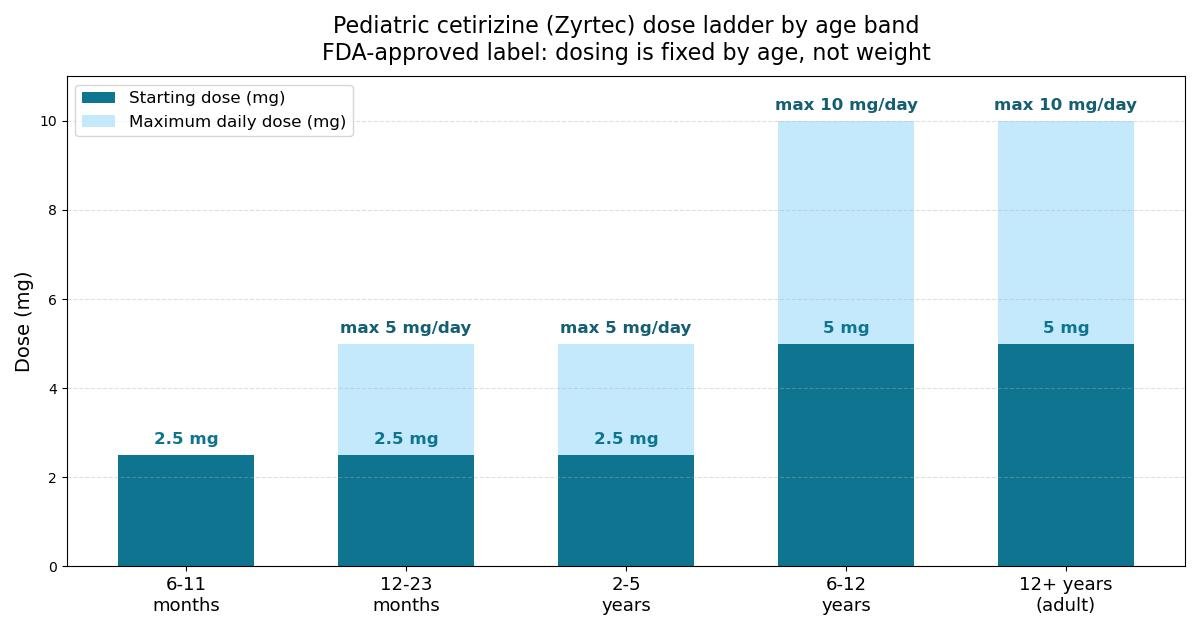
The single most important fact about cetirizine dosing is that it is fixed by age, not calculated from weight. The FDA label divides children into age bands and assigns each band a starting dose and a maximum daily dose. The table below reproduces those rules. Find your child's age band, start at the stated initial dose, and never exceed the maximum daily dose for that band.
| Age band | Starting dose | Maximum daily dose | Formulation and notes |
|---|---|---|---|
| Younger than 6 months | Not recommended. The label does not establish cetirizine dosing below 6 months of age. See the clinician instead. | ||
| 6 to 11 months | 2.5 mg (2.5 mL syrup) once daily | 2.5 mg per day | Syrup. The label gives one fixed dose for this band; do not increase it. |
| 12 to 23 months | 2.5 mg (2.5 mL syrup) once daily | 5 mg per day, given as 2.5 mg (2.5 mL) every 12 hours | Syrup is recommended for children under 2 years. Increase only if the prescriber directs. |
| 2 to 5 years | 2.5 mg (2.5 mL syrup) once daily | 5 mg per day: 5 mL syrup once daily, or 2.5 mL every 12 hours, or one 5 mg chewable tablet once daily | Syrup or 5 mg chewable. Increase only if the prescriber directs. |
| 6 to 12 years | 5 mg once daily | 10 mg per day | 5 mg or 10 mg tablet or chewable, or syrup. The label allows 5 or 10 mg depending on symptom severity; start at 5 mg and step up only if needed. |
| 12 years and older (adult dosing) | 5 or 10 mg once daily | 10 mg per day | 5 mg or 10 mg tablet. Most patients in the label's clinical trials started at 10 mg. |
Source: FDA-approved Zyrtec (cetirizine) prescribing information, Dosage and Administration section, and the cetirizine oral solution prescribing information for the 2-to-5-year and under-2-year bands.
A few details in the table deserve emphasis. First, the youngest band with an approved dose is 6 to 11 months, at 2.5 mg once daily, and the label offers no higher option there: 2.5 mg is both the starting and the maximum dose for that band. Second, the 12-to-23-month band is the first where the label permits an increase, up to 5 mg per day, but only as two divided 2.5 mg doses 12 hours apart, and only when the prescriber directs it. Third, the 2-to-5-year band reaches the same 5 mg daily ceiling, achievable as a single 5 mL syrup dose, two 2.5 mL doses, or one 5 mg chewable tablet. Fourth, children 6 to 12 years have the widest label range, 5 to 10 mg once daily, and the label explicitly ties the choice to symptom severity. The sensible reading, which the lookup above follows, is to start at 5 mg and move to 10 mg only if 5 mg does not control symptoms adequately.
Why cetirizine dosing is by age, not weight
Parents are used to children's medicines being dosed by weight. Antibiotics, fever reducers such as ibuprofen, and many other pediatric medicines follow a milligrams-per-kilogram rule, so it feels natural to weigh the child and scale the dose. With cetirizine, that instinct leads to a dosing error. The FDA label provides no weight-based formula for cetirizine at any pediatric age. The dose is determined entirely by which age band the child falls into.
This means a small 6-year-old and a large 6-year-old receive the same label dose: 5 mg once daily to start, with 10 mg per day as the ceiling. It also means a just-turned-2-year-old and an almost-6-year-old share the same 2.5 mg starting dose and 5 mg ceiling. The bands reflect how the medicine was studied and approved, and the approval data, not the child's weight, is what supports the dose. Do not invent a milligrams-per-kilogram conversion, and do not borrow one from another medicine. If a clinician individualizes the dose for a particular child, that is a medical judgment made with the full picture, not a calculation a caregiver should improvise.
The age-band design also explains why the youngest children get their dose as syrup. The label recommends the syrup for children under 2 years of age, because infants and toddlers cannot safely swallow tablets. As children grow into the 2-to-5-year band, the 5 mg chewable tablet becomes an option, and by 6 years the standard tablets join the list. The formulation changes with age for practical reasons of safe swallowing, while the milligrams follow the band rules above.
Starting dose versus maximum dose: more is not better
The label's ranges exist so that treatment can start low and increase only if symptoms demand it. In practice this means two different questions: what dose do you start with, and what is the most the child may receive in 24 hours. Confusing the two is the most common home dosing mistake with cetirizine. Starting with the maximum because symptoms are severe today is not what the label describes; the label describes starting at the initial dose and increasing only when the lower dose proves insufficient, under the prescriber's guidance.
Take the 6-to-12-year band as the worked example. The initial dose is 5 mg once daily, which is 5 mL of syrup or one 5 mg tablet or chewable. If 5 mg controls the sneezing and itching, that remains the dose. If it does not, the label permits stepping up to 10 mg once daily. Ten milligrams per day is the ceiling: no child in this band should receive more than 10 mg in 24 hours, because higher doses raise the chance of drowsiness and other effects without proportional benefit. The same logic applies to the younger bands on their smaller scales. For 12-to-23-month-olds, 2.5 mg once daily is the dose until a prescriber says otherwise; the 5 mg ceiling is reached only as two 2.5 mg doses spaced 12 hours apart, never as a single 5 mg dose, because the label specifies the divided schedule for that band.
Do not exceed the maximum daily dose for any band, and do not re-dose sooner than the label schedule allows. If the child's symptoms break through before the next dose is due, that is information for the prescriber, not a reason to add an extra dose. Persistent or worsening symptoms despite correct dosing can signal that the diagnosis needs review, which is covered in the red-flags section below.
How to measure the syrup correctly
Most home dosing errors with liquid medicines come from the measuring step, not the arithmetic, so it deserves careful attention. The standard cetirizine syrup contains 5 mg per 5 mL, which simplifies to 1 mg per mL. That makes the conversions easy: 2.5 mg is 2.5 mL, which is half a teaspoon, and 5 mg is 5 mL, which is one teaspoon. Before measuring anything, check the strength printed on your own bottle, because concentrations can vary between manufacturers, and this page's conversions assume the 5 mg per 5 mL strength.
Always measure with the oral syringe or dosing cup that comes with the medicine, and measure in milliliters. Kitchen teaspoons vary in size and are a classic source of under- or over-dosing, so they should not be used even though the label itself mentions teaspoon equivalents. Shake the bottle gently if the label directs it, draw up exactly the prescribed volume, and give it directly. The label states that cetirizine can be taken without regard to food, so the dose does not need to be timed around meals; pick a consistent time of day that is easy to remember, such as with breakfast or at bedtime.
Store the syrup as the label directs, generally at controlled room temperature, and keep all medicines, including cetirizine, out of children's reach. Check the expiry date before use, and do not use leftover syrup from a previous illness without confirming with the prescriber or pharmacist that the dose and the indication still apply.
Safety information: drowsiness, kidneys, liver, and interactions
Cetirizine's main advantage over older antihistamines is reduced sedation, but reduced does not mean absent. Somnolence, the medical term for drowsiness, is the most commonly reported adverse reaction in the label's clinical trials. In practice this means you should watch how your child responds to the first few doses before assuming full alertness: some children are unaffected, while others become noticeably sleepy. Be cautious with activities that need full attention, and be careful about combining cetirizine with other medicines that cause drowsiness, such as certain cough and cold products, unless the prescriber or pharmacist has reviewed the combination. Older children and teenagers should avoid alcohol while taking cetirizine, since the combination can worsen drowsiness.
Kidney and liver function change how cetirizine is handled by the body, and the label adjusts the dose accordingly. For adults and children 12 years and older with decreased renal function or hepatic impairment, the label recommends 5 mg once daily. Pediatric patients aged 6 to 11 years with impaired renal or hepatic function should use the lower recommended dose. For children under 6 years of age with impaired renal or hepatic function, the label states that use is not recommended, because there is no reliable pharmacokinetic or safety information for that group. This is a prescriber decision in every case: if your child has known kidney or liver problems, the prescriber must set the dose, and this lookup does not adjust for it.
Cetirizine is contraindicated in patients with known hypersensitivity to cetirizine or to any ingredient in the formulation. Signs of an allergic reaction to the medicine itself, such as rash, itching beyond the original symptoms, swelling of the face or lips, or difficulty breathing, require immediate medical attention. Overdose information in the label notes that in adults the main sign is extreme sleepiness, while in children restlessness and irritability may appear before drowsiness sets in. If you suspect an overdose, seek emergency care or contact your poison control centre immediately and bring the bottle so the dose can be verified.
When antihistamines are not enough: red flags
Cetirizine treats allergy symptoms and hives. It does not treat every condition that looks like an allergy, and knowing the boundary matters more than knowing the dose. The following situations call for prompt medical attention rather than another dose of antihistamine.
Seek emergency care for any sign of a severe allergic reaction: trouble breathing, wheezing, swelling of the lips, tongue, or face, throat tightness, dizziness, fainting, or a rapid pulse. Cetirizine does not treat anaphylaxis; epinephrine is the emergency treatment, and antihistamines are not a substitute. Hives accompanied by any breathing difficulty or swelling of the airway are an emergency, not a wait-and-see situation.
Contact your child's clinician promptly if symptoms persist despite correct dosing, if you find yourself wanting to exceed the maximum daily dose to get relief, or if the pattern of illness does not fit allergies: high or persistent fever, ear pain, thick colored nasal discharge with facial pain, or a cough that worsens instead of a clear allergy trigger. Colds and flu are viral, and antihistamines do not treat them; using cetirizine for a viral illness adds side-effect risk without benefit. Wheezing or asthma symptoms are not treated with antihistamines either. Finally, if allergy symptoms are frequent or year-round and keep requiring daily medicine, that is worth a dedicated clinician visit: identifying triggers, confirming the diagnosis, and discussing longer-term management options often helps more than indefinite daily dosing decided at home.
This page provides dosing information; it does not diagnose. If you are unsure whether your child's symptoms are allergies at all, the right step is a clinician visit, not a trial of cetirizine.
Key takeaways
- By age, not by weight.
- The label gives an initial dose of 2.5 mg (2.5 mL of the 5 mg/5 mL syrup) once daily for children 2 to 5 years.
- No.
- It can.
Frequently asked questions
Is cetirizine dosed by weight or by age in children?
By age, not by weight. The FDA-approved Zyrtec label sets pediatric cetirizine doses in fixed age bands (6-11 months, 12-23 months, 2-5 years, 6-12 years) and provides no milligrams-per-kilogram rule. A small child and a large child in the same age band receive the same label dose. Do not calculate a weight-based dose on your own; that is not how this medicine is approved to be dosed.
How much cetirizine can a 4-year-old take?
The label gives an initial dose of 2.5 mg (2.5 mL of the 5 mg/5 mL syrup) once daily for children 2 to 5 years. The dose can be increased to a maximum of 5 mg per day, given as 5 mL of syrup once daily, 2.5 mL every 12 hours, or one 5 mg chewable tablet once daily, under the prescriber's direction. Do not exceed 5 mg in 24 hours in this age band.
Can I give cetirizine to a baby younger than 6 months?
No. The FDA label does not recommend cetirizine for infants under 6 months of age, and it also states that use is not recommended in children under 6 years of age who have impaired renal or hepatic function. For allergy-like symptoms in a young infant, see the child's clinician instead of dosing at home.
Does cetirizine make children drowsy?
It can. Cetirizine is a second-generation antihistamine and is less sedating than older antihistamines such as diphenhydramine, but somnolence (drowsiness) is the most commonly reported adverse reaction in the label's clinical trials. Watch how your child responds to the first doses, and be cautious with activities needing full alertness and with other medicines that cause drowsiness.
How do I measure 2.5 mg of cetirizine syrup?
The standard cetirizine syrup contains 5 mg per 5 mL, which is 1 mg per mL, so 2.5 mg equals 2.5 mL (half a teaspoon). Measure with the oral syringe that comes with the medicine, not a kitchen spoon, and confirm the strength printed on your bottle, since concentrations can vary by manufacturer.
What should I do if my child gets too much cetirizine?
The label reports that in adults the main sign of overdose is extreme sleepiness, while in children restlessness and irritability may come before drowsiness. If you think your child has taken too much, contact your poison control centre or seek emergency care right away, and bring the bottle with you so the dose on the label can be checked.
Sources
- U.S. Food and Drug Administration prescribing information via Drugs.com. Zyrtec Tablets (cetirizine hydrochloride) package insert: dosage and administration by age band, dose adjustment for renal and hepatic impairment, warnings, and adverse reactions. Label (Drugs.com)
- U.S. Food and Drug Administration prescribing information via Drugs.com. Cetirizine hydrochloride package insert: oral solution 1 mg/mL pediatric dosing for children 2 to 5 years and 6 months to under 2 years, and overdose information. Label (Drugs.com)
References and further reading