Diphenhydramine Dosage Calculator for Children (Benadryl)
Weight-based pediatric diphenhydramine dosing from the FDA-approved label: 5 mg per kg per day, divided every 6 or 8 hours, with a 50 mg single-dose cap and a 300 mg daily maximum. Enter your child's weight, pick the interval and the liquid strength, and get the per-dose amount in mg and mL, the daily total, and the achieved mg per kg per day.
In short: Weight-based pediatric diphenhydramine dosing from the FDA-approved label: 5 mg per kg per day, divided every 6 or 8 hours, with a 50 mg single-dose cap and a 300 mg daily maximum. Enter your child's weight, pick the interval and the liquid strength, and get the per-dose amount in mg and mL, the daily total, and the achieved mg per kg per day. Use the calculator above, then read the guide below to interpret your result and its limitations.
What is diphenhydramine?
Diphenhydramine, sold under the brand name Benadryl and many store-brand equivalents, is a first-generation H1 antihistamine that has been in clinical use since the 1940s. It blocks histamine at H1 receptors, which relieves the classic allergy symptoms of hay fever and other upper respiratory allergies: runny nose, sneezing, itchy and watery eyes, and itching of the nose or throat. The label also lists temporary relief of runny nose and sneezing from the common cold. Because it crosses the blood-brain barrier readily, it has strong central nervous system effects that newer antihistamines were specifically designed to avoid.
That brain penetration is the reason diphenhydramine makes most people sleepy. Marked drowsiness may occur, and the label warns to avoid alcoholic drinks because alcohol, sedatives, and tranquilizers may increase drowsiness. It also warns to be careful when driving a motor vehicle or operating machinery. In children, however, the response can go the other way: the label states that excitability may occur, especially in children. This paradoxical reaction, where a child becomes restless, irritable, or hyperactive after a medicine expected to cause sleepiness, is a well-documented feature of first-generation antihistamines in pediatric patients. The overdose section of the label adds that stimulation after overdosage is particularly likely in children.
Diphenhydramine is available in many forms: liquid syrups and solutions, chewable tablets, capsules and tablets, topical creams, and injectable formulations for hospital use. For children, the liquid formulations are the most practical because they allow weight-based dosing in small increments. The standard children's oral solution contains 12.5 mg of diphenhydramine hydrochloride per 5 mL, which is 2.5 mg per mL, and a more concentrated 25 mg per 5 mL product also exists. Always confirm the strength printed on your own bottle before measuring, because concentrations vary between manufacturers and products. The Drug Facts panel on Children's Benadryl products tells users to use only the enclosed dosing cup specifically designed for the product, and not to use any other dosing device.
The 5 mg per kg per day regimen
Unlike some pediatric medicines that are dosed in fixed age bands, diphenhydramine is dosed by body weight, which makes the math straightforward but also makes accurate weighing and measuring essential. The prescription label states the pediatric rule directly: for pediatric patients other than premature infants and neonates, the dose is 5 mg per kg per 24 hours, or 150 mg per square meter per 24 hours, with a maximum daily dosage of 300 mg, divided into four doses. Divided into four doses means one dose every 6 hours, which is the standard interval in the prescription label.
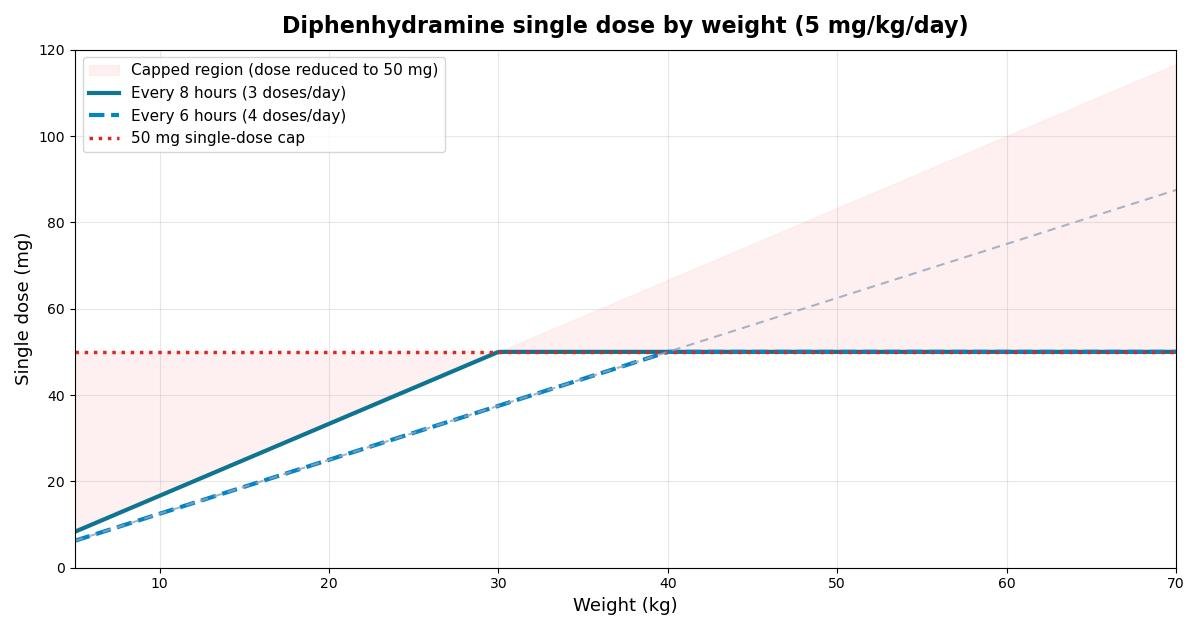
The over-the-counter label expresses the same idea in fixed doses. For children over 20 lb (about 9 kg), it gives 12.5 to 25 mg three to four times daily, and for physicians who want to calculate on the basis of body weight, it repeats the same 5 mg per kg per 24 hours figure. The two presentations agree: a 20 kg child given the weight-based rule at a 6-hourly interval receives 5 times 20 divided by 4, which is 25 mg per dose, and that matches the top of the over-the-counter 12.5 to 25 mg range. This calculator uses the weight-based rule with your choice of a 6-hourly interval (4 doses per day, as in the prescription label) or an 8-hourly interval (3 doses per day, matching the over-the-counter label's three to four times daily wording).
Two age gates from the over-the-counter Drug Facts panel matter before any calculation. Children under 2 years: do not use. Children 2 to 5 years: do not use unless directed by a doctor. The FDA has warned against antihistamine-containing cold and cough medicines in children under 2 years because of the risk of serious side effects, including a slowed heart rate. This calculator therefore refuses to compute a dose for a child under 2 years of age and displays a hard stop, and it shows a strong caution for the 2 to 5 year group, where the label requires a doctor's direction. The weight entry is accepted from 5 to 70 kg; weights outside that range are rejected because the label's pediatric dosing framework does not cover them, and a weight below 5 kg almost certainly means a very young infant who needs individual medical assessment rather than a calculator.
Single-dose cap versus daily cap
Two caps govern the calculation, and they engage at different weights. The single-dose cap is 50 mg. The adult label gives 25 to 50 mg as a single dose, and pediatric practice commonly holds single doses to 1 to 2 mg per kg with an absolute ceiling of 50 mg. The daily cap is 300 mg per 24 hours, stated in both the prescription and over-the-counter labels. The weight-based rule of 5 mg per kg per day means a child reaches the 300 mg daily ceiling at 60 kg, and reaches the 50 mg single-dose ceiling at 40 kg on a 6-hourly interval (5 times 40 divided by 4 equals 50).
Consider a 60 kg child on a 6-hourly interval. The raw calculation gives 5 times 60 divided by 4, which is 75 mg per dose. The 50 mg single-dose cap reduces this to 50 mg, and the calculator flags that the cap was applied. The raw daily total would have been 300 mg, which reaches the 300 mg daily maximum, so a second warning flags that the daily ceiling is reached. The dose actually given, 50 mg four times daily, totals 200 mg in 24 hours, which achieves 3.33 mg per kg per day, below the 5 mg per kg target. When caps engage, the calculator reports all of this openly: the raw calculated dose, the capped dose, the warnings, and the achieved mg per kg per day, so nothing is hidden from the person measuring the medicine.
Why not simply give more doses per day to reach 5 mg per kg in a heavier child? Because the label sets the boundaries. The over-the-counter label directs doses every 4 to 6 hours with no more than 6 doses in 24 hours, and the prescription label divides the daily amount into four doses. Exceeding the label's frequency or single-dose ceiling to chase the full 5 mg per kg in a heavier child is not this calculator's job. When a larger child's dose is capped, that is the moment to talk to the prescriber or pharmacist about whether diphenhydramine is still the right medicine, because newer, non-sedating antihistamines such as cetirizine or loratadine are often preferred for ongoing allergy symptoms. Our cetirizine dosage calculator and the loratadine pediatric information page cover those alternatives.
Sedation safety: why sleep use is discouraged
Diphenhydramine's most famous side effect is drowsiness, and for decades families have used it to help children fall asleep. The label answers that practice with an explicit prohibition: do not use it to make a child sleepy. That warning appears in the Drug Facts panel of Children's Benadryl oral solution, alongside the warning not to use the product with any other product containing diphenhydramine, even one used on skin, because the total exposure from multiple products adds up invisibly.
There are several reasons the label takes this stance. First, the sleep diphenhydramine produces is not normal sleep. First-generation antihistamines shorten sleep latency but alter sleep architecture, and tolerance to the sedative effect develops within days, which means escalating use for diminishing effect. Second, there is no safety data for using diphenhydramine as a nighttime sleep aid in children under 12 years of age; the label states that data are not available on that use in this age group. Third, the paradoxical reaction matters most here: a child given diphenhydramine at bedtime can become wired and restless instead of sleepy, which is the opposite of the intended outcome and distressing for the whole household.
Daytime sedation carries its own risks. A child who is drowsy from diphenhydramine is less alert at school and more prone to accidents during play and sport. The label's driving and machinery caution applies to adolescents as well. Children should also not combine diphenhydramine with other sedating medicines, and the label directs users to ask a doctor or pharmacist before use if the child is taking sedatives or tranquilizers. If a child's allergy symptoms are disturbing sleep night after night, that is a sign the allergy itself needs better control, not that more sedation is needed. Persistent symptoms are the point at which to see the clinician rather than reaching for the bottle again.
Measuring liquid correctly
Most diphenhydramine dosing errors in children are measurement errors, not calculation errors. The math may be perfect, but a kitchen teaspoon can hold anywhere from about 3 to 7 mL, so measuring with spoons can deliver half or double the intended dose. The label's instruction is specific: use only the enclosed dosing cup designed for the product, and do not use any other dosing device. An oral syringe with clear mL markings, the kind pharmacies dispense free with children's medicines, is equally precise and often easier to use for small volumes.
The conversion itself is simple division. The standard children's liquid holds 12.5 mg per 5 mL, which equals 2.5 mg per mL, so a 25 mg dose measures 10 mL. The concentrated 25 mg per 5 mL liquid holds 5 mg per mL, so the same 25 mg dose measures only 5 mL. Confusing the two strengths is a genuine hazard: pouring 10 mL of the concentrated liquid delivers 50 mg instead of 25 mg. That is why this calculator asks for the strength and why every family should check the number printed on their own bottle before every illness episode, since products change. This calculator rounds the liquid volume to the nearest 0.5 mL because most dosing cups and syringes are marked at that level of precision; it is better to measure 13.5 mL accurately than to guess at 13.33 mL on an unmarked cup.
A few practical points complete the routine. Shake the bottle well before each use, because suspensions settle and the first pour can be weaker or stronger than intended. Measure at eye level with the cup on a flat surface, or draw the volume into the syringe and check the meniscus. Give the dose and record the time, especially when more than one caregiver is involved, because a second dose given too soon is how daily maximums get exceeded. Never combine two diphenhydramine products at once, for example liquid by mouth plus an antihistamine cream on the skin, without checking total exposure. And keep the bottle out of reach of children; in case of overdose, the label directs families to get medical help or contact a Poison Control Center right away, even if there are no signs or symptoms yet.
When antihistamines are not enough
Diphenhydramine relieves histamine-driven symptoms, but many childhood presentations need something more or something different. Breathing difficulty, wheeze, swelling of the lips or tongue, a widespread rapidly spreading rash, or any sign of anaphylaxis is an emergency, and antihistamines are not emergency treatment for anaphylaxis. Epinephrine is. If a child has an epinephrine auto-injector prescribed, it comes first, and emergency services come next. Antihistamines have no role in replacing that sequence.
For ongoing allergic rhinitis, first-generation antihistamines like diphenhydramine are generally not first choice anymore. The sedation, short duration of action (four to six hours, which means middle-of-the-night redosing), and anticholinergic effects such as dry mouth and urinary difficulty make them a poor fit for daily control of hay fever. Second-generation antihistamines such as cetirizine and loratadine provide 24-hour relief with much less sedation, and intranasal corticosteroids are the most effective single treatment for persistent allergic rhinitis symptoms such as congestion. A child who needs diphenhydramine most days is a child whose allergy management should be reviewed by the clinician.
Diphenhydramine also has no useful role in the common cold beyond what the label states, and the FDA's warnings about antihistamine cold products in young children apply. Fever, ear pain, a cough that will not settle, symptoms lasting more than about ten days, or any child who looks seriously unwell should be assessed in person. Finally, keep an up-to-date list of everything the child takes, because diphenhydramine hides inside many combination cold, flu, cough, and sleep products under names like nighttime formulas and PM tablets. Accidental double dosing through two products with different brand names is one of the most common ways children exceed safe antihistamine amounts.
Dose by weight
Sources
- Diphenhydramine hydrochloride injection, DailyMed (U.S. National Library of Medicine): pediatric dosage 5 mg per kg per 24 hours or 150 mg per m2 per 24 hours, maximum daily dosage 300 mg, divided into four doses; overdose section notes stimulation particularly likely in pediatric patients. https://dailymed.nlm.nih.gov/dailymed/lookup.cfm?setid=3842d802-9b18-2c5e-e063-6394a90ae763&version=4
- Diphenhydramine hydrochloride capsules, DailyMed: children (over 20 lb) 12.5 to 25 mg three to four times daily, maximum daily dosage not to exceed 300 mg; weight-based alternative 5 mg per kg per 24 hours; no data on use as a nighttime sleep aid in children under 12 years. https://dailymed.nlm.nih.gov/dailymed/drugInfo.cfm?setid=75f0cde5-c419-416d-9c13-bfc03bd83b1d&audience=professional
- BENADRYL Allergy Oral Solution Drug Facts, DailyMed: active ingredient diphenhydramine HCl 12.5 mg per 5 mL; do not use to make a child sleepy; do not use with any other diphenhydramine product, even on skin; children under 2 years do not use; children 2 to 5 years do not use unless directed by a doctor; excitability may occur, especially in children; overdose guidance to contact a Poison Control Center right away. https://dailymed.nlm.nih.gov/dailymed/lookup.cfm?setid=224ba2a3-1a93-29c8-e063-6394a90a9bef&version=2
- Diphenhydramine monograph (AHFS Drug Information, via Drugs.com): pediatric acute allergic reactions, 5 mg per kg daily up to 300 mg daily divided in 4 doses; 1 to 2 mg per kg recommended by some experts; self-medication age bands and daily limits for oral use. https://www.drugs.com/monograph/diphenhydramine.html
Key takeaways
- The FDA-approved label recommends 5 mg per kg per 24 hours for children (other than premature infants and neonates), divided into doses given every 6 hours, with a maximum daily dosage of 300 mg.
- The adult single dose is 25 to 50 mg, and in pediatric practice a single dose is commonly kept at 1 to 2 mg per kg with an absolute ceiling of 50 mg per single dose.
- No.
- No.
Frequently asked questions
What is the pediatric dose of diphenhydramine by weight?
The FDA-approved label recommends 5 mg per kg per 24 hours for children (other than premature infants and neonates), divided into doses given every 6 hours, with a maximum daily dosage of 300 mg. For a 20 kg child, that is 25 mg per dose every 6 hours. The over-the-counter label also gives a practical oral range of 12.5 to 25 mg three to four times daily for children over 20 lb.
What is the maximum single dose of diphenhydramine for a child?
The adult single dose is 25 to 50 mg, and pediatric practice commonly keeps a single dose to 1 to 2 mg per kg with an absolute ceiling of 50 mg. When the weight-based calculation exceeds 50 mg, this calculator caps the dose at 50 mg, flags the cap, and rechecks the daily total against the 300 mg daily maximum.
Can children under 2 years old take diphenhydramine?
No. The Drug Facts label for Children's Benadryl oral solution states plainly: children under 2 years, do not use. Children aged 2 to 5 years should not use it unless directed by a doctor. The FDA warns against antihistamine-containing cold and cough medicines in children under 2 because of the risk of serious side effects, including a slowed heart rate.
Can I use diphenhydramine to make my child sleepy?
No. The label warns directly: do not use it to make a child sleepy. Marked drowsiness may occur as a side effect, but in children the opposite reaction is also possible, because excitability may occur, especially in children. Using a sedating antihistamine as a sleep aid in children is discouraged, and there are no safety data for sleep-aid use in children under 12.
How do I measure a liquid diphenhydramine dose in mL?
Divide the dose in mg by the strength of your syrup. The standard children's liquid contains 12.5 mg per 5 mL (2.5 mg per mL), while some products contain 25 mg per 5 mL (5 mg per mL). For example, a 25 mg dose is 10 mL of the 12.5 mg per 5 mL syrup. Always use the oral syringe or dosing cup that comes with the product, never a kitchen spoon, and check the strength printed on your bottle because concentrations vary.
What are signs of too much diphenhydramine in a child?
Overdose reactions can range from central nervous system depression to stimulation, and stimulation is particularly likely in pediatric patients. The label lists atropine-like signs: dry mouth, fixed dilated pupils, and flushing, along with gastrointestinal symptoms. In case of overdose, get medical help or contact a Poison Control Center right away, at 1-800-222-1222 in the United States, even if there are no signs or symptoms yet.