What loratadine is
Loratadine, sold under the brand name Claritin, is a second-generation antihistamine. Antihistamines work by blocking the H1 histamine receptor, which is the docking site through which histamine triggers the familiar allergy cascade: sneezing, a runny nose, itchy and watery eyes, and itching of the nose or throat. When loratadine occupies that receptor, histamine cannot, and the allergic response is blunted at its starting point.
The "second-generation" label matters because it describes the drug's behaviour in the body, not just its age. First-generation antihistamines such as diphenhydramine cross into the brain readily and bind receptors there, which is why they cause marked drowsiness. Loratadine crosses the blood-brain barrier much less, so at the doses on the label it is non-drowsy for most children. That is a "when taken as directed" property, though: the label warns that taking more than directed may cause drowsiness, which is why the 24-hour maximum on each age band is a real safety line rather than a suggestion.
Loratadine itself is partly converted in the liver to an active metabolite, descarboethoxyloratadine (better known as desloratadine), which also blocks H1 receptors and contributes to the long duration of action. A single daily dose provides about 24 hours of symptom relief, which is the entire basis of the once-daily dosing schedule. There is no need to split the dose across the day, and splitting it would break the label's once-daily instruction.
Why children take loratadine
Children take loratadine for the same two families of problems adults do. The first is allergic rhinitis, the doctor's term for hay fever and other upper respiratory allergies, which can be seasonal (pollen in spring and summer) or perennial (dust mites, pet dander, mould, present all year). The second is chronic idiopathic urticaria, meaning persistent hives with no identified trigger. The FDA-approved prescription labeling states loratadine is indicated for the relief of nasal and non-nasal symptoms of seasonal allergic rhinitis and for the treatment of chronic idiopathic urticaria in patients 2 years of age or older.
The over-the-counter Drug Facts label describes the uses in plain language: loratadine temporarily relieves the symptoms of hay fever or other upper respiratory allergies, namely runny nose, sneezing, itchy and watery eyes, and itching of the nose or throat. "Temporarily relieves" is honest wording worth noticing. Loratadine manages the symptoms while the child is exposed to the trigger; it does not cure the allergy, desensitize the immune system, or treat a cold, and the label does not position it as a cough-and-cold medicine. If the child's main problem is a blocked nose with thick discharge and fever rather than itchy, watery allergy symptoms, that is a different illness and a different conversation with the clinician.
The label's age-based dose ladder
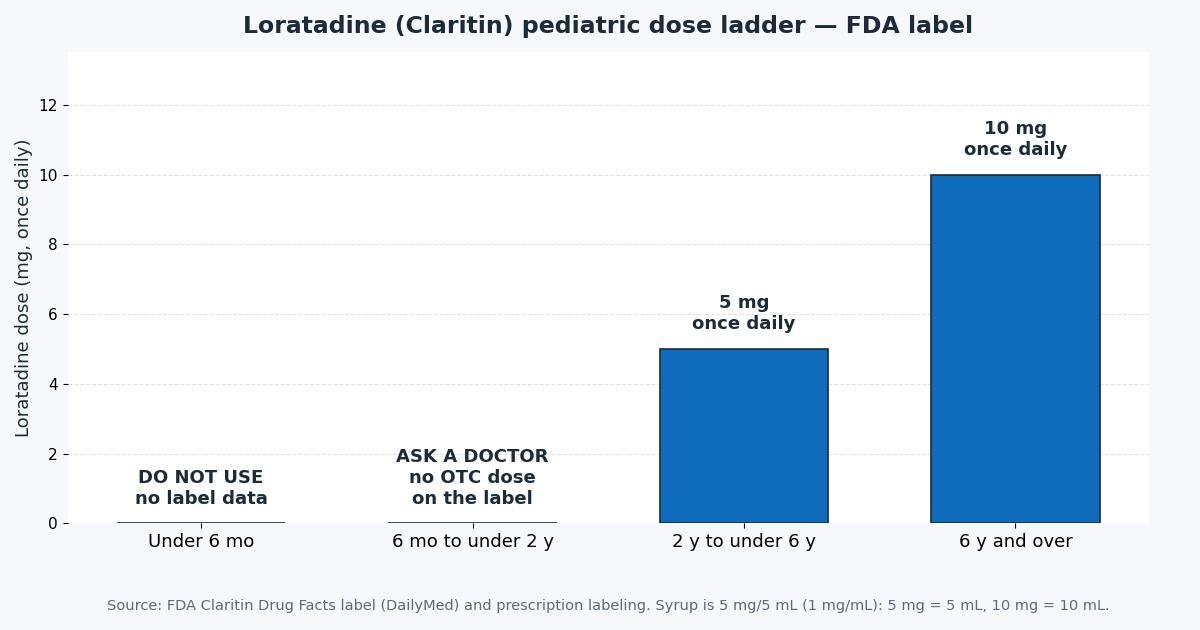
Unlike many pediatric medicines, loratadine is not dosed by weight. The FDA Claritin label doses it by age band, with three distinct situations: children under 2 years of age, children 2 to under 6 years of age, and adults and children 6 years of age and over. The bands exist because the dosing was studied and approved by age, so the label keeps it that way and the widget on this page follows the same structure.
| Age band | Dose (once daily) | Formulation options | 24-hour maximum |
|---|---|---|---|
| Under 2 years of age | No over-the-counter dose: ask a doctor | None on the OTC label | Not applicable |
| 2 to under 6 years | 5 mg once daily | 5 mL (1 teaspoonful) of syrup, or one 5 mg chewable tablet | 5 mg in 24 hours |
| 6 years and over | 10 mg once daily | 10 mL (2 teaspoonfuls) of syrup, or one 10 mg tablet or RediTab, or two 5 mg chewables | 10 mg in 24 hours |
The 5 mg dose for the middle band and the 10 mg dose for the older band are both hard ceilings in the label's wording: "not more than 1 teaspoonful in 24 hours" for the younger band and "not more than 2 teaspoonfuls in 24 hours" for the older one. Doubling a dose does not double the allergy relief; the label's drowsiness warning attaches precisely to exceeding the directed amount. Because the syrup and the chewables are both dosed in units that match the bands exactly (one teaspoonful of syrup is 5 mg, one chewable is 5 mg), the measuring step is forgiving as long as the right band is chosen first.
Children under 2: what the label actually says
This band deserves its own section because it is where most dosing mistakes and most internet charts go wrong. The current FDA Claritin label is explicit: for children under 2 years of age, the direction is "ask a doctor," and the dosing chart states "Do not give this medicine to a child younger than 2 years old." There is no over-the-counter loratadine dose for a baby or toddler under 2, and a parent should not extrapolate one by halving the 2-to-6 dose.
Why does the label draw the line at 2 years? Pediatric dosing approvals follow the ages actually studied in trials. Loratadine's prescription indication covers patients 2 years of age or older, and the over-the-counter label mirrors that boundary. A clinician who decides to use an antihistamine in a younger child weighs the child's exact age, weight, symptoms, and alternatives, and may choose a different drug entirely rather than an off-label loratadine dose. That individualized decision is exactly what "ask a doctor" means on the label: it is an instruction, not a suggestion.
For infants under 6 months specifically, the widget goes further than the label's "ask a doctor" and blocks the lookup outright. There is no established safety data for loratadine in newborns and young infants, and allergy symptoms in that age group are uncommon enough that the cause usually needs a clinician's eyes before any medicine is considered.
Formulations and how to measure the dose
Loratadine for children comes in three practical forms, and the label's bands map onto them cleanly. The syrup (Children's Claritin and generics) contains 5 mg of loratadine in every 5 mL, which is a concentration of 1 mg/mL. That means the 5 mg dose for ages 2 to under 6 is exactly 5 mL, and the 10 mg dose for ages 6 and over is exactly 10 mL. No arithmetic is needed, but the measuring device still matters: the label says to use only the enclosed dosing cup, and a pharmacist can provide an oral syringe if the cup is lost. Kitchen spoons vary in size and routinely deliver the wrong volume, so they are never an acceptable substitute.
The 5 mg chewable tablets are the second option. Children 2 to under 6 chew one tablet daily; children 6 and over chew two tablets daily. The label specifies chewing, not swallowing whole, and adds a detail that matters for a specific group: the chewables contain phenylalanine (1.4 mg per tablet), so children with phenylketonuria need that flagged to their clinician. The third option is the 10 mg tablet or the rapidly-disintegrating RediTab for children 6 and over. The RediTab is placed on the tongue, where it disintegrates rapidly, and can be taken with or without water.
Whichever form is used, two housekeeping rules from the label apply to all of them. First, confirm the concentration or strength on the actual package every time a new bottle or box is opened, because generic syrups and store brands can differ in how they express the strength even when the dose is the same. Second, store the product between 20 and 25 degrees Celsius (68 to 77 degrees Fahrenheit), keep the carton or blister sealed until use, and keep every form out of the reach of children, since the grape-flavoured syrup in particular is easy for a small child to mistake for a drink.
Liver or kidney disease
Loratadine is processed by the liver and its metabolites leave the body through the kidneys, so organ impairment changes how the drug is handled. The over-the-counter label handles this with a single, firm instruction: ask a doctor before use if the child has liver or kidney disease, because "your doctor should determine if you need a different dose." The widget on this page therefore never silently outputs a standard dose for this situation; it attaches the impairment note and directs the decision to the clinician.
What does the clinician actually do with that decision? The FDA-approved prescription labeling gives the reference starting points: for adults and children 6 years of age and over with hepatic failure or renal insufficiency (glomerular filtration rate under 30 mL per minute), the starting dose is 10 mg every other day; for children 2 to 5 years of age with the same conditions, the starting dose is 5 mg every other day. In other words, the impairment adjustment on the professional label stretches the interval rather than shrinking each dose, giving the body an extra day to clear the drug. The professional references also note that fixed-combination loratadine/pseudoephedrine products should generally not be used in hepatic impairment, which is one more reason the clinician, not the label alone, sets the plan.
Parents sometimes wonder whether a "mild" liver or kidney issue counts. It does for the purposes of this page: the label says "liver or kidney disease" without grading it, and the grading is the doctor's job. Bring the child's full medicine list to that conversation, because the same visit is the right time to review everything else the child takes.
Giving it: timing, missed doses, and what to expect
Loratadine is taken once daily, and the professional references state it can be taken without regard to food, so it fits wherever the family's routine has a reliable slot: breakfast, after school, or bedtime. Consistency matters more than the clock position, because the 24-hour coverage depends on one dose every 24 hours. If a dose is missed, the label's 24-hour maximum sets the rule: give the missed dose when remembered, keep it to one dose per day, and never give a double dose to catch up. A doubled dose is exactly the "more than directed" situation the label's drowsiness warning is written for.
Families should know what "working" looks like so they can judge the response honestly. Loratadine begins to relieve sneezing, runny nose, and itchy eyes within the first few hours of the dose, and the effect builds to steady 24-hour coverage. It reduces the histamine-driven symptoms; it does not shrink swollen nasal tissue the way a decongestant does, and it does not treat the underlying allergy. If symptoms do not improve after several days of correct once-daily dosing, or if they worsen, that is a reason to talk to the clinician rather than to increase the dose, because the label's answer to poor response is never "take more."
Side effects and when to seek care
At the labeled doses, loratadine is usually well tolerated, which is part of why it became the standard children's allergy medicine. In clinical trials in adults, the effects reported most often were headache, sleepiness, fatigue, and dry mouth, and they occurred at rates close to those seen with placebo, meaning many were background noise rather than drug effects. Children in the pediatric trials showed a similar pattern. The single most important safety sentence on the over-the-counter label is the dosing one: do not take more than directed, because taking more than directed may cause drowsiness.
The label lists a hard contraindication as well: do not use the product if the child has ever had an allergic reaction to it or to any of its ingredients. An allergy to the allergy medicine is rare but real, and the label's instruction is to stop use and ask a doctor if such a reaction occurs, seeking medical help right away. That is distinct from the drug simply not working; hives, swelling, or breathing difficulty after a dose are emergencies, not wait-and-see situations.
Overdose guidance on the label is brief and absolute: in case of overdose, get medical help or contact a Poison Control Center right away (1-800-222-1222 in the United States), even if the child seems fine. Symptoms of significant overdose reported with loratadine in adults have included sleepiness, rapid heartbeat, and headache, but the instruction does not wait for symptoms. The practical prevention is the same as for every medicine in the house: dose with the proper device, keep the 24-hour maximum in view, and store the bottle where children cannot reach it.
Interactions to tell the doctor about
Loratadine has a short, well-studied interaction list, and the label's own studies are reassuring: when loratadine was given with ketoconazole, erythromycin, or cimetidine, blood levels of loratadine rose, but no clinically significant changes in heart rhythm measurements were observed. That finding is on the label because those three drugs were specifically tested, not because the list is exhaustive. The standing rule still applies: the clinician should know every medicine the child takes, including over-the-counter products, vitamins, and herbal supplements, before loratadine is started.
Two practical interactions deserve a mention because they affect daily life rather than the prescription chart. First, although loratadine is non-drowsy at label doses, combining it with anything else that causes sedation can add up, so the clinician should know about sleep medicines, certain cough and cold products, and anti-anxiety medicines. Second, other antihistamines, including other allergy medicines and some sleep aids that contain diphenhydramine or doxylamine, should not be stacked on top of loratadine without direction; doubling up on the same drug class is another route to the "more than directed" territory the label warns about.
For families comparing children's allergy medicines on this site, the sibling guides cover the other common options: the cetirizine pediatric dosing guide (the drug behind the infant dose this page warns not to borrow) and the diphenhydramine pediatric dosing guide (the sedating first-generation option, dosed by weight rather than age).