What levetiracetam is and how it works
Levetiracetam, sold under the brand name Keppra, is an antiepileptic (anti-seizure) medicine used to reduce the frequency of seizures in epilepsy. It is one of the most widely prescribed seizure medicines in children because it is available as a liquid that can be measured precisely for small body weights, it has relatively few interactions with other antiepileptic drugs, and its dosing follows a simple, predictable ladder. Generic levetiracetam products contain the same active ingredient and follow the same FDA-approved dosing.
The prescribing information is candid about the science: the precise mechanism by which levetiracetam exerts its antiepileptic effect is unknown. What is known is that the drug binds to a specific site in brain tissue called synaptic vesicle protein 2A (SV2A), a protein involved in regulating how nerve cells release their chemical messengers. Experimental work shows that binding to SV2A correlates with the drug's antiseizure potency, but the full chain from binding to fewer seizures has not been mapped. For families, the practical point is simpler: the drug's effect is measured by seizure control, and the dose is adjusted until seizures are controlled at the lowest dose the child tolerates.
Levetiracetam comes as oral tablets (250 mg, 500 mg, 750 mg, and 1000 mg) and as an oral solution at 100 mg/mL, a clear grape-flavored liquid. An extended-release tablet (Keppra XR) exists for adults, but the pediatric weight-based dosing in the label uses the immediate-release tablets and the oral solution. The injectable form is a hospital product used only when oral dosing is temporarily not feasible, at the same total daily doses as the oral form.
Approved uses and the ages they start at
The FDA label approves levetiracetam as adjunctive therapy. Meaning added to the child's existing seizure treatment, not necessarily replacing it. For three seizure types, each with its own minimum age:
- Partial-onset seizures (seizures that begin in one area of the brain, with or without secondary generalization): patients 1 month of age and older. This is the indication with the detailed pediatric weight-based dosing, and it is what the calculator above is built around.
- Myoclonic seizures in juvenile myoclonic epilepsy: patients 12 years of age and older.
- Primary generalized tonic-clonic seizures in idiopathic generalized epilepsy: patients 6 years of age and older.
The label's dosing section for partial-onset seizures notes that the recommended dosing is the same for monotherapy and adjunctive therapy. Levetiracetam is not labeled for infants younger than 1 month; seizure treatment in neonates follows neonatal formularies under specialist care. The calculator enforces these age floors: it returns a named error for ages under 1 month and for indications chosen below their labeled minimum age.
How the pediatric dose is set: three age bands, not one
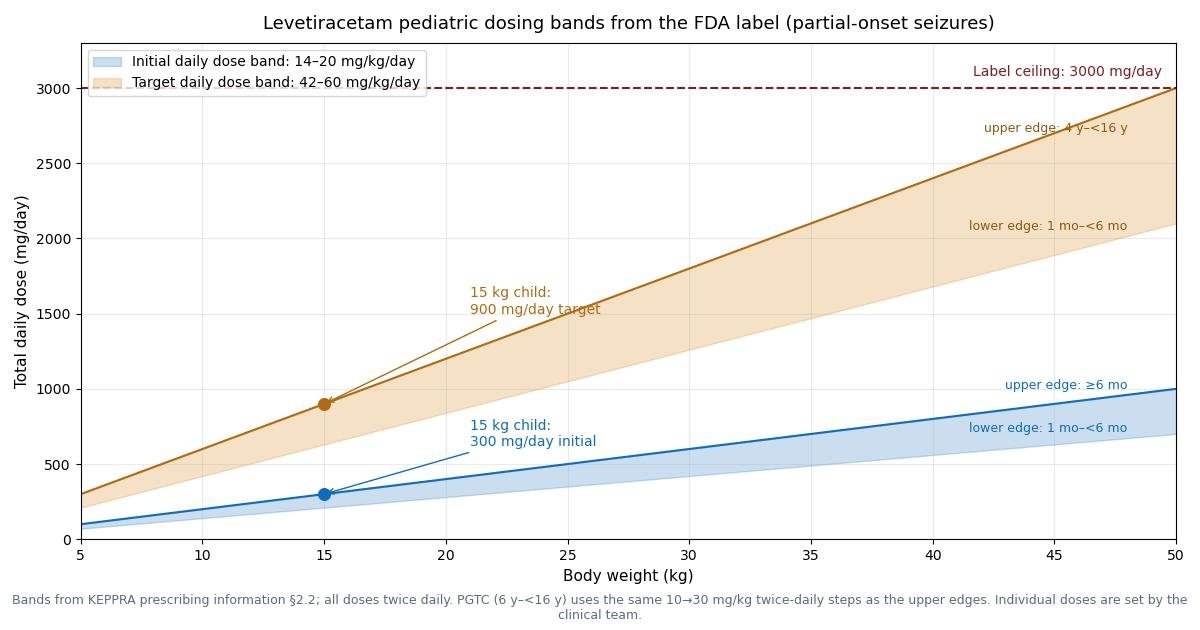
A common simplification says children take 10 mg/kg twice daily to start, rising to 30 mg/kg twice daily. The actual FDA label is more careful: it defines three age bands for partial-onset seizures, because infants clear and handle the drug differently from older children. Using the wrong band would under- or over-dose a baby, so the calculator selects the band from the exact age:
| Age band | Starting dose (twice daily) | Increase every 2 weeks by | Target dose (twice daily) |
|---|---|---|---|
| 1 month to < 6 months | 7 mg/kg | 7 mg/kg | 21 mg/kg (42 mg/kg/day) |
| 6 months to < 4 years | 10 mg/kg | 10 mg/kg | 25 mg/kg (50 mg/kg/day) |
| 4 years to < 16 years | 10 mg/kg | 10 mg/kg | 30 mg/kg (60 mg/kg/day) |
| Adults 16 years and older | 500 mg | 500 mg | 1500 mg (3000 mg/day) |
Two details in that table deserve attention. First, the youngest band starts lower and aims lower: a 4-month-old starts at 7 mg/kg twice daily and targets 21 mg/kg twice daily, not the 10 and 30 used for older children. In the label's clinical trial the mean daily dose actually achieved in this age group was 35 mg/kg/day, below the 42 mg/kg/day target. A reminder that the target is a ceiling to titrate toward, not a dose every child must reach. Second, for the 4-to-16-year band the label caps the total at 3000 mg per day, the same as the adult maximum; the calculator applies that cap automatically and says so in the result.
Titration: the every-two-weeks ladder
Levetiracetam is never started at the target dose. The label builds the dose in steps: start low, wait two weeks, and increase only if the current dose is tolerated and seizures are not yet controlled. Each increase uses the same per-kilogram step as the starting dose. 7 mg/kg twice daily for the youngest band, 10 mg/kg twice daily for the older bands, 500 mg twice daily for flat adult dosing. The two-week interval gives the drug time to reach steady levels and gives the family and clinician time to see both the seizure response and any side effects before the next step.
A concrete example makes the ladder tangible. Take a 15 kg five-year-old with partial-onset seizures (the 4-to-16-year band, target 30 mg/kg twice daily):
- Weeks 1 to 2: 150 mg twice daily (1.5 mL of 100 mg/mL solution)
- Weeks 3 to 4: 300 mg twice daily (3.0 mL)
- Week 5 onward: 450 mg twice daily (4.5 mL). The target dose, 900 mg per day
Titration is response-driven, not automatic. If seizures stop at 300 mg twice daily, there is no reason to climb to 450 mg; the label's goal is the lowest effective dose. Conversely, if the target dose cannot be tolerated, the label explicitly allows the dose to be reduced. The calculator's titration table shows the full ladder so families know what to expect, but every step up or down is a clinical decision.
Worked examples by weight
The table below applies the label's bands to common weights. Millilitres assume the standard 100 mg/mL oral solution, and doses are rounded to the nearest 10 mg (0.1 mL). The smallest volume a calibrated oral syringe measures reliably. Exactly as the calculator does. The 1-month-to-6-month band is shown separately because its per-kilogram numbers differ:
| Weight | Starting dose, 6 mo to <16 y (10 mg/kg BID) | Target, 6 mo to <4 y (25 mg/kg BID) | Target, 4 to <16 y (30 mg/kg BID) |
|---|---|---|---|
| 5 kg | 50 mg (0.5 mL) | 130 mg (1.3 mL) | 150 mg (1.5 mL) |
| 10 kg | 100 mg (1.0 mL) | 250 mg (2.5 mL) | 300 mg (3.0 mL) |
| 15 kg | 150 mg (1.5 mL) | 380 mg (3.8 mL) | 450 mg (4.5 mL) |
| 20 kg | 200 mg (2.0 mL) | 500 mg (5.0 mL) | 600 mg (6.0 mL) |
| 30 kg | 300 mg (3.0 mL) | 750 mg (7.5 mL) | 900 mg (9.0 mL) |
| 40 kg | 400 mg (4.0 mL) | 1000 mg (10.0 mL) | 1200 mg (12.0 mL) |
For the youngest band (1 month to < 6 months, 7 mg/kg starting and 21 mg/kg target twice daily): a 4 kg infant starts at 30 mg twice daily (0.3 mL) and targets 80 mg twice daily (0.8 mL); a 6 kg infant starts at 40 mg twice daily (0.4 mL) and targets 130 mg twice daily (1.3 mL). Because infants grow quickly, the prescriber recalculates the dose from the current weight at follow-up visits rather than reusing an old number.
The oral solution and the tablets: measuring correctly
Getting the liquid measurement right is where most home dosing errors happen, and the label is specific about how to avoid them. The oral solution contains 100 mg of levetiracetam per millilitre. The label directs that pediatric patients use weight-based dosing for the oral solution with a calibrated measuring device. An oral syringe marked in millilitres. And explicitly warns against using a household teaspoon or tablespoon, which can vary by 50 percent or more. Children with a body weight of 20 kg or less should use the oral solution rather than tablets, because tablet strengths are too coarse for small doses.
The tablets come in 250 mg, 500 mg, 750 mg, and 1000 mg strengths. The label is blunt about how they are taken: tablets should be swallowed whole and should not be chewed or crushed. Only whole tablets are administered, which is why the label gives a separate tablet schedule for children weighing 20 to 40 kg: start at 500 mg per day given as 250 mg twice daily, increase every two weeks by 500 mg per day, to a maximum of 1500 mg per day (750 mg twice daily). Families switching between the solution and tablets. For example, an older child who learns to swallow tablets. Should have the prescriber or pharmacist confirm the tablet dose, because the per-kilogram liquid dose rarely lands exactly on a whole-tablet amount. The calculator shows a whole-tablet combination only when the computed dose divides evenly into whole tablets and the child weighs over 20 kg.
Kidney function changes the plan
Levetiracetam is cleared from the body mainly by the kidneys, so when the kidneys work less well the drug stays in the body longer and the dose must come down. The FDA label handles this with a dedicated renal adjustment table. But it is written for adult patients, using creatinine clearance adjusted for body surface area (estimated with the Cockcroft-Gault formula from age, weight, and serum creatinine):
| Kidney function group | Creatinine clearance (mL/min/1.73 m²) | Label dosage | Frequency |
|---|---|---|---|
| Normal | > 80 | 500 to 1,500 mg | Every 12 hours |
| Mild impairment | 50 to 80 | 500 to 1,000 mg | Every 12 hours |
| Moderate impairment | 30 to 50 | 250 to 750 mg | Every 12 hours |
| Severe impairment | < 30 | 250 to 500 mg | Every 12 hours |
| End-stage renal disease, on dialysis | - | 500 to 1,000 mg | Every 24 hours, plus a 250 to 500 mg supplemental dose after each dialysis session |
Notice that the label gives ranges, not single doses: the prescriber selects within the band based on the patient's response. The calculator reproduces this honestly. For an adult with impaired kidney function it shows the matching band and range from the label's Table 1 rather than inventing a point dose.
For children, the label provides no renal bands at all and directs that dosing be individualized. That is a deliberate safety boundary, not an omission the calculator should fill in: a child's renal-adjusted dose depends on the degree of impairment, the underlying kidney condition, growth, and concomitant medicines. So when impaired kidney function is selected for a weight-based pediatric regimen, the calculator returns a named renal-caution gate instead of a number, and the dose is set by the clinical team with the clinical pharmacist. Families should make sure the neurology team knows about any kidney condition before the first dose.
Safety: what the label warns about
Levetiracetam is generally well tolerated, but the label's warnings section exists because real risks have been observed, and families should know them by name.
Behavioral and psychiatric effects. The label reports behavioral abnormalities including psychotic symptoms, suicidal ideation, irritability, and aggressive behavior, and directs that patients be monitored for psychiatric signs and symptoms. In pediatric trials the adverse reactions seen at least 5 percent more often with levetiracetam than with placebo included fatigue, aggression, nasal congestion, decreased appetite, and irritability. Parents often notice these before anyone else: a child who becomes unusually irritable, aggressive, anxious, or withdrawn after starting or increasing the drug should be reported to the prescriber promptly rather than waited out.
Suicidal thoughts and behavior. Like all antiepileptic drugs, levetiracetam carries the class warning to monitor for new or worsening depression, suicidal thoughts or behavior, and unusual changes in mood or behavior. The absolute risk is small, but the label treats it as a monitoring duty for every patient, and families should know to call immediately. Not at the next appointment. If such changes appear.
Sleepiness and fatigue. Somnolence and fatigue are among the most common effects (in adult trials: somnolence, asthenia, infection, and dizziness). The label advises monitoring for these symptoms and warns patients not to drive or operate machinery until they have enough experience with the drug to know how it affects them. For children this translates to watching school performance and alertness, especially in the first weeks and after each dose increase; the sleepiness often eases as the body adjusts.
Allergy and serious skin reactions. Levetiracetam is contraindicated in anyone with hypersensitivity to it; anaphylaxis and angioedema have been reported. Serious skin reactions including Stevens-Johnson syndrome and toxic epidermal necrolysis have also been reported. Any blistering or peeling rash, mouth sores, or swelling of the face or lips needs urgent medical care.
Blood counts. The label reports decreases in red blood cell counts, hemoglobin, and white blood cell and neutrophil counts in some patients, so the clinical team may check blood counts during treatment. Pregnancy: levetiracetam blood levels can fall during pregnancy and need close monitoring, and animal data suggest possible fetal harm. Anyone who is pregnant or planning pregnancy should discuss the plan with their neurologist and obstetrician rather than adjusting the dose alone.
Missed doses, overdose, and storage
If a dose is missed, the general guidance is to take it as soon as it is remembered. Unless it is almost time for the next dose, in which case the missed dose is skipped and the regular schedule resumes. A double dose is never taken to make up for a missed one. Because doses are twice daily, "almost time for the next dose" in practice means within a few hours of it; when in doubt, the pharmacist or prescriber's office can advise the same day.
Overdose experience with levetiracetam is limited but documented: the highest dose taken in the clinical development program was 6000 mg per day. Reported overdose effects include extreme drowsiness, agitation, aggression, depressed level of consciousness, respiratory depression, and coma. There is no specific antidote; emergency care is supportive, and hemodialysis can remove a substantial fraction of the drug. Any suspected overdose. Especially in a child. Means calling emergency services or poison control immediately and bringing the bottle.
Storage follows the label's handling instructions: keep the tablets and the oral solution at room temperature, protect from light and moisture, and keep all forms. Especially the sweet grape-flavored liquid. Out of the reach of children. Check expiry dates when a new bottle is opened, and do not use leftover solution from a long-completed course without the prescriber's direction.
When to call the doctor promptly
Beyond the warning signs above, families should contact the clinical team promptly if seizures increase in frequency or a new seizure type appears, if the child is excessively sleepy or difficult to wake, if behavioral changes interfere with school or family life, if a rash or signs of allergy develop, or if vomiting or illness prevents keeping the medicine down for more than a day. Routine follow-up matters too: weight, seizure diary, behavior, and sometimes blood levels or blood counts are reviewed at visits, and the dose is recalculated as the child grows. This page explains the label's numbers so families can follow the plan with confidence. It does not replace the prescribing clinician, who individualizes every dose.