What montelukast is and what it does
Montelukast, sold under the brand name Singulair, is a leukotriene receptor antagonist. Leukotrienes are inflammatory chemicals the body releases in asthma and allergic reactions; they narrow the airways, increase mucus, and drive swelling. By blocking the leukotriene receptor, montelukast reduces that airway inflammation. It is taken once daily by mouth and comes in three dosage forms: 10 mg film-coated tablets, 4 mg and 5 mg chewable tablets, and 4 mg oral granules in child-resistant foil packets. It received its initial US approval in 1998 and is now widely used in children, which is exactly why dosing by age, and the safety cautions that travel with it, need to be precise.
Montelukast is a controller medicine, not a reliever. It helps prevent symptoms over time; it does not open the airways during an acute asthma attack. The label is explicit on this point: montelukast is not indicated for the reversal of bronchospasm in acute asthma attacks, including status asthmaticus. A child on montelukast must still have appropriate rescue medication available, such as a short-acting inhaled beta-agonist, and therapy with montelukast can be continued during acute exacerbations.
The boxed warning: serious neuropsychiatric events
Every caregiver should know this before anything else about dosing. The FDA label for montelukast carries a boxed warning for serious neuropsychiatric events. These events were reported during postmarketing surveillance, were highly variable, and included, but were not limited to: agitation, aggressive behavior or hostility, anxiousness, depression, disorientation, disturbance in attention, dream abnormalities, dysphemia (stuttering), hallucinations, insomnia, irritability, memory impairment, obsessive-compulsive symptoms, restlessness, sleepwalking, suicidal thoughts and behavior (including suicide), tic, and tremor. These events were reported in adult, adolescent, and pediatric patients, with and without a previous history of psychiatric disorder. Most were reported during treatment, but some were reported after the medicine was stopped. Animal studies showed that montelukast distributes into the brain in rats, although the mechanisms underlying the reported events are currently not well understood, and it is difficult to identify risk factors or quantify the risk.
Because of this risk, the label directs a careful benefit-risk judgment. The benefits of montelukast may not outweigh the risks in some patients, particularly when the symptoms of disease are mild and adequately treated with alternative therapies. For allergic rhinitis specifically, the label says to reserve montelukast for patients who have had an inadequate response or intolerance to alternative therapies. For asthma and exercise-induced bronchoconstriction, the prescriber is directed to consider the benefits and risks before prescribing. When prescribing, the benefits and risks should be discussed with patients and caregivers, and caregivers should be alert for changes in behavior or new neuropsychiatric symptoms. If changes in behavior are observed, or if new neuropsychiatric symptoms or suicidal thoughts and/or behavior occur, the label advises patients to stop montelukast and contact a healthcare provider immediately. In many cases symptoms resolved after stopping, but in some cases they persisted after discontinuation, so monitoring and supportive care should continue until symptoms resolve.
Indications by age: what the label establishes
The label establishes four uses, each with its own minimum age, and these cut-offs matter because they shape what the dose ladder means at each age:
- Asthma: indicated for the prophylaxis and chronic treatment of asthma in adults and pediatric patients 12 months of age and older. Safety and effectiveness in children younger than 12 months with asthma have not been established.
- Exercise-induced bronchoconstriction (EIB): indicated for prevention of EIB in patients 6 years of age and older. Safety and effectiveness in patients younger than 6 years have not been established.
- Seasonal allergic rhinitis: indicated for relief of symptoms in patients 2 years of age and older. Not established under 2 years.
- Perennial allergic rhinitis: indicated for relief of symptoms in patients 6 months of age and older. Not established under 6 months.
This is why the youngest age band in the dose ladder, 6 to 11 months, carries a 4 mg granule dose that applies only to perennial allergic rhinitis: it is the only indication established at that age. A 9-month-old can receive 4 mg granules for year-round allergic rhinitis, but the label does not establish montelukast for asthma at that age, and the dose lookup widget flags exactly that distinction.
The dose ladder: montelukast is dosed by age, not weight
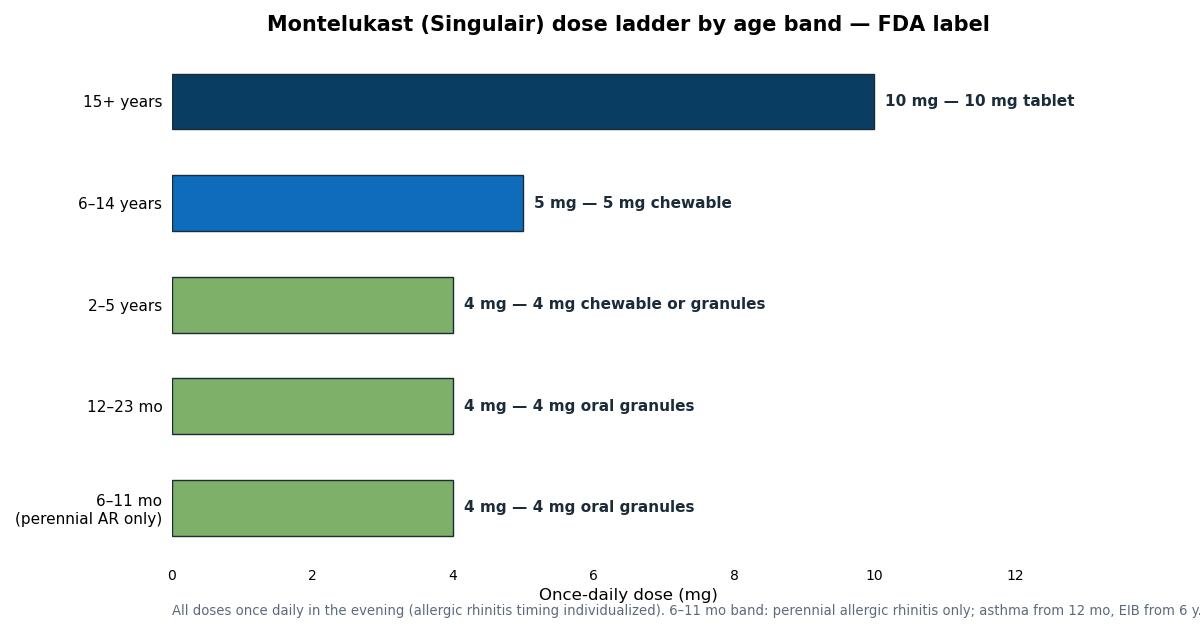
Unlike many pediatric medicines, montelukast is dosed by age band rather than milligrams per kilogram. The child takes one dose per day, and the dose steps up at fixed birthdays:
| Age | Dose | Form | Timing |
|---|---|---|---|
| 6 to 11 months | 4 mg once daily | One packet of 4 mg oral granules | Evening (asthma); individualized for allergic rhinitis |
| 12 to 23 months | 4 mg once daily | One packet of 4 mg oral granules | Once daily in the evening |
| 2 to 5 years | 4 mg once daily | One 4 mg chewable tablet or one packet of 4 mg oral granules | Once daily in the evening |
| 6 to 14 years | 5 mg once daily | One 5 mg chewable tablet | Once daily in the evening |
| 15 years and older | 10 mg once daily | One 10 mg tablet | Once daily in the evening |
A child moves to the next band on the birthday that starts it: the 6th birthday moves the child from 4 mg to 5 mg, and the 15th birthday moves the adolescent from 5 mg to 10 mg. There is no intermediate titration and no weight adjustment. If a dose is missed, the label says to take the next dose at the regular time and not to take two doses at the same time.
When to give it: evening for asthma, individualized for allergic rhinitis
For asthma, the label directs that montelukast be given once daily in the evening, with or without food. It notes that there have been no clinical trials comparing morning versus evening dosing for asthma; efficacy was demonstrated for evening dosing without regard to food. For allergic rhinitis, montelukast is given once daily without regard to food, and the time of administration can be individualized to suit the patient. In practice this means a child taking montelukast for asthma takes it in the evening, while a child taking it only for allergic rhinitis may take it at whatever time of day works consistently.
How to give the oral granules to a toddler
The granule formulation exists so that children too young to chew a tablet can take the medicine. The label's administration instructions are specific and worth following exactly:
- The 4 mg oral granules can be given directly into the mouth, dissolved in 1 teaspoonful (5 mL) of cold or room-temperature baby formula or breast milk, or mixed with a spoonful of cold or room-temperature soft food. Based on stability studies, only applesauce, carrots, rice, or ice cream should be used for mixing with food.
- Do not open the packet until ready to use. After opening, the full dose, with or without mixing, must be given within 15 minutes.
- If mixed with formula, breast milk, or food, the mixture must not be stored for future use. Discard any unused portion.
- The granules are not intended to be dissolved in any liquid other than baby formula or breast milk for administration, though liquids may be drunk afterwards. They can be given without regard to the time of meals.
The chewable tablets are pink and are distinguished by strength: the 4 mg chewable is oval, the 5 mg chewable is round. Children who can chew safely may take the 4 mg chewable from age 2; the granules remain an option through age 5.
Exercise-induced bronchoconstriction: single dose before exercise
For prevention of exercise-induced bronchoconstriction in patients 6 years of age and older, montelukast is used differently: as a single dose taken at least 2 hours before exercise. The labeled doses are one 10 mg tablet for patients 15 years and older and one 5 mg chewable tablet for patients 6 to 14 years. Three rules from the label govern this use: an additional dose should not be taken within 24 hours of a previous dose; patients already taking montelukast daily for another indication, including chronic asthma, should not take an additional dose to prevent EIB; and all patients should have a short-acting beta-agonist available for rescue. The label also notes that daily administration for chronic asthma has not been established to prevent acute episodes of EIB.
What montelukast is not for
Montelukast is not indicated for the treatment of an acute asthma attack. It will not relieve sudden wheezing or shortness of breath, and it must never replace a rescue inhaler. The label also warns against abrupt substitution: while the dose of inhaled corticosteroid may be reduced gradually under medical supervision, montelukast should not be abruptly substituted for inhaled or oral corticosteroids. Tapering steroids is a clinical decision made with the prescriber, not something to attempt because a new medicine has started.
Other precautions from the label
Phenylketonuria. Montelukast chewable tablets contain aspartame, a source of phenylalanine, which can be harmful to patients with phenylketonuria. Each 4 mg chewable tablet contains 0.674 mg of phenylalanine and each 5 mg chewable tablet contains 0.842 mg. The label directs that before prescribing to a patient with PKU, the prescriber should consider the combined daily amount of phenylalanine from all sources, including montelukast.
Aspirin sensitivity. Patients with known aspirin sensitivity should continue to avoid aspirin and non-steroidal anti-inflammatory drugs while taking montelukast. Although montelukast improves airway function in asthmatics with documented aspirin sensitivity, it has not been shown to blunt the bronchoconstrictor response to aspirin and other NSAIDs in those patients.
Eosinophilic conditions. Patients with asthma on montelukast may present with systemic eosinophilia, sometimes with clinical features of vasculitis consistent with Churg-Strauss syndrome, a condition often treated with systemic corticosteroids. These events have sometimes been associated with the reduction of oral corticosteroid therapy. Physicians are advised to be alert to eosinophilia, vasculitic rash, worsening pulmonary symptoms, cardiac complications, or neuropathy. A causal association between montelukast and these conditions has not been established.
Hypersensitivity. Montelukast is contraindicated in patients with hypersensitivity to any of its components.
Common side effects
In controlled clinical trials, the most common adverse reactions with montelukast, occurring at an incidence of 5 percent or more and greater than with placebo, were: upper respiratory infection, fever, headache, pharyngitis, cough, abdominal pain, diarrhea, otitis media, influenza, rhinorrhea, sinusitis, and otitis. As with any medicine, the clinical trial rates reflect trial conditions and may not match everyday experience. Any side effect that is severe, persistent, or worrying should be reported to the child's clinician, and any neuropsychiatric change, per the boxed warning, warrants stopping the medicine and seeking care immediately.
Practical tips for parents and caregivers
- Pick one consistent time. Evening dosing for asthma, as the label directs; for allergic rhinitis alone, any time that is easy to remember. Consistency matters more than the clock.
- Do not double up. A missed dose is skipped; the next dose is taken at the regular time.
- Watch behavior, not just breathing. The boxed warning exists because mood and behavior changes, sleep problems, and in rare cases suicidal thoughts have been reported. Agitation, vivid or disturbing dreams, new anxiety or sadness, or unusual irritability after starting montelukast are reasons to call the clinician promptly, even if the asthma or allergy symptoms are improving.
- Keep the rescue inhaler. Montelukast does not treat acute attacks. The rescue inhaler goes everywhere the child goes, including school and sports.
- Tell every clinician. The dentist, the emergency department, the new pediatrician: montelukast should be on the child's medication list, along with the reason and the dose.
- Store granule packets sealed. Do not open a packet until the moment of use, and never save a mixed dose for later.
Related pediatric dosing guides
Montelukast is often prescribed alongside reliever and controller medicines. Related label-based guides in this collection: Albuterol (Salbutamol) pediatric dosing for the rescue inhaler every child on montelukast should carry, Fluticasone pediatric dosing and Budesonide pediatric dosing for inhaled corticosteroid controllers, and Loratadine pediatric dosing for an alternative allergic rhinitis option to discuss with the clinician.