What morphine is
Morphine is a strong opioid painkiller, the reference drug against which most other opioids are measured. It belongs to a completely different drug family from the everyday pain relievers many families know: it is not a non-steroidal anti-inflammatory drug like ibuprofen, and it is not related to acetaminophen. While NSAIDs such as ibuprofen, covered in our ibuprofen pediatric dosing guide, reduce pain partly by calming inflammation, morphine works in the brain and spinal cord. It binds to mu-opioid receptors in the central nervous system, which dampens the transmission of pain signals and changes how pain is perceived.
That power comes with a matching level of risk. Morphine slows breathing, causes drowsiness, and can produce dependence even after a short course. In the United States it is a Schedule II controlled substance, the category reserved for drugs with a high potential for abuse. For children, the FDA label draws a tight box around its use: oral morphine sulfate solution is dosed for pediatric patients 2 years of age and older, only in specific concentrations, with a hard ceiling on the initial dose. Everything on this page follows those label boundaries exactly.
Morphine sulfate oral solution is supplied in three concentrations: 10 mg per 5 mL (2 mg/mL), 20 mg per 5 mL (4 mg/mL), and 100 mg per 5 mL (20 mg/mL). The concentrated 20 mg/mL solution is reserved for opioid-tolerant adults and must never be used in children. Only the 2 mg/mL and 4 mg/mL solutions are permitted for pediatric patients, and the label says this twice, in both the highlights and the dosage section, because confusing the bottles is one of the most dangerous medication errors in pediatric pain care.
When children receive morphine
Morphine is not a first-line medicine for everyday childhood pain. The FDA label positions opioid analgesics for pain severe enough to require an opioid and for which alternative treatments are inadequate. In pediatrics, that means situations such as significant post-surgical pain, severe pain from injury or burns, cancer-related pain, and pain crises in conditions such as sickle cell disease. Mild or moderate pain that responds to non-opioid medicines should not be treated with morphine, because the risks of respiratory depression, sedation, and dependence outweigh the benefit.
The label frames the whole dosing philosophy in one sentence: initiate treatment at the lowest dose necessary to achieve adequate analgesia, and titrate based on the individual patient's response. In plain language, the clinician starts small, watches the child's pain and breathing, and adjusts. There is no fixed dose for a given age or a given operation; weight sets the starting range, and the child's response sets the rest.
Because the label's pediatric dosing covers children 2 years and older, infants and young toddlers receive morphine only in settings where specialists can monitor them continuously, such as post-operative recovery or intensive care, and always with clinician-set doses. The lookup widget on this page enforces that boundary: it calculates oral doses only for children 24 months and older, IV doses only from 6 months onward, and nothing at all for neonates under 1 month.
Pediatric oral dosing
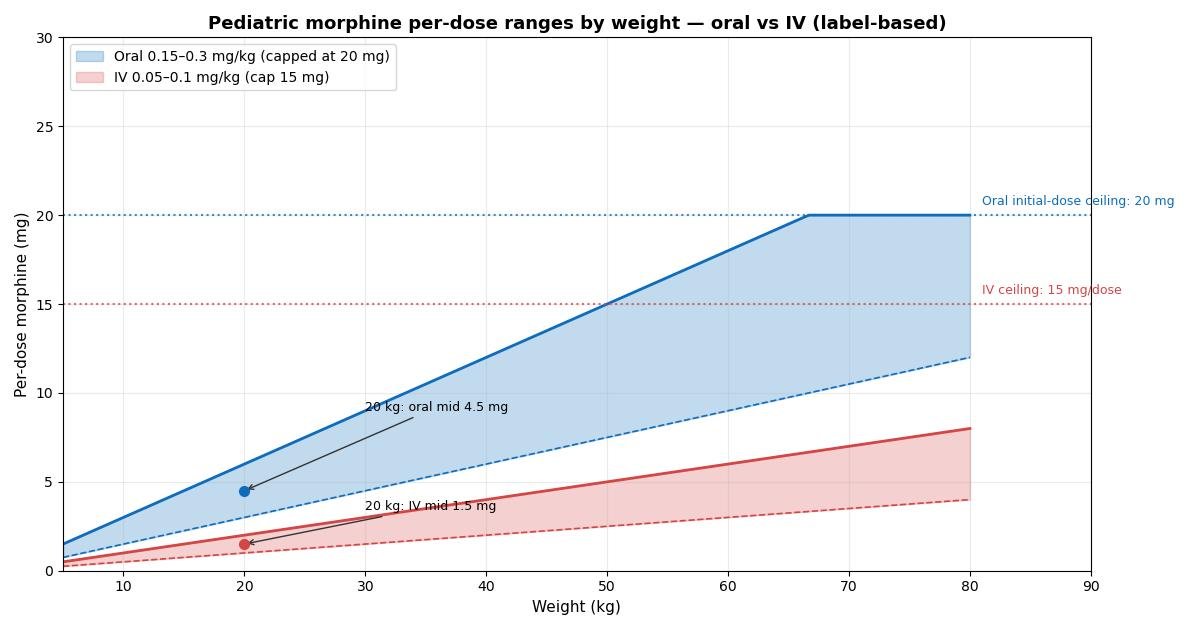
The FDA prescribing information for morphine sulfate oral solution states the pediatric rule in full. For pediatric patients 2 years of age and older: only use morphine sulfate oral solution 2 mg/mL and 4 mg/mL in pediatric patients. Initiate treatment with a dosing range of 0.15 mg/kg to 0.3 mg/kg every 4 hours as needed for pain, and at the lowest dose necessary to achieve adequate analgesia. Do not exceed 20 mg as an initial dose. The label then walks through a five-step calculation: multiply the child's actual body weight by a value in the 0.15 to 0.3 mg/kg range, convert the mg dose to millilitres using the chosen concentration, round the volume (under 1 mL to the nearest 0.1 mL; 1 mL or more to the nearest 0.2 mL), recompute the final mg dose from the rounded volume, and write both the mg and the mL on the prescription.
The label illustrates this with a worked example: an 11.4 kg child at 0.15 mg/kg gives 1.71 mg; dividing by the 2 mg/mL concentration gives 0.855 mL, which rounds to 0.9 mL; the final dose is 0.9 mL times 2 mg/mL, which is 1.8 mg. The widget on this page performs exactly this arithmetic, including the label's rounding step, so the lookup and the label example agree by construction.
Applied across common weights, the oral range produces the following reference values. Each row shows the low end (0.15 mg/kg), the mid-range dose (0.225 mg/kg), the high end (0.3 mg/kg), and the millilitres of the 2 mg/mL solution for the mid-range dose after the label's rounding. All values were generated from the same lookup code as the widget:
| Weight (kg) | Low (0.15 mg/kg) | Mid (0.225 mg/kg) | High (0.3 mg/kg) | mL of 2 mg/mL solution (mid dose) |
|---|---|---|---|---|
| 10 | 1.5 mg | 2.25 mg | 3 mg | 1.2 mL |
| 15 | 2.25 mg | 3.38 mg | 4.5 mg | 1.6 mL |
| 20 | 3 mg | 4.5 mg | 6 mg | 2.2 mL |
| 30 | 4.5 mg | 6.75 mg | 9 mg | 3.4 mL |
| 40 | 6 mg | 9 mg | 12 mg | 4.6 mL |
| 50 | 7.5 mg | 11.25 mg | 15 mg | 5.6 mL |
| 60 | 9 mg | 13.5 mg | 18 mg | 6.8 mL |
| 70 | 10.5 mg | 15.75 mg | 20 mg (capped) | 7.8 mL |
Notice how the 20 mg ceiling engages at higher weights: for a 70 kg adolescent, the high end of the range would be 21 mg, so the label cap cuts it back to 20 mg. That cap matches the adult starting dose, which the label sets at 10 to 20 mg every 4 hours; the label is effectively saying that no initial pediatric dose should exceed a standard adult starting dose. Titration above the starting range is a clinical decision, not a calculation to be done at home.
Measuring the oral solution correctly
Most morphine dosing errors in children are measurement errors, and the label devotes an unusual amount of space to preventing them. The first rule is the device: always use a calibrated oral syringe to measure the dose, and always confirm the concentration on the bottle before drawing it up. A household teaspoon varies from about 3 to 7 mL, so spoon-measuring a 1.2 mL dose could easily double it or halve it.
The second rule is the concentration. The three solutions look similar on a pharmacy shelf but differ enormously: 10 mg per 5 mL is 2 mg/mL, 20 mg per 5 mL is 4 mg/mL, and 100 mg per 5 mL is 20 mg/mL. Drawing the same volume from the 20 mg/mL bottle delivers ten times the intended dose. The label restricts pediatric use to the 2 mg/mL and 4 mg/mL solutions precisely because of this hazard, and caregivers should read the bottle every time a new bottle is opened.
The third rule is the label's rounding arithmetic. Volumes under 1 mL are rounded to the nearest 0.1 mL, and volumes of 1 mL or more to the nearest 0.2 mL, because oral syringes are marked in those increments. For a 20 kg child at the mid-range dose, 4.5 mg divided by 2 mg/mL is 2.25 mL, which rounds to 2.2 mL, and the final administered dose is 2.2 mL times 2 mg/mL, or 4.4 mg. The rounding is deliberate and safe: it keeps the dose within the range the prescriber intended while making the volume measurable. The prescription carries both numbers, mg and mL, so that the person administering the dose can verify one against the other.
Pediatric IV dosing
When a child needs rapid pain control, cannot keep down oral medicine, or is already receiving IV fluids after surgery, morphine is given by injection. The parenteral doses are smaller than the oral ones because injected morphine bypasses the gut and liver: roughly one-third of an oral dose reaches the bloodstream as active drug, while the full injected dose does.
Davis's Drug Guide gives the usual parenteral starting dose for adults and children under 50 kg as 0.05 to 0.2 mg/kg every 3 to 4 hours, with a maximum of 15 mg per dose. This guide uses the conservative lower half of that range, 0.05 to 0.1 mg/kg every 4 hours, which also matches the New Zealand data sheet's description of IV morphine being titrated with caution at 0.05 to 0.1 mg/kg in a closely monitored environment, given incrementally over 5 to 15 minutes. Independent clinical references agree at the same order of magnitude: Drugs.com's dosage guide lists 0.1 mg/kg IV every 4 to 6 hours for children 6 months and older under 45 kg, which sits at the top of our range.
Across the same weights, the IV reference values are:
| Weight (kg) | Low (0.05 mg/kg) | Mid (0.075 mg/kg) | High (0.1 mg/kg) |
|---|---|---|---|
| 10 | 0.5 mg | 0.75 mg | 1 mg |
| 15 | 0.75 mg | 1.13 mg | 1.5 mg |
| 20 | 1 mg | 1.5 mg | 2 mg |
| 30 | 1.5 mg | 2.25 mg | 3 mg |
| 40 | 2 mg | 3 mg | 4 mg |
| 50 | 2.5 mg | 3.75 mg | 5 mg |
IV morphine in children is a hospital procedure, not a home one. The label for parenteral use assumes that opioid antagonists, oxygen, and resuscitation equipment are available during and immediately after administration. The data sheet instruction to titrate slowly, over 5 to 15 minutes, exists because rapid injection raises peak drug levels in the brain quickly, which is what triggers the sudden respiratory depression that makes IV opioids dangerous. The widget's IV lookup is informational, for understanding what the hospital team is doing; no caregiver should ever inject morphine at home.
Babies, neonates, and the age gates
The youngest children are handled differently, and the label's silence about them is itself the guidance. The FDA oral morphine label gives pediatric dosing only for patients 2 years of age and older. For younger infants, the numbers come from neonatal formularies and drug references, and they are smaller and slower. Drugs.com's dosage guidance lists, for infants under 6 months not on a ventilator, an initial dose of 0.025 to 0.03 mg/kg IV, or 0.075 to 0.09 mg/kg orally, every 4 to 6 hours. Davis's Drug Guide lists 0.05 mg/kg every 4 to 8 hours for neonates, with a maximum dose of 0.1 mg/kg, using preservative-free formulations.
The reason is pharmacology, not caution for its own sake. Neonates clear morphine far more slowly than older children: the enzymes that metabolize the drug are immature, and the drug's half-life is markedly prolonged in the first weeks of life, so a dose that is modest for a toddler accumulates in a newborn. Intervals are therefore stretched, typically to every 4 to 8 hours or longer, and every dose is set by the neonatal team with continuous monitoring of breathing.
The widget reflects this by design. It refuses to calculate any dose for a child under 1 month, refuses oral calculations under 2 years, and refuses IV calculations under 6 months, each with a named explanation pointing to the clinical team. These are not limitations of the tool; they are the safest representation of the current references. Morphine is sometimes needed in very young infants, for example after surgery in the first days of life, but it is dosed there by specialists with monitoring, not by a lookup.
How morphine is given and titrated
The dosing interval is the same for both the oral and the IV range on this page: every 4 hours as needed for pain. "As needed" is load-bearing: morphine is given when pain is present, not on a fixed schedule regardless of pain, and the label's repeated instruction is to use the lowest dose necessary to achieve adequate analgesia. If a child's pain is controlled at the low end of the range, there is no reason to move toward the high end.
Titration means adjusting the dose to the balance between pain control and side effects. The clinical team increases the dose when pain persists and side effects are manageable, and holds or decreases it when the child is excessively sleepy, nauseated, or constipated. Because morphine's full effect on pain and breathing develops over minutes (IV) to about an hour (oral), doses are never stacked closer together than the interval allows. Giving a second dose early because the first "is not working yet" is how accidental overdoses happen.
Families should also know what the label says about duration. Morphine is intended for the period the pain requires it, and the prescribing team reassesses regularly. For children who have been on morphine for more than a few days, the team plans a taper rather than an abrupt stop, because sudden discontinuation in a physically dependent child causes withdrawal. The label is explicit that rapid discontinuation has resulted in serious withdrawal symptoms, uncontrolled pain, and suicide, so a gradual dose reduction over a schedule the clinician sets is the standard.
Overdose signs, naloxone, and what to do
Respiratory depression is the central danger of every opioid, and morphine is no exception. The label lists respiratory depression first among its warnings, and the FDA's current labels urge prescribers to discuss naloxone with the patient and caregiver, to assess each patient's need for access to it both when starting and when renewing treatment, and to consider prescribing it based on risk factors for overdose. Naloxone is an opioid antagonist: it temporarily reverses the respiratory depression while emergency care is on the way. It does not replace emergency care, and its effect wears off, so a child who improves after naloxone still needs to be seen urgently.
Overdose risk rises sharply in two situations. The first is dose confusion, especially between concentrations: the 20 mg/mL solution delivers ten times the dose of the 2 mg/mL solution for the same volume, which is why the label forbids its use in children. The second is combining morphine with other sedating medicines or alcohol. The label warns that concomitant use of opioids with benzodiazepines or other central nervous system depressants, including alcohol, may result in profound sedation, respiratory depression, coma, and death, and reserves such combinations for patients for whom alternative treatment options are inadequate. Sleep medicines, antihistamines that cause drowsiness, and anti-anxiety medicines all count.
Prevention is mostly logistics. Store morphine in its original labeled bottle, locked away and out of sight and reach of children; the label's counseling section stresses secure storage because accidental ingestion by a child or visitor can be deadly. Measure with the oral syringe every time. Keep naloxone where a responsible adult can find it quickly, and make sure more than one adult in the household knows the overdose signs and what to do.
Side effects and monitoring
The common effects of morphine in children are the same as in adults. Constipation is nearly universal with continued use, and the clinical team usually plans for it from the first dose with fluids, fiber, activity, and sometimes a prescribed laxative. Nausea and vomiting are common when treatment starts and often settle within a day or two. Drowsiness is expected after a dose and is useful information: a child who is comfortable and easily roused is in the right zone, while a child who cannot be woken needs urgent assessment.
Other effects families should know about include itching, sweating, dry mouth, dizziness on standing, and urinary retention, meaning difficulty passing urine. Urinary retention is worth reporting promptly rather than waiting, because a full bladder in a child who cannot void is painful and sometimes needs a catheter in hospital. Morphine can also lower blood pressure on standing, so older children should sit up slowly after a dose.
What the team monitors is driven by the label's warnings. Breathing rate and depth, level of alertness, and pain scores are checked after doses, especially after the first dose and after any increase. For children on morphine for more than a few days, the team watches bowel function, watches for signs of dependence as doses continue, and plans the taper. If morphine is used during pregnancy or around delivery, the label notes the risk of neonatal opioid withdrawal syndrome, which requires management by neonatal experts; this matters for adolescent patients as well.
Contraindications and interactions
The FDA label lists absolute contraindications, situations in which morphine must not be used. These are significant respiratory depression; acute or severe bronchial asthma in an unmonitored setting or without resuscitative equipment; concurrent use of monoamine oxidase inhibitors (MAOIs) or use of MAOIs within the last 14 days; known or suspected gastrointestinal obstruction, including paralytic ileus; and known hypersensitivity to morphine. Each has a mechanism: asthma and existing respiratory depression leave no margin if the drug slows breathing further; MAOIs can trigger dangerous interactions with opioids; an obstructed gut plus an opioid that slows gut motility risks worsening the obstruction.
The interaction that the label emphasizes most is with benzodiazepines and other central nervous system depressants, including alcohol: profound sedation, respiratory depression, coma, and death. Prescribers are told to reserve such combinations for patients with no adequate alternative and to limit dosages and durations to the minimum required. Other sedating medicines, including sleep aids, some antihistamines, and anti-anxiety medicines, stack the same risk and must be disclosed to the prescribing team.
Two more label points close the loop on safe use. First, healthcare providers are strongly encouraged to complete a REMS-compliant education program and to counsel patients and caregivers on the serious risks, safe use, and the importance of reading the Medication Guide with each prescription; families should expect that counseling and ask for it if it is not offered. Second, morphine can impair the mental and physical abilities needed for hazardous activities, which matters for adolescents: no driving, cycling in traffic, or operating machinery while taking it.
Safe storage and disposal
Storage rules for morphine are stricter than for most children's medicines because the consequences of a mistake are so severe. The label directs patients and caregivers to store the oral solution securely, out of sight and reach of children, in a location not accessible by others including visitors to the home, and to protect it from light and moisture at room temperature. A locked medicine box is the practical standard. Never transfer the solution to an unmarked container or a drinks bottle; the original labeled bottle is part of the safety system.
When morphine is no longer needed, dispose of it promptly rather than keeping leftovers "just in case." The label's counseling section advises that expired, unwanted, or unused morphine sulfate oral solution should be disposed of by flushing it down the toilet if a drug take-back option is not readily available, because the FDA lists it among medicines recommended for disposal by flushing: the risk of accidental ingestion or misuse of a leftover opioid outweighs the environmental concern. Take-back programs at pharmacies or law-enforcement collection points are the preferred route where available. Never give leftover morphine to another child or adult, even if their symptoms seem similar.
For more pediatric dosing references in the same format, see the Pediatric Dosage collection and the label-based furosemide pediatric dosing guide.