What mupirocin is
Mupirocin, sold under the brand name Bactroban, is an antibiotic that is applied to the body rather than swallowed. It was developed from the bacterium Pseudomonas fluorescens and works by blocking bacterial isoleucyl-tRNA synthetase, an enzyme bacteria need to assemble proteins. Without that enzyme, the bacteria cannot grow and multiply. Mupirocin is active against gram-positive organisms, and the FDA label specifically names the two it is approved to treat on the skin: Staphylococcus aureus (S. aureus) and Streptococcus pyogenes (S. pyogenes).
Because mupirocin is applied directly where it is needed, it acts locally with minimal absorption into the bloodstream in patients with intact skin. That local action is the reason it is a first-choice option for small, localized skin infections in children: the infection gets a high concentration of antibiotic at the site, while the rest of the body sees very little of the drug. Mupirocin is prescription-only in the United States, and the regimens below are taken directly from the FDA-approved labeling, verified against the current DailyMed entries.
Two products, never interchangeable
The single most important fact on this page is that "mupirocin" comes as two different products, and they must never be swapped. The comparison below sets them side by side; the sections that follow explain each one in detail.
| Product | Indication | Regimen (FDA label) | Labeled from |
|---|---|---|---|
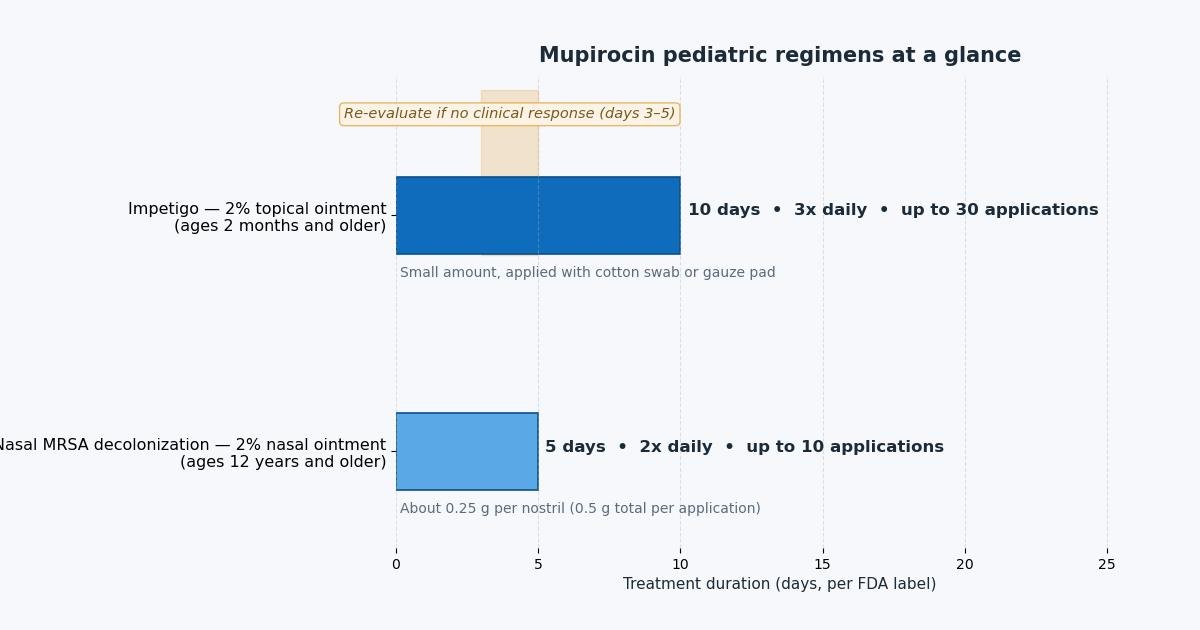
| Mupirocin 2% ointment (skin) | Impetigo due to susceptible S. aureus or S. pyogenes | Small amount to the affected area 3 times daily for up to 10 days; re-evaluate if no response in 3 to 5 days | 2 months of age |
| Mupirocin calcium 2% nasal ointment (nose only) | Nasal carriage of staphylococci including MRSA | Half of a single-use 1.0 g tube per nostril (about 0.25 g, 0.5 g total) twice daily for 5 days | 12 years of age |
The labels are explicit about the boundary. The ointment label states that mupirocin ointment is not for intranasal, ophthalmic, or other mucosal use. The nasal ointment is labeled for intranasal use only. A third related product, mupirocin 2% cream, is indicated for secondarily infected traumatic skin lesions, is labeled from 3 months of age, and is applied 3 times daily for 10 days; it is a separate prescription product and is not covered by the widget on this page.
Impetigo in children
Impetigo is a common, contagious bacterial skin infection of childhood, often called "school sores." It typically begins as small red sores or blisters, most often around the nose and mouth, which rupture and develop honey-colored crusts. The infection is caused by S. aureus, S. pyogenes, or both. Exactly the two organisms the mupirocin ointment label names. It spreads easily through skin-to-skin contact and shared towels or bedding, which is why it moves quickly through classrooms and households.
Most cases of limited impetigo are treated topically rather than with oral antibiotics. A topical antibiotic delivers the drug straight to the infected skin and avoids the systemic side effects of an oral course. The FDA label's impetigo indication is limited to infections due to susceptible isolates of S. aureus and S. pyogenes; infections that are extensive, deep, or not responding are a different clinical situation and are handled by the treating clinician, who may choose a systemic antibiotic instead.
The impetigo regimen, step by step
The FDA label's dosing section for the 2% ointment is short and exact. Apply a small amount of the ointment, with a cotton swab or gauze pad, to the affected area 3 times daily for up to 10 days. The treated area may be covered with a gauze dressing if desired. Patients not showing a clinical response within 3 to 5 days should be re-evaluated.
Two practical details sit inside that paragraph. First, the label specifies application with a cotton swab or gauze pad rather than a bare finger, which keeps the tube's contents clean and avoids introducing new bacteria into the ointment. Second, the "up to 10 days" wording is a ceiling, not a target: treatment stops when the infection has resolved and the clinician's instructions say to stop, and it never continues past 10 days without re-evaluation. The label also directs that the ointment not be applied concurrently with any other lotions, creams, or ointments, because other products can interfere with how the drug behaves at the application site.
The pediatric section of the label establishes safety and effectiveness of the ointment in the age range of 2 months to 16 years, supported by evidence from adequate and well-controlled trials of the ointment in impetigo in pediatric subjects studied as part of the pivotal clinical trials. That is the source of the widget's lower age gate: below 2 months of age, impetigo treatment is entirely a clinician decision.
The nasal decolonization regimen, step by step
Nasal decolonization is a different job from treating impetigo. Some people, including children being prepared for certain procedures or managed during institutional outbreaks, carry S. aureus. Including methicillin-resistant S. aureus (MRSA). Inside the nose without being sick. Reducing that nasal carriage lowers the risk of the bacteria causing or spreading infection. The nasal ointment's labeled indication is the reduction of nasal MRSA carriage.
The FDA label's nasal dosing is exact: for ages 12 years and older, approximately one-half of the ointment from the single-use tube goes into one nostril and the other half into the other nostril, twice daily (morning and evening) for 5 days. The label states that the single-use 1.0-gram tube delivers a total of approximately 0.5 grams of ointment, which is about 0.25 grams per nostril. After application, the nostrils are closed by pressing together and releasing the sides of the nose repetitively for approximately 1 minute, which spreads the ointment throughout the nares. The tube is discarded after use and is not reused.
Two limits in the label deserve emphasis. The safety and effectiveness of applications for longer than 5 days have not been established, and there are no data supporting chronic or off-label manners of use. And until further information is known, the nasal ointment should not be applied concurrently with any other intranasal products. The widget on this page blocks ages below 12 for this indication, because the label states that safety and effectiveness in children younger than 12 years have not been established.
Why the age gates exist
Age gates on a label are not guesses; they mark where evidence exists and where it does not. For the ointment, pediatric trials in impetigo covered ages 2 months to 16 years, so the label supports use from 2 months. For the nasal ointment, the dosing section addresses ages 12 and older, and the pediatric-use section states that safety in children younger than 12 years has not been established.
The nasal age gate has an additional pharmacokinetic reason. The label's clinical pharmacology discussion notes that, unlike in adults (where repeated intranasal application produced no evidence of systemic absorption), significant systemic absorption occurred following intranasal administration in neonates and premature infants. That finding is why intranasal mupirocin in young children is strictly a clinician decision with direct supervision, and why this page's widget refuses to return a regimen below age 12 for the nasal indication.
Parents sometimes ask whether a child just under a cutoff can "round up." The honest answer is that cutoffs in the label reflect the studied populations. A clinician who knows the child may have reasons to use a product outside the labeled age range, and that is their judgment call. It is not something a lookup widget or an information page can authorize.
What to expect, and when to seek care
For impetigo, the label's 3-to-5-day re-evaluation rule is the timeline that matters. A child whose sores are improving. Less redness, drying crusts, no new lesions. Is on the expected track. A child with no clinical response within 3 to 5 days should be re-evaluated, because the infection may be caused by a resistant organism, may need a different antibiotic, or may not be impetigo at all. Treatment is not extended past 10 days without that re-evaluation.
For nasal decolonization, the course is a fixed 5 days, and longer courses are not supported by the label. Families should also know the general warning signs that apply to any antibiotic course: spreading redness, increasing pain or swelling, fever, or any sign of an allergic reaction such as hives, swelling of the lips or face, or difficulty breathing. The label lists severe allergic reactions, including anaphylaxis, among the reported events with mupirocin formulations, and any such sign needs urgent medical attention.
Cautions, contraindications, and warnings
The contraindication is the same for both products: known hypersensitivity to mupirocin or to any of the formulation's excipients. A child who has previously had an allergic reaction to mupirocin should not receive either product.
The label's warnings for the ointment cover severe allergic reactions, eye irritation (it is not for ophthalmic use), local irritation, Clostridioides difficile-associated diarrhea, the potential for microbial overgrowth (prolonged use can allow non-susceptible organisms, including fungi, to overgrow), and the risk associated with mucosal use. One warning deserves special attention in children with kidney problems: the ointment is formulated in a water-miscible polyethylene glycol base, and polyethylene glycol can be absorbed from open wounds and damaged skin. The label directs caution. With monitoring. When the ointment is used in patients with moderate or severe renal impairment, particularly over large surface areas.
For the nasal ointment, the label adds that the effect of combining it with other intranasal products has not been studied, hence the direction not to mix them. Local nasal irritation was among the reported events in trials. As with the ointment, any sign of a severe allergic reaction needs immediate care.
Side effects with the reported rates
The label gives actual trial numbers, which are more useful than vague reassurance. For the ointment, the local adverse reactions reported in connection with use were burning, stinging, or pain in 1.5% of subjects and itching in 1% of subjects, with rash, nausea, erythema, dry skin, tenderness, swelling, contact dermatitis, and increased exudate each in less than 1% of subjects. Systemic allergic reactions, including anaphylaxis, urticaria, angioedema, and generalized rash, have been reported in patients treated with mupirocin formulations.
For the nasal ointment, the trials enrolled 210 domestic and 2,130 foreign adult subjects, and less than 1% in either group were withdrawn because of adverse events. The most frequently reported events in the foreign trials were rhinitis (1.0%), taste perversion (0.8%), and pharyngitis (0.5%). In the domestic trials, 17% (36 of 210) of treated adults reported adverse events thought to be at least possibly drug-related. These are adult trial figures, and the label does not establish separate pediatric rates. One more reason the age gates matter.
Missed doses, storage, and practical handling
The labels do not specify a missed-dose ritual for either product. The general principle is to apply the missed application when remembered and then continue the regular schedule; doses are never doubled to make up for a missed one, and the total course length is not extended beyond the labeled maximum (up to 10 days for the ointment, exactly 5 days for the nasal course) without clinician direction. If several applications are missed, or if the impetigo is not improving by day 3 to 5, the re-evaluation rule applies.
Storage follows the label: store at 20° to 25°C (68° to 77°F), the standard controlled room temperature range, and keep the products out of the reach of children. The nasal product comes as single-use 1.0-gram tubes. Once a tube has been used for its two nostril applications, it is discarded, not saved for the next dose; each of the 10 applications in the 5-day course uses a fresh tube.
Two interaction-style rules from the labels are worth repeating because families commonly break them without realizing. Do not apply the skin ointment at the same time as any other lotions, creams, or ointments on the same area. Do not use the nasal ointment together with any other intranasal products, such as saline sprays or steroid nose sprays, during the 5-day course, unless the clinician specifically directs otherwise.
When to call the doctor
Call the clinician promptly if the impetigo shows no improvement within 3 to 5 days, if it spreads rapidly, if the child develops fever, if the sores become deeply painful or swollen, or if new symptoms appear during treatment. For the nasal course, report persistent nosebleeds, severe nasal irritation, or any allergic symptoms. For both products, severe or bloody diarrhea at any point during or after the course needs medical attention because of the Clostridioides difficile warning. And any sign of an allergic reaction. Hives, facial or lip swelling, wheezing, or difficulty breathing. Needs emergency care.
Related pediatric guides
For other pediatric medication references on this site, see the cephalexin pediatric dosage calculator (an oral antibiotic also used for skin infections in children), the topical hydrocortisone pediatric guide (another skin-applied product with its own application rules), and the full pediatric dosage collection.