What penicillin V is
Penicillin V, sold as penicillin VK, Veetids, and generics, is a narrow-spectrum penicillin antibiotic. It belongs to the beta-lactam family: it binds to penicillin-binding proteins in the bacterial cell membrane and blocks the cross-linking of the cell wall, so growing bacteria cannot complete division and eventually lyse. What distinguishes penicillin V from the older penicillin G is acid stability. Penicillin V survives stomach acid, so it is well absorbed from the gastrointestinal tract and reaches effective blood levels after an oral dose, which is why it became the oral penicillin of choice for streptococcal infections. Peak blood levels are reached about 30 to 60 minutes after a dose, and absorption is not meaningfully affected by food.
Potency is expressed in two ways on the label. Each 250 mg of penicillin V is approximately equivalent to 400,000 penicillin V units, and each 500 mg to 800,000 units. Both milligrams and units describe the same drug; modern dosing almost always uses milligrams. The drug is supplied as the potassium salt, so the full name on prescriptions is penicillin V potassium, and the label doses refer to milligrams of penicillin V itself.
Why children receive penicillin V
Penicillin V is a first-choice antibiotic for several childhood infections caused by susceptible bacteria. Its main jobs in children are treating group A streptococcal pharyngitis and tonsillitis, treating mild to moderately severe pneumococcal respiratory infections including otitis media, and preventing rheumatic fever from coming back in children who have already had it. It is a narrow-spectrum drug, which is a deliberate advantage: it targets streptococci and pneumococci while disturbing the child's normal bacterial flora less than a broad-spectrum antibiotic would.
For strep throat, penicillin V remains the reference treatment because group A streptococcus has never developed meaningful resistance to penicillin, unlike many other antibiotics. That makes the narrow, old, cheap drug the right one. For ear infections, penicillin V is one of the options when the infection is known or suspected to be pneumococcal and mild, although amoxicillin is more commonly used first; the dosing guidance here follows the pediatric references for penicillin V specifically. For rheumatic fever prevention, penicillin V taken twice daily over months to years keeps streptococci out of the throat and protects the heart valves from further damage.
Streptococcal pharyngitis: the 27 kg cutoff
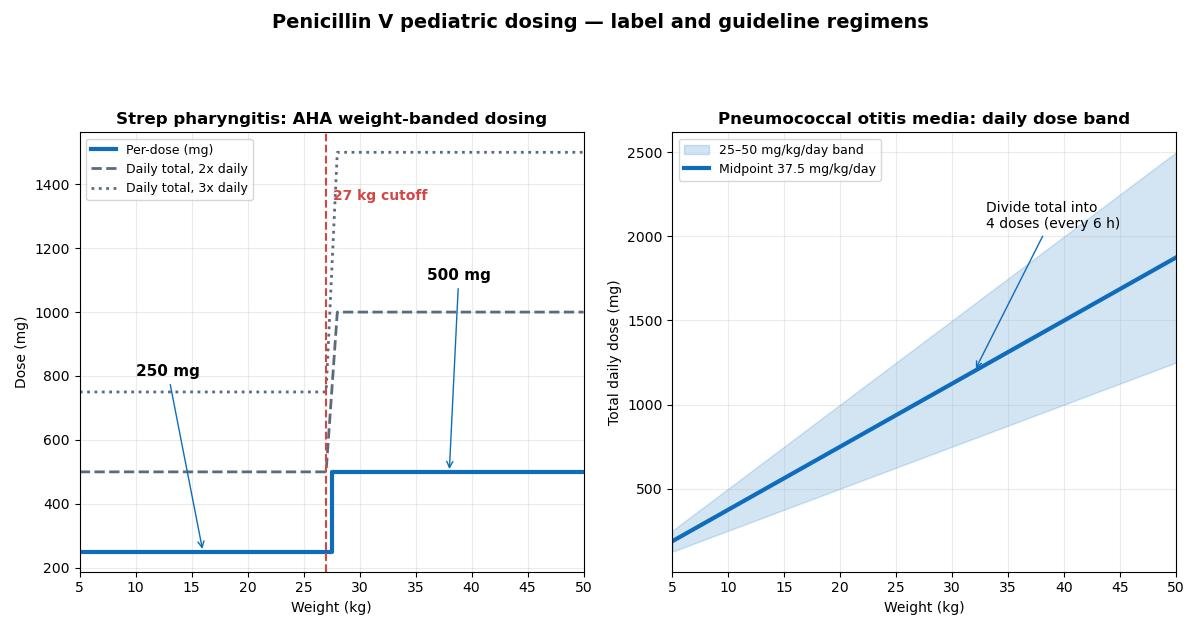
The most-used pediatric penicillin V regimen is for group A streptococcal pharyngitis and tonsillitis, and it is defined by a single weight cutoff from American Heart Association recommendations. Children weighing 27 kg (60 lb) or less receive 250 mg by mouth 2 or 3 times daily; children weighing more than 27 kg receive 500 mg by mouth 2 or 3 times daily; the course is 10 days in both cases. The 27 kg child, exactly at the cutoff, falls in the 250 mg band, because the AHA wording is "27 kg or less" versus "greater than 27 kg".
It is worth understanding why the dose is banded rather than calculated per kilogram. A smooth mg/kg rule would produce awkward doses like 312 mg that match no tablet and no convenient spoonful. The banded schedule keeps every dose at a practical size: 250 mg is one 250 mg tablet, 10 mL of the 125 mg/5 mL suspension, or 5 mL of the 250 mg/5 mL suspension; 500 mg is one 500 mg tablet, 20 mL of the 125 mg/5 mL suspension, or 10 mL of the 250 mg/5 mL suspension. The prescriber chooses between twice-daily and three-times-daily schedules; both are supported by the guidance, and twice-daily dosing often helps families complete the full course.
The FDA label's own streptococcal regimen, written for adults and children 12 years and over, is 125 to 250 mg every 6 to 8 hours for 10 days. The 27 kg banded schedule is the pediatric refinement from the AHA and the pediatric infectious disease guidelines, and it is what pediatricians actually prescribe. The Infectious Diseases Society of America guideline adds the adolescent detail: adolescents may receive 250 mg four times daily or 500 mg twice daily for 10 days. For chronic pharyngeal carriers of group A streptococcus treated in special circumstances, the IDSA describes 12.5 mg/kg four times daily for 10 days, up to a maximum of 2 g per day.
| Weight | Per-dose | Frequency | Daily total | Course | mL (125 mg/5 mL) | mL (250 mg/5 mL) |
|---|---|---|---|---|---|---|
| 15 kg | 250 mg | 2x daily | 500 mg | 10 days | 10 mL | 5 mL |
| 20 kg | 250 mg | 2x daily | 500 mg | 10 days | 10 mL | 5 mL |
| 27 kg | 250 mg | 2x daily | 500 mg | 10 days | 10 mL | 5 mL |
| 30 kg | 500 mg | 2x daily | 1000 mg | 10 days | 20 mL | 10 mL |
| 40 kg | 500 mg | 2x daily | 1000 mg | 10 days | 20 mL | 10 mL |
| 30 kg | 500 mg | 3x daily | 1500 mg | 10 days | 20 mL | 10 mL |
Why the course is 10 full days
The 10-day duration for strep throat is not arbitrary, and it is the part of the regimen families most often want to shorten, because the child usually feels better by day two or three. Feeling better means the throat symptoms have resolved; it does not mean the streptococcus has been eradicated. The 10-day course is what reliably clears group A streptococcus from the pharynx, and eradication is what prevents the delayed, dangerous complication of rheumatic fever, an immune reaction that can permanently damage the heart valves weeks after the sore throat is forgotten.
This is why the primary purpose of treating strep pharyngitis is stated in the guidance as prevention of rheumatic fever, with symptom relief almost a side benefit. Stopping at day four or five because the child feels well leaves surviving bacteria and the rheumatic fever protection incomplete. The full 10 days are finished exactly as prescribed, even if the child is back at school and eating normally. If doses are vomited or missed, the prescribing clinician should be told rather than the family improvising catch-up doses.
Pneumococcal otitis media: 25 to 50 mg/kg/day
For pneumococcal infections of the respiratory tract in children, including otitis media, pediatric references give a weight-based range rather than a banded dose: 25 to 50 mg/kg per day, divided into 4 doses given every 6 hours. The middle of that range, 37.5 mg/kg per day, is a practical anchor. For a 20 kg child the arithmetic is 20 x 37.5 = 750 mg per day, divided into 4 doses of 187.5 mg every 6 hours, which is about 7.5 mL per dose of the 125 mg/5 mL suspension or 3.8 mL of the 250 mg/5 mL suspension. The lookup widget above performs exactly this calculation, showing the full 25 to 50 mg/kg band alongside the midpoint.
The daily total is capped at 3 g per day in pediatric references. The course length follows the FDA label's pneumococcal rule, written for adults and older children as 250 to 500 mg every 6 hours until the patient has been afebrile for at least 2 days: treatment continues until the fever has been gone for a full two days, rather than for a fixed number of days. The ear should be re-examined if pain, fever, or discharge persists beyond 48 to 72 hours of treatment, because the organism may not be susceptible or the diagnosis may need revisiting. Children 12 years and over may receive the label's adult regimen of 250 to 500 mg every 6 hours until afebrile for at least 2 days.
| Weight | Low (25 mg/kg/day) | Mid (37.5 mg/kg/day) | High (50 mg/kg/day) | Mid per-dose (q6h) |
|---|---|---|---|---|
| 10 kg | 250 mg/day | 375 mg/day | 500 mg/day | 93.8 mg |
| 15 kg | 375 mg/day | 562.5 mg/day | 750 mg/day | 140.6 mg |
| 20 kg | 500 mg/day | 750 mg/day | 1000 mg/day | 187.5 mg |
| 25 kg | 625 mg/day | 937.5 mg/day | 1250 mg/day | 234.4 mg |
| 30 kg | 750 mg/day | 1125 mg/day | 1500 mg/day | 281.3 mg |
Rheumatic fever prophylaxis: 250 mg twice daily
Children who have had rheumatic fever need long-term protection against another streptococcal infection, because each recurrence can add damage to the heart valves. The FDA label gives the prophylaxis dose as 125 to 250 mg twice daily on a continuing basis, and pediatric practice standardizes this as 250 mg twice daily in children. That is 10 mL of the 125 mg/5 mL suspension or 5 mL of the 250 mg/5 mL suspension per dose, morning and evening, continued for months to years exactly as the cardiology or pediatric team directs.
Prophylaxis only works if it is actually taken, and the twice-daily schedule is chosen partly because it is easier to sustain over a long period than a four-times-daily one. Duration is individualized: it depends on the child's age, whether there is established heart valve disease, and how long it has been since the last episode. Stopping prophylaxis early without the cardiology team's agreement leaves the child unprotected, so this is never a decision made at home. The label also describes prophylaxis against bacterial endocarditis before dental or upper respiratory procedures: 1 g for children under 60 lb given 1 hour before the procedure, then 500 mg 6 hours later, although current cardiology guidelines have narrowed which heart conditions need this.
Suspension strengths and measuring millilitres
Penicillin V potassium for oral solution comes in two FDA-label strengths: powder that, once mixed by the pharmacy, gives 125 mg in every 5 mL, or 250 mg in every 5 mL. In mg-per-mL terms those are 25 mg/mL and 50 mg/mL. The conversion is simple division: millilitres equal the prescribed milligrams divided by the mg-per-mL concentration. A 250 mg dose is 250 / 25 = 10 mL of the weaker suspension or 250 / 50 = 5 mL of the stronger one; a 500 mg dose is 20 mL or 10 mL respectively.
Three practical rules keep liquid dosing safe. First, always read the concentration on the actual bottle, because the two strengths look similar and using the wrong one doubles or halves the dose. Second, measure with the oral syringe or dosing cup supplied with the medicine, never a kitchen spoon, and shake the bottle before each use. Third, store the mixed suspension in the refrigerator and discard any unused portion after 14 days; the label is explicit that the reconstituted solution must be refrigerated and the unused portion discarded after two weeks. The mixed 125 mg/5 mL suspension is red in color, which is normal.
Tablets and unit conversions
Penicillin V tablets come in 250 mg and 500 mg strengths, which map exactly onto the banded strep-pharyngitis doses: a child at or below 27 kg takes one 250 mg tablet per dose, and a child above 27 kg takes one 500 mg tablet per dose. Children who can swallow tablets reliably may prefer them to large suspension volumes; a 30 kg child on the 250 mg/5 mL suspension would otherwise drink 10 mL per dose, and on the 125 mg/5 mL suspension 20 mL, so the single 500 mg tablet is simpler.
Older prescriptions and some references express penicillin V in units rather than milligrams. The conversion is fixed: 250 mg of penicillin V equals approximately 400,000 units, and 500 mg equals approximately 800,000 units. The relationship is linear, so 125 mg is about 200,000 units. Modern pediatric prescribing uses milligrams, and the widget and tables on this page do the same.
Giving the medicine: food, timing, and missed doses
Penicillin V is well absorbed and its absorption is not meaningfully affected by food; blood levels may be slightly higher when it is given on an empty stomach, so families can give it with or without meals and simply pick a routine the child will stick to. What matters most is spacing: twice-daily doses roughly 12 hours apart, three-times-daily doses roughly 8 hours apart, and four-times-daily (q6h) doses roughly 6 hours apart, keeping the intervals as even as the day allows.
If a dose is missed, give it as soon as it is remembered unless it is nearly time for the next dose; in that case skip the missed one and continue the schedule. Never double up two doses to catch up. If the child vomits shortly after a dose, the prescribing clinician or pharmacist should be asked whether to repeat it. A full 10-day strep course interrupted by missed doses should be discussed with the clinician, because the protection against rheumatic fever depends on completing the course, not just on starting it.
Safety: allergy is the main concern
A careful allergy history comes before the first dose, every time. Families should know the difference between a true allergy and an intolerance: a rash, hives, swelling, or breathing difficulty after penicillin is an allergy and must be reported and recorded; mild nausea or loose stools are common, non-allergic effects of the antibiotic. A child who once had a severe reaction should wear or carry allergy identification, and the allergy should be flagged in every medical record.
The common adverse effects of oral penicillin V are gastrointestinal: nausea, vomiting, abdominal cramps, and diarrhea. Thrush or yeast infection of the mouth and a sore mouth or tongue can occur because the antibiotic disturbs normal flora. Severe, watery, or bloody diarrhea during or after the course deserves prompt medical attention, as it can signal a more serious intestinal complication. High doses of parenteral penicillin have been associated with blood and kidney effects, which is one reason doses stay within the label ranges. As with every medicine on this site, this page is informational: it explains what the label and guidelines say so families can follow the care plan with confidence, but it does not replace the prescribing clinician.
When penicillin V is the wrong choice
Penicillin V treats bacterial infections; it does nothing for viral illnesses, and most childhood sore throats and colds are viral. A rapid strep test or throat culture is what separates a strep throat that needs the 10-day course from a viral sore throat that needs only rest and fluids. Giving antibiotics for viral infections does not speed recovery and contributes to resistance.
Penicillin V is also not the drug for infections caused by organisms that make penicillinase, the enzyme that destroys penicillin, which includes many staphylococci; the label notes that culture and sensitivity testing should guide treatment of staphylococcal skin infections. Children with infectious mononucleosis (glandular fever) should not receive penicillin V or amoxicillin, because a widespread rash commonly follows. Finally, penicillin V is inappropriate for any child with a documented penicillin allergy, for whom guideline-directed alternatives exist and are chosen by the clinician. Related pediatric dosing guides in this collection include the amoxicillin dosage calculator, the amoxicillin-clavulanate dosage calculator, the azithromycin dosage calculator, the cephalexin dosage calculator, and the cefdinir dosage calculator.
What the widget does and does not do
The lookup widget at the top of this page is a deterministic calculator: it applies the same fixed rules every time, with no rounding surprises and no hidden adjustments. For streptococcal pharyngitis it applies the 27 kg cutoff (250 mg at or below 27 kg, 500 mg above), multiplies by the chosen twice- or three-times-daily frequency, and converts to millilitres from the selected suspension strength. For otitis media it computes the 25 to 50 mg/kg/day band, shows the midpoint that clinicians commonly anchor on, divides by 4 for the every-6-hour dose, and converts to millilitres. For rheumatic fever prophylaxis it returns the fixed 250 mg twice-daily dose with its millilitre equivalents.
What it does not do is diagnose, choose the indication, or replace the prescriber. It does not adjust for kidney function, concurrent medicines, allergy history, or the severity of the infection, and its weight range is capped at 50 kg, beyond which dosing is entirely a clinical decision. Use it to understand the prescription you have been given and to double-check a millilitre volume before measuring, and always follow the clinician's instructions when they differ from anything on this page.