Salmeterol (Serevent Diskus) Pediatric Dose Lookup and Parent Guide
In short: Pediatric salmeterol (Serevent Diskus) dose lookup verified against the FDA label: 50 mcg twice daily for ages 4+, exercise dose 30 minutes before sport, and why it must never be used alone. Free, with worked examples and FAQs. Use the calculator above, then read the guide below to interpret your result and its limitations.
Dose lookup for inhaled salmeterol in children, verified against the current FDA label on 2026-10-05 (SEREVENT DISKUS, revised 10/2022). Covers asthma maintenance, exercise-induced bronchospasm prevention, and the safety rules that make this drug different from a rescue inhaler. Medically reviewed by Dr. Taimoor Asghar.
Look up the label dose for your child's age
Enter the child's age and the reason salmeterol is being used. This returns the regimen from the FDA label, nothing more.
This lookup is a reference for understanding a prescription, not a tool for self-dosing. Dosing decisions for your child are made by the prescribing clinician.
Why salmeterol is not a reliever
Parents meeting salmeterol for the first time often assume it works like the familiar short-acting reliever inhaler, because both are beta2-agonists. They are in the same family but they play opposite roles. The reliever (albuterol/salbutamol) is the medicine that eases an attack within minutes. Salmeterol is a long-acting bronchodilator, a controller: it keeps the airways open over roughly 12 hours when used twice daily, which is why the label spaces the two inhalations about 12 hours apart. It is never a substitute for the rescue inhaler, and the label states plainly that it is not indicated for the relief of acute bronchospasm. The widget above reflects this distinction: the "having breathing trouble right now" option returns a do-not-use answer on purpose, with instructions to reach for the rescue inhaler instead.
The second thing that sets salmeterol apart is the company it must keep. Most controller medicines work alone; salmeterol for asthma works only alongside an inhaled corticosteroid (ICS). The ICS treats the underlying airway inflammation, while salmeterol holds the airways open. The label goes further than recommending this pairing: asthma treatment without concomitant ICS is listed as a contraindication, and salmeterol is reserved for patients who are currently taking but inadequately controlled on an ICS. A child whose asthma is well controlled on a low or medium dose of ICS alone should not have salmeterol added at all.
The label's age rule, and a correction worth noting
The dosing section of the FDA label gives one rule, not an age ladder: for bronchodilatation and prevention of asthma symptoms, including nocturnal asthma symptoms, the usual dosage for adults and children aged 4 years and older is 1 inhalation (50 mcg) twice daily, approximately 12 hours apart. There is no separate band for children aged 4 to 11 and another for adolescents; the dose is identical across the board. Safety and effectiveness below age 4 have not been established, so the age gate in the widget (4 years) is the label's own boundary, not a choice we made.
This matters because an earlier draft of this page described asthma dosing as two bands (4 to 11 years, then 12 years and up) with 50 mcg twice daily in both. That description gave the right dose but the wrong impression that the label thinks in age bands. The 4-to-11 band does exist on the label, but only in the trial data: in two randomized studies of children aged 4 to 11 with exercise-induced bronchospasm, a single 50 mcg dose prevented bronchospasm when taken 30 minutes before exercise, with protection lasting up to 11.5 hours in repeat testing. Similarly, the 12-week pediatric efficacy trials enrolled 211 pediatric subjects. So age bands describe the trial populations and how long protection lasts, never a different dose. We kept this correction on the page so that anyone comparing sources sees exactly where the numbers come from.
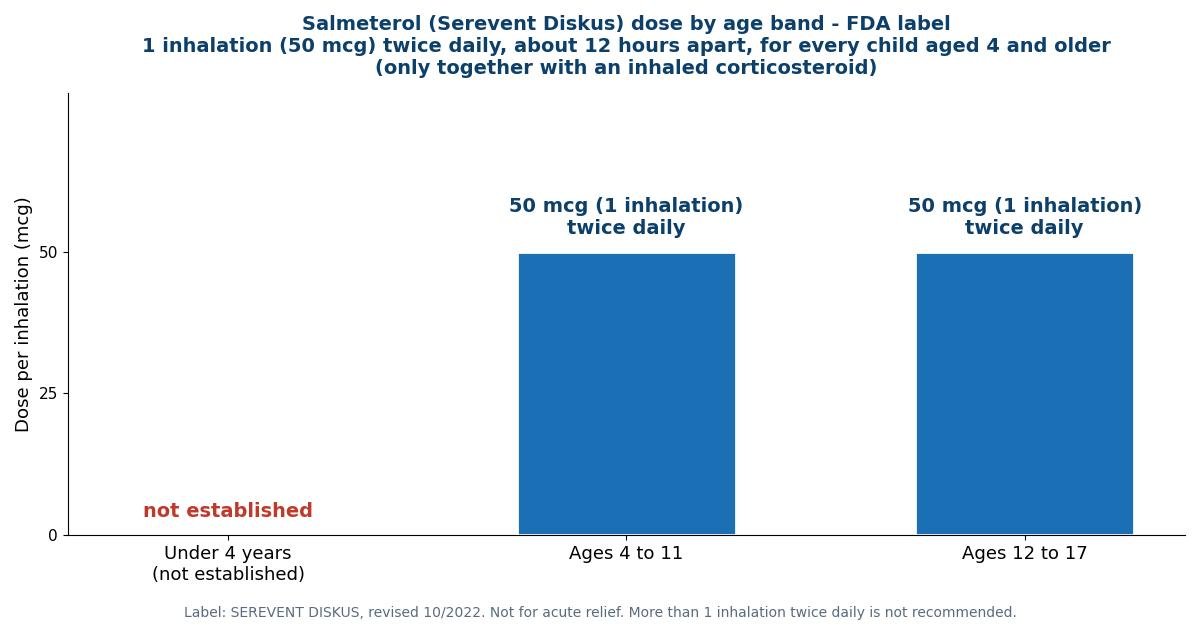
| Age | Asthma maintenance (label 2.1) | Exercise prevention (label 2.2) |
|---|---|---|
| Under 4 years | Not established, not recommended | Not established, not recommended |
| 4 to 11 years | 50 mcg (1 inhalation) twice daily, about 12 h apart, with ICS | 50 mcg (1 inhalation) at least 30 min before exercise; protection up to 12 h |
| 12 to 17 years | 50 mcg (1 inhalation) twice daily, about 12 h apart, with ICS | 50 mcg (1 inhalation) at least 30 min before exercise; protection up to 9 h |
The protection-duration split (12 hours in children 4 to 11, 9 hours in adolescents and adults) is the one place where age genuinely changes what to expect. It does not change what to give.
Asthma maintenance: the regimen in detail
For children aged 4 years and older whose asthma is not adequately controlled on their inhaled steroid, the label's maintenance regimen is deliberately simple: one inhalation (50 mcg) in the morning and one in the evening, about 12 hours apart. Each blister in the Diskus delivers 50 mcg of salmeterol, so there is nothing to measure or count beyond the dose counter. The label adds three rules that parents should know by heart. First, more frequent administration or more than 1 inhalation twice daily is not recommended: doubling up when symptoms break through increases the risk of adverse effects without better control. Second, the child must not use any additional long-acting beta2-agonist for any reason; stacking LABAs is a labeled overdose risk. Third, if a previously effective regimen fails to provide the usual response, medical advice should be sought immediately, because that failure is often a sign that the asthma is destabilizing.
What happens between the two daily doses matters too. The label says that if symptoms arise in the period between doses, an inhaled short-acting beta2-agonist should be taken for immediate relief. That is the correct division of labor: salmeterol holds the baseline, the reliever handles the breakthrough. Needing the reliever often is a signal to contact the clinician, not a reason to add salmeterol doses. And for children and teenagers specifically, the label ordinarily recommends a fixed-dose combination product containing both the ICS and the LABA in a single inhaler, rather than two separate devices, because a child who forgets the steroid inhaler while using the salmeterol one is effectively on the monotherapy the boxed warning is about. Where the clinician judges separate inhalers to be appropriate, the label requires steps to ensure the child actually takes both.
Exercise-induced bronchospasm: the 30-minute rule
Exercise-induced bronchospasm (EIB) is the other labeled pediatric use, and it has its own timing logic. The dose is one inhalation (50 mcg), taken at least 30 minutes before exercise. The protection is long but not infinite: up to 12 hours in children aged 4 to 11 and up to 9 hours in adolescents and adults, with the caveat that duration may decrease with regular use. Two hard limits follow. No additional doses within 12 hours of the exercise dose. And patients already taking SEREVENT DISKUS twice daily for asthma should not take an additional dose for exercise: their twice-daily regimen already covers the exercise period, and adding a dose breaks the 12-hour spacing and the twice-daily maximum. The widget enforces this: if you tick "already takes salmeterol twice daily," the exercise option is blocked with that explanation.
One subtlety from the label is worth spelling out. A child who does not have persistent asthma, whose only problem is exercise-triggered wheeze, may use salmeterol as a single agent for EIB prevention; no daily steroid is required in that scenario. But a child with persistent asthma who wants exercise protection needs the ICS alongside, as usual. Parents sometimes read the "single agent" phrase as permission to drop the steroid; it is not. It is permission for the child without persistent asthma to use the exercise dose without one.
When salmeterol must not be used
The contraindications are short and absolute. Do not use salmeterol for asthma without a concomitant inhaled corticosteroid. Do not use it as the primary treatment of status asthmaticus or of acute asthma or COPD episodes where intensive measures are required. Do not use it in anyone with severe hypersensitivity to milk proteins, or demonstrated hypersensitivity to salmeterol or any of the excipients: the Diskus formulation contains lactose, which carries milk protein, so this is a practical question to ask families with milk allergy. Beyond the contraindications, the warnings add: do not initiate salmeterol during acutely deteriorating asthma or COPD, and do not use it to treat acute symptoms. If paradoxical bronchospasm (worsening wheeze immediately after inhalation) occurs, stop the drug and start alternative therapy. Use with caution in children with cardiovascular or central nervous system disorders, convulsive disorders, thyrotoxicosis, diabetes mellitus, or ketoacidosis, and be alert to hypokalemia and hyperglycemia, because beta-agonists can lower potassium and raise blood sugar.
Common adverse effects in children with asthma
The label lists the most common adverse reactions (incidence 5 percent or more) in asthma trials: headache, influenza, nasal or sinus congestion, pharyngitis, rhinitis, and tracheitis/bronchitis. Parents should read that list for what it is: the background noise of childhood respiratory trials, where viral infections and nasal symptoms are common in any case. The genuinely drug-related effects of beta2-agonists, tremor, nervousness, palpitations, are the ones to report promptly, along with any chest pain, rapid or irregular heartbeat, or worsening breathing after a dose. Because each extra inhalation adds adverse-effect risk without added benefit, the twice-daily ceiling is also an adverse-effect ceiling.
Interactions parents should know about
Four interaction groups appear on the label. Strong CYP3A4 inhibitors, such as ritonavir and ketoconazole, are not recommended with salmeterol because they can raise salmeterol exposure and the risk of cardiovascular effects; this matters for children on certain HIV or antifungal regimens. Monoamine oxidase inhibitors and tricyclic antidepressants require extreme caution because they may potentiate salmeterol's effects on the vascular system. Beta-blockers should be used with caution because they can block the bronchodilatory effect and produce severe bronchospasm, and non-potassium-sparing diuretics call for caution because the ECG changes and hypokalemia they can cause may be worsened by beta-agonists. Families should tell every prescriber that the child uses salmeterol, not just the asthma clinician.
Practical points about the Diskus itself
The dose on the label is 50 mcg per blister of inhalation powder, delivered by oral inhalation only. The label notes that the precise amount of drug reaching the lungs depends on the child's inspiratory flow, which is why technique matters: a fast, deep inhalation through the device, not a gentle sniff. Children who cannot generate a strong inspiratory flow will get less drug, which is one reason the clinician, not this page, decides whether the device suits a young child. The Diskus has a dose counter; when it reads zero, the device is empty even if it still rattles. Store it at room temperature in a dry place, and never wash or take apart the device. These are device-care basics rather than label dosing, but they decide whether the labeled dose is the dose the child actually receives.
What the pediatric trials actually showed
The pediatric section of the label cites two 12-week, randomized, double-blind, controlled trials in which 50 mcg of SEREVENT DISKUS was given to 211 pediatric subjects with asthma, some with and some without concurrent inhaled corticosteroids. Efficacy was demonstrated over the 12 weeks on peak expiratory flow and on FEV1 (the volume exhaled in the first second of a forced breath), and the effect held across gender and age subgroups. The exercise trials, in children aged 4 to 11 with asthma and EIB, showed that a single 50 mcg dose taken 30 minutes before exercise prevented exercise-induced bronchospasm, with protection lasting up to 11.5 hours in repeat testing for many subjects. The label's conclusion from this body of data is plain: no dose adjustment is warranted in pediatric patients for either asthma or EIB. A child's dose is the adult dose, which is why the lookup returns the same 50 mcg for a 5-year-old and a 16-year-old.
Worked examples
Example 1: a 6-year-old with asthma not controlled on her inhaled steroid. Entering age 6 and "asthma maintenance" returns 1 inhalation (50 mcg) twice daily, about 12 hours apart, with the ICS continuing. The notes flag the boxed warning (no salmeterol without the steroid), the twice-daily ceiling, the ban on extra LABA medicines, and the under-18 fixed-combination recommendation: this family should ask the clinician whether a combination inhaler would suit the child better than two separate devices.
Example 2: a 13-year-old who wheezes during football practice but has no daily asthma. Entering age 13 and "preventing exercise-induced bronchospasm" returns a single 1-inhalation (50 mcg) dose at least 30 minutes before practice, with protection lasting up to 9 hours. The notes add: no further doses for 12 hours, and because there is no persistent asthma, this single-agent exercise use is the labeled scenario that does not require a daily steroid. If he later starts twice-daily salmeterol for asthma, the pre-exercise dose must stop.
Example 3: a 9-year-old mid-attack, parents reaching for the wrong inhaler. Choosing "having breathing trouble right now" returns a refusal: salmeterol is not indicated for acute bronchospasm and is contraindicated as primary treatment of acute episodes. The guidance points to the short-acting rescue inhaler, the written asthma action plan, and emergency care if there is no improvement. This is the scenario the lookup exists to prevent.
Sources and verification
Every regimen and safety statement on this page was checked against the current FDA-approved prescribing information for SEREVENT DISKUS (salmeterol xinafoate inhalation powder), revised 10/2022, as published on DailyMed: SEREVENT DISKUS on DailyMed (sections cited: 1.1, 1.2, 2, 2.1, 2.2, 3, 4, 5.1, 5.2, 6.1, 7, 8.4). The pediatric dosing tables and the trial numbers (13/13,176 vs 3/13,179; 211 pediatric subjects; up to 11.5 hours protection) come from that label, not from secondary summaries. Verification date: 2026-10-05.
Key takeaways
- Per the FDA label, the usual dosage for children aged 4 years and older is 1 inhalation (50 mcg) twice daily, approximately 12 hours apart.
- Salmeterol dosing is not weight-based the way many childhood medicines are: it is a single 50 mcg inhalation delivered by the Diskus device, and the label sets one rule for every patient aged 4 years and older.
- Yes, for exercise-induced bronchospasm prevention: 1 inhalation (50 mcg) at least 30 minutes before exercise.
- The label carries a boxed warning: long-acting beta2-agonists as monotherapy (without inhaled corticosteroids) increase the risk of asthma-related death.
Frequently asked questions
How much Serevent does a child need for asthma maintenance?
Per the FDA label, the usual dosage for children aged 4 years and older is 1 inhalation (50 mcg) twice daily, approximately 12 hours apart. The dose is the same for a 4-year-old and a 17-year-old; the label does not subdivide children into smaller dose bands. Critically, this maintenance dose is only for children who are already taking but are inadequately controlled on an inhaled corticosteroid. Salmeterol alone for asthma is contraindicated because long-acting beta2-agonist monotherapy increases the risk of asthma-related death. For patients under 18, the label ordinarily recommends a fixed-dose combination inhaler (ICS plus LABA in one device) rather than two separate inhalers.
Why does the label give the same salmeterol dose to every child aged 4 and older?
Salmeterol dosing is not weight-based the way many childhood medicines are: it is a single 50 mcg inhalation delivered by the Diskus device, and the label sets one rule for every patient aged 4 years and older. The 4-to-11 age band appears on the label only in the clinical-trial data, not in the dosing section: in exercise-induced bronchospasm trials, one 50 mcg dose protected children aged 4 to 11 for up to 12 hours, versus up to 9 hours in adolescents and adults. So the age bands describe how long protection lasts in the trial data, not different doses.
Can my child use salmeterol before sports or PE class?
Yes, for exercise-induced bronchospasm prevention: 1 inhalation (50 mcg) at least 30 minutes before exercise. Protection may last up to 12 hours in children aged 4 to 11 and up to 9 hours in adolescents and adults, although duration can decrease with regular use. Do not give any additional doses within 12 hours of this dose, and do not add an exercise dose if the child is already taking salmeterol twice daily. Children with persistent asthma who use salmeterol before exercise should also be on an inhaled corticosteroid; children without persistent asthma may use it as a single agent for exercise prevention.
Why can salmeterol never be used without an inhaled steroid?
The label carries a boxed warning: long-acting beta2-agonists as monotherapy (without inhaled corticosteroids) increase the risk of asthma-related death. A large U.S. trial found 13 asthma-related deaths among 13,176 subjects on salmeterol versus 3 among 13,179 on placebo over 28 weeks. That is why asthma treatment without concomitant ICS is listed as a contraindication, and why the label restricts salmeterol to patients inadequately controlled on an ICS alone. In pediatric and adolescent patients, LABA monotherapy is also linked to increased asthma-related hospitalizations, so children and teenagers who need a LABA added to their steroid should ordinarily use a fixed-dose combination product.
What should we do if my child's asthma gets worse on salmeterol?
Do not increase the dose: the label states that more frequent administration or more than 1 inhalation twice daily is not recommended, because extra doses raise the risk of adverse effects without better control. If a previously effective regimen stops providing the usual response, seek medical advice immediately, because this is often a sign of destabilizing asthma. For symptoms that arise between the twice-daily doses, an inhaled short-acting beta2-agonist should be used for immediate relief. Never start salmeterol during acutely deteriorating asthma, and never use it as the primary treatment of an acute attack or status asthmaticus.
Can salmeterol rescue my child during an asthma attack?
No. The label states plainly that SEREVENT DISKUS is NOT indicated for the relief of acute bronchospasm, and its use is contraindicated as the primary treatment of status asthmaticus or acute asthma episodes where intensive measures are required. Salmeterol is a long-acting controller: it keeps airways open over about 12 hours but is not a fast rescue medicine. During an attack, use the child's short-acting rescue inhaler (such as albuterol) according to the written asthma action plan, and seek emergency care if there is no improvement.
Related pediatric dosing guides
- Albuterol (salbutamol) pediatric dosing: the rescue inhaler
- Fluticasone pediatric dosing: the inhaled steroid partner
- Montelukast pediatric dosing
References and further reading
Last medically reviewed 2026-10-05 by Dr. Taimoor Asghar. Dose regimens verified against the FDA DailyMed SEREVENT DISKUS label (revised 10/2022).