What nystatin is
Nystatin is a polyene antifungal medicine, one of the oldest antifungal drugs still in routine use. It was discovered in 1950 by Elizabeth Hazen and Rachel Fuller Brown, working for the New York State Department of Health. The drug's name is a contraction of "New York State." It is produced by the bacterium Streptomyces noursei, and it kills fungi by binding to ergosterol, a sterol found in fungal cell membranes but not in human ones. The binding punches holes in the fungal membrane, the cell's contents leak out, and the organism dies. Because ergosterol is a fungal feature, nystatin is selectively toxic to fungi while leaving human cells alone, which is part of why the drug is so well tolerated.
The defining property of nystatin is that it is essentially not absorbed. When swallowed, it stays in the gut lumen; when applied to the skin, it stays on the skin. Almost none of it reaches the bloodstream. That single fact explains the whole shape of nystatin therapy: it is a drug for infections it can touch directly. The mouth, the intestinal tract, and the skin. And it is useless, by design, against infections anywhere else. Nystatin is available as an oral suspension (100,000 USP nystatin units per mL), as film-coated tablets (500,000 units) for intestinal candidiasis in older patients, and as topical cream, ointment, and powder (100,000 units per gram). This guide covers the two forms used in children: the oral suspension and the topical preparations.
Nystatin treats fungal infections, principally those caused by Candida species. It has no activity against bacteria or viruses, so it does nothing for bacterial diaper rash, impetigo, or viral mouth sores. Prescribers reach for it when the clinical picture points to Candida: the classic white, cottage-cheese-like plaques of oral thrush that do not wipe away easily, or a diaper rash with bright red satellite spots at its edges that has not responded to barrier cream.
Why children need nystatin
Oral thrush is the most common reason a child receives nystatin. It is an overgrowth of Candida albicans on the lining of the mouth, and it is especially common in the first months of life. A newborn's immune system is still learning, and the balance of microbes in the mouth is easily disturbed. After a course of antibiotics, for example, which clears competing bacteria and lets Candida flourish. The plaques appear on the tongue, inner cheeks, gums, or palate. They look like milk curds but, unlike milk residue, they do not wipe away cleanly; scraping them can leave a raw, bleeding surface underneath. Babies with thrush may feed poorly or seem fussy at the breast or bottle because the mouth is sore.
Thrush can also travel with breastfeeding: a mother whose infant has oral thrush may develop a painful Candida infection of the nipples, with burning pain during and after feeds. Treating both members of the pair is standard practice when that happens, because each can re-infect the other. The clinician decides the mother's treatment separately; this guide covers the child's regimen.
The second pediatric use is candidal diaper dermatitis. A yeast diaper rash. Ordinary diaper rash is irritant: prolonged contact with urine and stool inflames the skin of the convex surfaces. When Candida moves in, the rash changes character. It becomes an intense, beefy red, spreads into the skin folds (which irritant rash usually spares), and develops the telltale satellite lesions. Small red papules and pustules scattered just beyond the main border. A diaper rash that has lasted more than a few days despite frequent changes and barrier cream, especially one with satellite spots or fold involvement, is likely candidal, and that is when topical nystatin enters the picture.
Premature and low-birth-weight infants deserve special mention. They are more vulnerable to Candida colonization because their skin and mucosal barriers are immature, they spend time in neonatal units where Candida circulates, and many receive broad-spectrum antibiotics. The FDA oral suspension label carries a specific note for them, covered below, and any suspected fungal infection in a premature infant is managed by the neonatal team. Including a careful judgment about whether the infection is confined to surfaces or has become invasive.
Oral suspension regimens from the FDA label
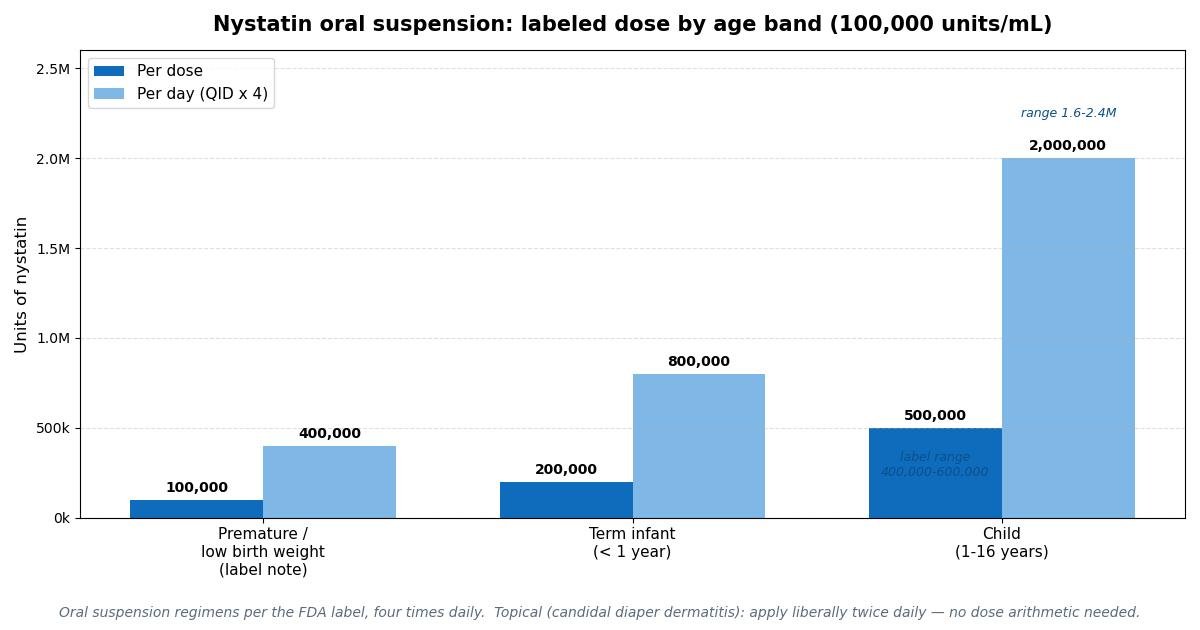
The FDA label for nystatin oral suspension gives age-based regimens in units, and the suspension's concentration makes the millilitre conversion exact: 100,000 units per mL. The table below reproduces the labeled regimens. Doses are given four times daily, spaced through the waking hours.
| Age band | Labeled dose | Millilitres (100,000 units/mL) | Frequency |
|---|---|---|---|
| Premature and low-birth-weight infants (per label note) | 100,000 units | 1 mL | Four times daily |
| Infants | 200,000 units | 2 mL | Four times daily |
| Children and adults | 400,000 to 600,000 units | 4 to 6 mL | Four times daily |
A few points about how the label phrases these bands. The label itself says "infants" and "children and adults" without printing exact age cut-offs; the standard reference mapping used in pediatric dosing references is 1 month to 12 months for the infant dose and 1 year to 18 years for the child dose, which matches the label's regimens exactly. The premature and low-birth-weight entry is not a standard band at all. It is a labeled note stating that limited clinical studies in premature and low-birth-weight infants indicate that 1 mL four times daily is effective. Because the evidence base is described as limited, that regimen belongs under neonatal supervision rather than as a routine home calculation.
The daily totals follow from the arithmetic: an infant receiving 200,000 units four times daily gets 800,000 units per day; a premature infant on the note regimen gets 400,000 units per day; a child on 400,000 to 600,000 units four times daily gets 1.6 to 2.4 million units per day. For context on the drug's safety margin, the label's overdosage section reports that oral doses in excess of five million units daily have caused nausea and gastrointestinal upset, with no reports of serious toxic effects. So even the top of the pediatric range sits well below the dose at which adverse effects begin to appear.
How to give the suspension: the half-and-half technique
Nystatin works by contact, so how it is given matters as much as how much is given. A dose that is swallowed immediately spends almost no time on the infected mucosa and does less good. The FDA label therefore builds the administration technique into the dosing instructions, and caregivers should follow it exactly.
For infants and young children, the label directs using the dropper to place one-half of the dose in each side of the mouth. Painting half the dose onto each cheek's inner surface maximizes the area of infected mucosa the drug touches. After the dose, the infant should not be fed for 5 to 10 minutes, so that milk or formula does not wash the drug away before it has had contact time.
For older children, the label says one-half of the dose goes in each side of the mouth, and the preparation should be retained in the mouth as long as possible before swallowing. In practice that means swishing the suspension around the whole mouth. Reaching the tongue, cheeks, gums, and palate. Holding it for as long as the child can manage, ideally a few minutes, and then swallowing. Swallowing matters too: it carries the drug down to treat any candidiasis of the esophagus, which often accompanies oral thrush.
Two timing rules complete the picture. First, doses should be spaced evenly through the day. Four times daily typically means roughly every six waking hours, for example after meals and at bedtime. Second, the label directs that treatment continue for at least 48 hours after perioral symptoms have disappeared and cultures demonstrate eradication of Candida albicans. In other words, the disappearance of the white plaques is not the stop signal; treatment continues two full days beyond it. Professional references describe a usual treatment course of 7 to 14 days for oropharyngeal candidiasis, which is consistent with that rule.
Premature and low-birth-weight infants: the label note
The label's note on premature and low-birth-weight infants deserves its own section because it is easy to misread. The note states that limited clinical studies in premature and low-birth-weight infants indicate that 1 mL (100,000 units) four times daily is effective. Three things follow from that wording. First, the dose is half the standard infant dose. 100,000 units instead of 200,000 units per dose, 400,000 units per day instead of 800,000. Second, the evidence is explicitly described as limited, which is the label's way of saying this is not as firmly established as the standard regimens. Third, in practice this means the regimen is chosen and supervised by the neonatal team, not derived at home from a dosing guide.
There is a related professional-guidance point worth knowing. Infectious-disease references describe an off-label prophylactic use: in low-birth-weight neonates under 1.5 kg at high risk of candidiasis, 100,000 units three times daily for six weeks has been recommended as an alternative preventive strategy. That is off-label, applies to a specific high-risk neonatal population, and is mentioned here only so that families who encounter it understand it is a recognized professional recommendation rather than an error. It is never something to start without the neonatal team.
The broader caution for this population is about invasive disease. Premature infants, particularly those with central venous catheters or on prolonged antibiotics, are at risk of candidemia (Candida in the bloodstream). Nystatin cannot treat that, because it is not absorbed. If a premature infant is systemically unwell with suspected fungal infection, the answer is urgent evaluation and systemic antifungal therapy, not oral nystatin. The regimen lookup widget on this page makes the same point: the "suspected systemic candidiasis" option returns a warning, not a dose.
Topical nystatin for candidal diaper dermatitis
The FDA label for nystatin cream and ointment. Both 100,000 USP nystatin units per gram. States the regimen plainly: the preparation should be applied liberally to the affected areas twice daily, or as indicated, until healing is complete. The label adds formulation guidance: the cream is usually preferred to the ointment in candidiasis involving intertriginous areas (the skin folds, which includes the diaper region), while very moist lesions are best treated with nystatin topical powder. The label establishes safety and effectiveness in the pediatric population from birth to 16 years, so the topical regimen covers the full pediatric age range without the age bands the oral suspension needs.
| Formulation | Concentration | Labeled regimen | Best for |
|---|---|---|---|
| Cream | 100,000 units/g | Apply liberally twice daily until healing is complete | Diaper area and other skin folds (intertriginous areas) |
| Ointment | 100,000 units/g | Apply liberally twice daily until healing is complete | Drier lesions outside the folds |
| Powder | 100,000 units/g | Apply to affected areas as directed | Very moist lesions |
Professional references add a practical layer on top of the label. The standard professional monograph describes topical nystatin for candidal diaper dermatitis as applied 3 or 4 times daily for 7 to 10 days, and for cutaneous candidiasis generally as 2 or 3 times daily, with 7 to 10 days usually effective. While noting that symptomatic relief may appear within 24 to 72 hours but the full course should still be completed. The labeled twice-daily regimen is the floor; the prescriber may direct more frequent application for diaper dermatitis, and the widget's duration note reflects both.
Good diaper-area care multiplies the drug's effect. Change diapers frequently so the skin spends as little time as possible in contact with urine and stool, clean gently with water rather than fragranced wipes during the outbreak, pat dry rather than rubbing, and allow brief periods of air exposure when practical. Barrier creams such as zinc oxide can be used alongside nystatin. Apply the nystatin first so it contacts the skin, then the barrier over it. But check with the prescriber or pharmacist about the specific combination, since thick barriers applied first can block the antifungal from reaching the skin.
What nystatin cannot do
This limitation is worth stating plainly because the drug's gentleness can mislead. Nystatin is so well tolerated that it is easy to assume it is a general-purpose antifungal. It is not. Its spectrum is surfaces: the mouth, the gut lumen, the skin. When Candida has entered the bloodstream or deep tissues, the drugs that work are the systemically absorbed ones. The azoles such as fluconazole, which does reach the bloodstream and tissues. The choice between a surface drug and a systemic drug is a clinical decision driven by how sick the child is and where the infection is, and it is never made on the basis of a dosing guide.
Two further boundaries: nystatin has no antibacterial activity, so it does nothing for bacterial skin infections or bacterial diaper rash, and no antiviral activity. And it is not a preventive daily medicine for healthy children. It is used to treat diagnosed or clinically evident candidiasis, for the labeled duration, and then stopped.
Side effects and safety
Oral nystatin's adverse effects are mostly gastrointestinal and mostly mild. The label lists diarrhea, gastrointestinal distress, nausea, vomiting, and burning of the mouth. Hypersensitivity reactions including rash, pruritus, and anaphylactoid reaction have also been reported, but these are rare. Because the drug is not absorbed, systemic toxicity is essentially absent at labeled doses. The overdosage section notes that oral doses in excess of five million units daily have caused nausea and gastrointestinal upset, and that there have been no reports of serious toxic effects. To put that in perspective, the highest labeled pediatric daily dose (2.4 million units) is less than half the dose at which even mild overdosage effects begin.
Topical nystatin is similarly benign. In clinical studies with the cream, the frequency of reported adverse events was less than 0.1 percent, and the label describes nystatin as virtually nontoxic and nonsensitizing, well tolerated by all age groups including debilitated infants, even on prolonged administration. The more common events reported were local: allergic reactions, burning, itching, rash, eczema, and pain on application. The label's instruction is simple: if irritation on topical application occurs, discontinue the medication and tell the clinician.
There are no absolute contraindications beyond hypersensitivity to nystatin itself. The drug's pregnancy and lactation data are limited. It is not known whether nystatin is excreted in human milk, and the label advises caution in nursing mothers. But for the pediatric patient, the safety profile is among the most favorable of any antimicrobial in the formulary. That favorable profile is exactly why the drug's limits, not its risks, are the main thing to understand: the danger with nystatin is almost never toxicity, it is using a surface drug for a deep infection.
Measuring, storage, and missed doses
Measure the oral suspension with the calibrated dropper supplied with the bottle or with an oral syringe, never with a household teaspoon, whose volume varies enough to matter at these small doses. The suspension is a ready-to-use liquid; confirm the concentration on the label (100,000 units per mL) whenever a new bottle is opened, because using the wrong conversion is the most common dosing error with liquid medicines. Store the suspension at controlled room temperature, 20 to 25 degrees Celsius, and do not freeze it. Keep the bottle, like all medicines, out of the reach of children.
If a dose is missed, the standard guidance is to give it as soon as it is remembered, unless it is almost time for the next scheduled dose. In which case the missed dose is skipped and the regular schedule resumes. A missed dose is never made up by doubling the next one. Because nystatin works by contact and the course runs for days, a single missed dose matters less than consistent technique for the remaining doses, but frequent misses are worth mentioning to the clinician, since persistent thrush despite treatment can signal that the administration technique needs review rather than that the drug has failed.
For the topical preparations, storage is the same controlled room temperature range. The cream and ointment are for external use on the skin; they are not for ophthalmic use and should not be applied in the eyes. If the diaper rash has not begun to improve within a week to 10 days of correct use, or if it worsens at any point, that is the signal to return to the clinician rather than to continue indefinitely. The professional monograph advises appropriate laboratory testing when there is no response, because a rash that does not respond to an antifungal may not be candidal after all.
When to call the clinician
Certain situations should prompt a call rather than continued home treatment. If oral thrush has not improved after 7 to 10 days of correct administration, if the plaques are spreading down the throat or the child is refusing feeds and at risk of dehydration, or if thrush keeps recurring, the clinician should reassess. Recurrent thrush can occasionally signal an underlying immune issue that needs evaluation. For diaper dermatitis, call if the rash is worsening, blistering, oozing, or developing open sores; if the infant has fever; or if there is no improvement after 7 to 10 days of treatment.
Any sign of hypersensitivity. Hives, swelling of the lips or face, difficulty breathing, or a spreading rash after starting nystatin. Needs prompt medical attention, though such reactions are rare. And as emphasized throughout this guide, any premature, low-birth-weight, or immunocompromised child who is systemically unwell with suspected fungal infection needs urgent evaluation for invasive disease, where nystatin is not the treatment. When in doubt, the clinician who prescribed the nystatin is the right first call; this page explains the label so families can follow the care plan with confidence, but it does not replace clinical judgment.
Families dealing with recurrent surface Candida sometimes ask about related medicines. Miconazole is another topical antifungal occasionally used for skin candidiasis, and topical hydrocortisone is sometimes discussed for the inflammation around diaper rashes. But steroids must never be combined with antifungal treatment on a child's skin without explicit clinical direction, as explained in the combination-cream caution above.