What propranolol is
Propranolol is a nonselective beta-adrenergic blocker: it blocks both beta-1 and beta-2 adrenergic receptors. Beta-1 blockade slows the heart rate and reduces the force of each heartbeat, which lowers blood pressure; beta-2 blockade affects the airways, the metabolism, and the vascular smooth muscle. Because propranolol does not select between receptor types, its benefits always travel with a defined set of risks: slower heart rate, lower blood pressure, narrowing of the airways, masking of the warning signs of low blood sugar, and coldness of the hands and feet. The pediatric product discussed on this page is Hemangeol, an oral solution of propranolol hydrochloride, which is the only propranolol product with an FDA-approved pediatric indication. Hemangeol was initially approved for adults in 1967 as propranolol itself, and the infantile hemangioma indication was added later for this specific pediatric formulation.
The solution is alcohol-free, paraben-free, and sugar-free, which matters for infants. Each millilitre contains 4.28 mg of propranolol hydrochloride, and the product is supplied in a carton containing one 120 mL bottle with a syringe adapter and one 5 mL oral dosing syringe. That syringe is the only measuring device that should be used: household spoons are inaccurate, and at infant doses a few tenths of a millilitre represent a meaningful fraction of the dose.
Why infants receive propranolol: infantile hemangioma
The FDA label gives Hemangeol exactly one indication: the treatment of proliferating infantile hemangioma requiring systemic therapy. An infantile hemangioma is a benign vascular tumor of infancy. A cluster of extra blood vessels that grows quickly in the first months of life and then slowly regresses over years. Most hemangiomas are harmless and never need treatment. "Proliferating" refers to the fast-growth phase, and "requiring systemic therapy" identifies the minority of cases that cannot be managed by watchful waiting or local treatment: hemangiomas that threaten vision, breathing, hearing, or the airway; large facial lesions; ulcerated lesions; or lesions causing heart strain.
The label describes the clinical evidence behind this indication. Of 460 infants with proliferating infantile hemangioma requiring systemic therapy who were treated with Hemangeol starting at 5 weeks to 5 months of age, 60 percent had complete or nearly complete resolution of their hemangioma at week 24. That figure comes from the label's pediatric use section and is the single efficacy number this page reports, because it is the only one traceable to the prescribing information.
Treatment is started between 5 weeks and 5 months of age. During the proliferating window, when the drug can act on growing vessels. The label states that safety and effectiveness for infantile hemangioma have not been established in pediatric patients greater than 1 year of age, and there is no experience in infants with hepatic or renal impairment. This is a treatment with a defined window, not an indefinite therapy.
Who may start treatment
Before the first dose, the clinical team checks the label's contraindications, because several common infant conditions rule Hemangeol out entirely. It is contraindicated in premature infants with corrected age below 5 weeks, in infants weighing less than 2 kg, in known hypersensitivity to propranolol or any of the excipients, in asthma or a history of bronchospasm, in heart rate below 80 beats per minute, greater than first degree heart block, or decompensated heart failure, in blood pressure below 50/30 mmHg, and in pheochromocytoma. The dose lookup widget on this page enforces the weight boundary: infants under 2 kg receive a hard stop, not a dose.
One screening step deserves emphasis because it is specific to this disease. Infants with a large facial infantile hemangioma must be investigated for potential arteriopathy associated with PHACE syndrome before Hemangeol therapy begins. PHACE syndrome is an association of a large facial hemangioma with anomalies of the brain, arteries, heart, and eyes. The label warns that by dropping blood pressure, Hemangeol may increase the risk of stroke in PHACE syndrome patients with severe cerebrovascular anomalies, so the arterial workup comes first.
The labeled titration schedule
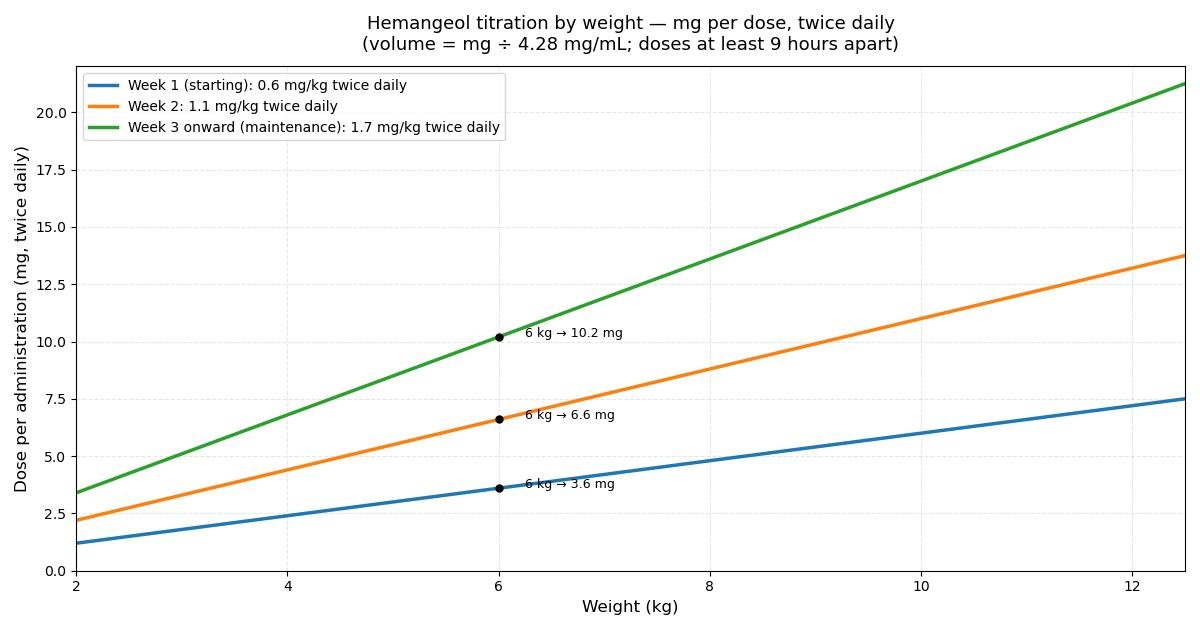
The label's dosing is a three-step titration with fixed calendar points. The starting dose is 0.15 mL/kg (0.6 mg/kg) twice daily, with the two doses taken at least 9 hours apart. After 1 week, the dose is increased to 0.3 mL/kg (1.1 mg/kg) twice daily. After 2 weeks of treatment, the dose is increased to 0.4 mL/kg (1.7 mg/kg) twice daily, and this maintenance dose is kept for 6 months. The dose is readjusted periodically as the child's weight increases, because an infant grows substantially over 6 months and a fixed dose would drift below the intended mg/kg over time.
Applied to real weights, the label's mg/kg steps and the 4.28 mg/mL concentration produce the following reference values. Each row shows the twice-daily dose for week 1, week 2, and the maintenance phase, in both milligrams and the millilitres that deliver them:
| Weight (kg) | Week 1: 0.6 mg/kg BID | Week 2: 1.1 mg/kg BID | Maintenance: 1.7 mg/kg BID |
|---|---|---|---|
| 2 | 1.2 mg = 0.28 mL | 2.2 mg = 0.51 mL | 3.4 mg = 0.79 mL |
| 3 | 1.8 mg = 0.42 mL | 3.3 mg = 0.77 mL | 5.1 mg = 1.19 mL |
| 4 | 2.4 mg = 0.56 mL | 4.4 mg = 1.03 mL | 6.8 mg = 1.59 mL |
| 5 | 3.0 mg = 0.70 mL | 5.5 mg = 1.29 mL | 8.5 mg = 1.99 mL |
| 6 | 3.6 mg = 0.84 mL | 6.6 mg = 1.54 mL | 10.2 mg = 2.38 mL |
| 8 | 4.8 mg = 1.12 mL | 8.8 mg = 2.06 mL | 13.6 mg = 3.18 mL |
| 10 | 6.0 mg = 1.40 mL | 11.0 mg = 2.57 mL | 17.0 mg = 3.97 mL |
| 12 | 7.2 mg = 1.68 mL | 13.2 mg = 3.08 mL | 20.4 mg = 4.77 mL |
A note on precision: the label's own printed weight table expresses the titration in millilitres per kilogram (0.15, 0.3, and 0.4 mL/kg) and rounds the volumes to convenient syringe markings. For example, the printed table lists 0.9 mL rather than 0.84 mL for a 6 kg infant in week 1. The table above and the widget compute the exact label mg/kg divided by the 4.28 mg/mL concentration, which is the same label math without the syringe rounding. In practice the prescribing clinician confirms the final volume against the current weight at each visit.
Giving each dose correctly
The label's administration instructions are built around one dominant safety concern: hypoglycemia. To reduce the risk of low blood sugar, Hemangeol is given orally during or right after a feeding, and the dose is skipped if the child is not eating or is vomiting. Administration directly into the child's mouth with the supplied oral dosing syringe is recommended. If necessary, the product may be diluted in a small quantity of milk or fruit juice and given in a baby's bottle, but the full measured dose must still be delivered.
Storage and handling follow the label exactly: store at 25 degrees Celsius (excursions permitted from 15 to 30 degrees), do not freeze, do not shake the bottle before use, and dispense in the original container. Do not shake is a distinctive instruction. The solution is ready to dose as it is, and shaking is unnecessary.
What the clinical team monitors
Propranolol lowers heart rate and blood pressure, so the label requires monitoring of heart rate and blood pressure for 2 hours after Hemangeol initiation and after dose increases. In the label's clinical studies, the mean decrease in heart rate was about 7 beats per minute, with little effect on blood pressure. But individual infants can respond more strongly, which is why the monitoring is required rather than optional.
The stopping thresholds are explicit in the label. Treatment is discontinued if severe bradycardia (below 80 beats per minute) or symptomatic bradycardia occurs, or if hypotension develops with systolic blood pressure below 50 mmHg. These are the same numbers that appear in the contraindications list, which tells caregivers that a heart rate under 80 is never acceptable on this drug. It is either a reason not to start or a reason to stop.
Hypoglycemia: the warning that governs every dose
Section 5.1 of the label explains the mechanism in plain terms. Hemangeol prevents the response of the body's own catecholamines that would normally correct hypoglycemia, and it masks the adrenergic warning signs, especially tachycardia. The risk is increased during a fasting period. Poor oral food intake, infection, or vomiting. Or when the infant's glucose demands are increased, such as during cold, stress, or infections. The label directs the dose to be withheld under these conditions, and to discontinue Hemangeol if hypoglycemia develops and treat it appropriately.
Two practical consequences follow. First, the feeding rule is absolute: during or right after a feeding, never on an empty stomach, and skip the dose if the child is not eating or is vomiting. Second, caregivers should know that a sick, fasting, or vomiting infant on propranolol is in the highest-risk state, and any unusual sleepiness, shakiness, or seizure needs immediate medical attention. Concomitant treatment with corticosteroids may further increase the risk of hypoglycemia, because it removes the counter-regulatory cortisol response. Another reason the clinical team reviews every concurrent medicine.
Bradycardia, hypotension, and bronchospasm
The cardiac warning in section 5.2 is straightforward: Hemangeol may cause or worsen bradycardia or hypotension. Monitoring after initiation and dose increases is the label's control, and the discontinuation thresholds. Heart rate below 80 beats per minute, systolic blood pressure below 50 mmHg. Are the backstop. Parents are typically taught to recognize an unusually slow or weak pulse and abnormal pallor or limpness, and to seek care rather than give the next dose.
The respiratory warning in section 5.3 is a hard boundary rather than a monitoring task. Hemangeol can cause bronchospasm, and the label contraindicates it in asthma or a history of bronchospasm. It further directs that treatment be interrupted in the event of a lower respiratory tract infection associated with dyspnea and wheezing. This is why the widget asks about indication but the article stresses history: a wheezy infant with a hemangioma needs the respiratory history reviewed before the first dose, not after. The label also notes that beta-blockers interfere with epinephrine used to treat serious anaphylaxis, which the allergy history should cover.
Section 5.4 adds a cardiac-failure caution that flows from the pharmacology: sympathetic stimulation supports circulatory function in congestive heart failure, so beta blockade may precipitate more severe failure. This is one of the reasons the pre-treatment cardiac assessment is not a formality.
Adverse reactions seen in the trials
The label reports the trial experience in detail. In the clinical trials for proliferating infantile hemangioma, the most frequently reported adverse reactions. Occurring in more than 10 percent of treated infants. Were sleep disorders, aggravated respiratory tract infections such as bronchitis and bronchiolitis associated with cough and fever, diarrhea, and vomiting. Adverse reactions led to treatment discontinuation in fewer than 2 percent of treated patients. Dose-related patterns appeared in the adverse-event table: for example, sleep disorders occurred in about 17 percent on either dose versus 5.9 percent on placebo, and bronchitis rose from 4.7 percent on placebo to 13.4 percent on the higher dose.
The serious adverse reactions called out in the label are hypoglycemia and related events such as hypoglycemic seizure, and bronchospasm. Events seen in less than 1 percent of trial patients included second-degree atrioventricular heart block in a patient with an underlying conduction disorder, urticaria, alopecia, decreased blood glucose, and decreased heart rate. In a compassionate-use program of more than 600 infants, with a mean treatment duration of 7.1 months, the reported reactions were similar to the trials but some were more severe.
Overdose information in the label is reassuring in scale but serious in content. Few cases were reported; for a single intake, the maximum dose was 20 mg/kg. Symptomatic cases featured hypotension, hypoglycemic seizure, and restlessness. The toxicity of beta-blockers is described as an extension of their therapeutic effects: decreased heart rate and hypotension, atrioventricular blocks and conduction delays and heart failure in severe poisoning, bronchospasm particularly in asthma, and hypoglycemia whose signs may be masked. Supportive care is cardiac monitoring with vital signs, mental status, and blood glucose; intravenous fluids for hypotension; atropine for bradycardia; glucagon then catecholamines if there is no response; and isoproterenol and aminophylline for bronchospasm. Propranolol is not dialyzable.
Propranolol for childhood hypertension or arrhythmias: not labeled
This is the section where precision about sources matters most. Propranolol has been used in children for high blood pressure and heart rhythm problems for decades, and pediatric dosing references publish typical regimens. But no FDA label currently carries pediatric propranolol dosing for hypertension or arrhythmias. The only pediatric-labeled indication is Hemangeol for proliferating infantile hemangioma. That is why the dose widget on this page refuses to calculate for those indications and returns a clinician gate instead. The reference numbers below are included so families understand what the literature describes, not as instructions to dose a child.
For pediatric hypertension, the pediatric dosing references describe the following typical oral regimens, all off-label and all clinician-decided. Drugs.com lists an initial immediate-release dose of 0.5 to 1 mg/kg/day in divided doses every 6 to 12 hours, a usual dose of 1 to 5 mg/kg/day, and a maximum of 8 mg/kg/day. A separate expert recommendation cited in the propranolol monograph (the National High Blood Pressure Education Program Working Group on High Blood Pressure in Children and Adolescents) suggests an initial 1 to 2 mg/kg/day given in 2 or 3 divided doses, up to a maximum of 4 mg/kg/day (up to 640 mg/day). The British National Formulary for Children lists, for a child 1 month to 11 years, an initial 0.25 to 1 mg/kg three times a day, increased at weekly intervals to 5 mg/kg daily in divided doses. These ranges differ between references, which is itself a reason they are never self-administered.
For pediatric arrhythmias, Drugs.com lists an oral regimen for children of an initial 0.5 to 1 mg/kg/day in divided doses every 6 to 8 hours, titrated upward every 3 to 5 days, with a usual dose of 2 to 4 mg/kg/day and a maximum of 16 mg/kg/day. The intravenous regimen is 0.01 to 0.1 mg/kg given as a slow IV infusion over 10 minutes, with a maximum of 1 mg per dose in infants and 3 mg per dose in children. The BNFC lists 250 to 500 micrograms/kg 3 to 4 times a day by mouth for a child (maximum 1 mg/kg per dose 4 times a day, maximum 160 mg per day), and 25 to 50 micrograms/kg by slow intravenous injection. Intravenous propranolol in children is given under ECG monitoring by the cardiology team. It is never a home treatment.
One safety thread connects both contexts: the hypoglycemia, bradycardia, and bronchospasm warnings of the Hemangeol label apply to propranolol as a drug, not to one product. A child on propranolol for any reason needs the same vigilance about fasting and missed meals, the same heart-rate awareness, and the same asthma history review. Abrupt withdrawal of beta-blockers is also a known concern with long-term therapy in older patients, so any plan to stop is made with the clinician rather than by skipping doses.
Duration, stopping, and recurrence
The label keeps the maintenance dose for 6 months. That duration is tied to the trial evidence: the 60 percent complete-or-nearly-complete resolution figure was measured at week 24. During those 6 months the dose is readjusted periodically as the child's weight increases, so the mg/kg exposure stays on target while the infant grows.
After treatment ends, the hemangioma is reassessed. The label states that if hemangiomas recur, treatment may be re-initiated. Recurrence is a recognized possibility, not a failure of the family or the drug. There is no label-directed taper described for Hemangeol; when and how to stop is a decision for the treating team, who weigh the hemangioma's response against the infant's age and cardiac status.
Related pediatric guides
Dosing information for other common pediatric medicines is available in the same collection: see the dosage guides for ibuprofen and paracetamol (acetaminophen), and the furosemide pediatric dosing guide for another example of a label-based titration with monitoring rules.