What pseudoephedrine is and what it does
Pseudoephedrine, sold under the brand name Sudafed among many others, is a nasal decongestant: a sympathomimetic medicine that shrinks the swollen blood vessels and mucous membranes inside the nose. The Drug Facts label states its uses plainly: it temporarily relieves nasal congestion due to the common cold, hay fever, or other upper respiratory allergies, and nasal congestion associated with sinusitis; it also temporarily relieves sinus congestion and pressure. Unlike antihistamines such as diphenhydramine, it does not cause drowsiness at label doses, which is why parents often reach for it during daytime colds and allergy seasons.
The word "temporarily" matters. Pseudoephedrine treats the symptom, not the cause: it does not shorten a cold, cure an allergy, or treat an infection. That limitation is exactly why the label sets strict rules about who may take it and for how long. This guide covers the oral forms a child might take. Tablets and the oral solution. And it follows the current United States Drug Facts labeling, which is the legal expression of the FDA-reviewed dosing. The same age bands appear on products in many other countries, with small local variations noted below.
Why the age bands are so strict: the 2008 FDA advisory
Parents sometimes ask why a medicine sold without a prescription is forbidden for small children. The answer goes back to January 2008, when the FDA issued a public health advisory strongly recommending that over-the-counter cough and cold products. Including decongestants like pseudoephedrine. Not be used for children under 2 years of age. The agency's review found that these products treat symptoms and not the underlying condition, had not been shown to be safe or effective in children under 2, and had been linked to rare but serious and potentially life-threatening side effects, including death, convulsions, rapid heart rates, and decreased levels of consciousness.
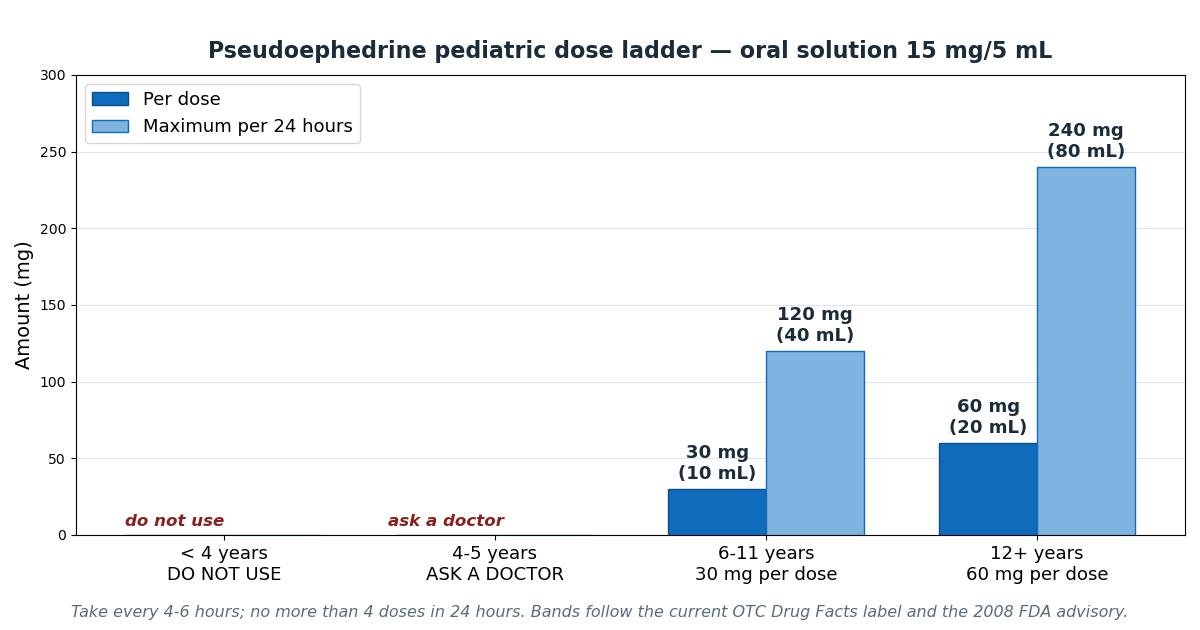
Following that advisory, manufacturers voluntarily changed the labeling on over-the-counter cough and cold products: the labels now say "do not use" in children under 4 years of age, and "ask a doctor" for children 4 to 6 years of age. That is the rule embedded in the widget above. A hard stop under 4 and a consult gate at 4 to 5. And it is not a suggestion. Accidental overdose, especially when a child is given more than one cough and cold product containing the same active ingredient, was a central concern behind the change. This history is worth knowing because it explains why the bands on today's label look the way they do, and why guessing a smaller dose for a toddler is never acceptable.
The label's age-band dosing, verified line by line
The current Drug Facts directions for pseudoephedrine read: take every 4 to 6 hours, and do not take more than 4 doses in 24 hours. Adults and children 12 years of age and over take 60 mg; children 6 to under 12 years of age take 30 mg; children under 6 years of age are directed to ask a doctor. Each standard tablet contains 30 mg of pseudoephedrine hydrochloride, so the tablet doses translate directly: one tablet for 6 to 11, two tablets for 12 and over. Combined with the post-2008 relabeling, the practical pediatric bands are:
| Age | Label direction | Single dose | Frequency | Maximum in 24 hours |
|---|---|---|---|---|
| Under 4 years | Do not use | None | - | - |
| 4 to 5 years | Ask a doctor | Only if a doctor advises | - | - |
| 6 to under 12 years | Label dose | 30 mg (10 mL of 15 mg/5 mL solution) | Every 4 to 6 hours | 4 doses = 120 mg (40 mL) |
| 12 years and over | Label dose | 60 mg (20 mL of 15 mg/5 mL solution) | Every 4 to 6 hours | 4 doses = 240 mg (80 mL) |
Two details deserve emphasis. First, the 12-year-old receives the full adult dose of 60 mg. There is no intermediate step between 30 and 60 mg on the label. Second, some adult-strength liquid products (for example a 30 mg per 5 mL formulation) print "do not use" for children under 6 rather than the ask-a-doctor line, so always read the directions on the exact bottle in the house rather than assuming one label matches another.
Measuring the oral solution: the millilitre arithmetic
The standard children's pseudoephedrine oral solution contains 15 mg of pseudoephedrine hydrochloride in each 5 mL. The arithmetic is then fixed:
- 30 mg ÷ 15 mg per 5 mL = 10 mL (2 teaspoons). The single dose for ages 6 to 11
- 60 mg ÷ 15 mg per 5 mL = 20 mL (4 teaspoons). The single dose for ages 12 and over
- 120 mg ÷ 15 mg per 5 mL = 40 mL. The absolute maximum per 24 hours for ages 6 to 11
- 240 mg ÷ 15 mg per 5 mL = 80 mL. The absolute maximum per 24 hours for ages 12 and over
The label says to use only the enclosed dosing cup, and there is a reason: kitchen teaspoons vary in size and routinely deliver the wrong amount. Use the dosing cup that came with the bottle, or an oral syringe marked in millilitres, and measure at eye level. Before measuring, confirm the concentration printed on your own bottle. If it is anything other than 15 mg per 5 mL, redo the division with your bottle's numbers rather than using the volumes above.
How often, and why the 24-hour maximum matters
"Every 4 to 6 hours" and "no more than 4 doses in 24 hours" work together as a pair, and the second rule is the one families most often break. Four doses of 30 mg is exactly 120 mg, the daily ceiling for the 6-to-11 band; four doses of 60 mg is exactly 240 mg, the ceiling for 12 and over. If a child were dosed every 4 hours around the clock, that would be six doses and would exceed the label maximum. Which is precisely why the label forbids it. In practice, a child dosed at breakfast, midday, late afternoon, and bedtime stays within the limit with room to spare.
The label also says "do not use more than directed," and it sets a time limit on the whole course: stop use and ask a doctor if symptoms do not improve within 7 days or are accompanied by fever. A stuffy nose that persists beyond a week, or congestion with a fever, may be something other than a simple cold. Such as a sinus infection or allergies needing different treatment. And deserves clinical assessment rather than another week of decongestant.
Warnings and cautions from the Drug Facts label
The label's warnings apply to every age, and several of them matter especially for children. Read these before the first dose, not after:
- Do not use with an MAOI. Pseudoephedrine must not be taken with a prescription monoamine oxidase inhibitor (a class of drugs used for depression, psychiatric or emotional conditions, or Parkinson's disease), or for 2 weeks after stopping the MAOI drug. If you do not know whether a prescription drug contains an MAOI, ask a doctor or pharmacist before giving this product.
- Ask a doctor before use if the child has heart disease, high blood pressure, thyroid disease, or diabetes, or trouble urinating due to an enlarged prostate gland. Pseudoephedrine is a stimulant-like medicine: it can raise blood pressure and heart rate, which is why the label names hypertension and cardiac cautions explicitly.
- When using this product, do not use more than directed. The daily maximums in the table above are ceilings, not targets.
- Stop use and ask a doctor if the child becomes nervous, dizzy, or sleepless; these are the label's named early signs of excess stimulation. Also stop and ask a doctor if symptoms do not improve within 7 days or are accompanied by fever.
- If pregnant or breast-feeding, ask a health professional before use. Relevant for adolescent patients as well as for caregivers handling the medicine.
- Keep out of reach of children. In case of overdose, get medical help or contact a Poison Control Center (1-800-222-1222) right away.
These cautions explain why a child with a known heart condition or hypertension should never receive pseudoephedrine on a parent's initiative: the decision belongs to the child's doctor, who can weigh the decongestant benefit against the cardiovascular risk.
A 2024 safety update: the very rare PRES and RCVS risk
In February 2024, European regulators (the MHRA and CHM, as summarized in the British National Formulary) reminded healthcare professionals that pseudoephedrine carries a very rare risk of two brain-vessel conditions: posterior reversible encephalopathy syndrome (PRES) and reversible cerebral vasoconstriction syndrome (RCVS). Affected patients typically recover fully within 3 months when the condition is recognized and treated early. Pseudoephedrine-containing medicines are for short-term, symptomatic use only, and they are contra-indicated in patients with severe or uncontrolled hypertension or severe renal disease.
Parents and carers should know the warning signs and act on them: stop the medicine and seek urgent medical attention if the child develops a sudden severe headache or thunderclap headache, sudden nausea or vomiting, confusion, seizures, or visual disturbances. This risk is very rare, but because it is serious, the label-era advice to use the lowest effective dose for the shortest time still stands.
Overdose: what to watch for and what to do
The label's overdose instruction is unambiguous: get medical help or contact a Poison Control Center right away. Promptly, even if you do not notice any signs or symptoms. Do not wait to see whether the child looks unwell, because early treatment matters. Reported overdose effects of pseudoephedrine include feeling restless or nervous, rapid heart rate, and agitation. The risk of accidental overdose rises sharply when a child is given more than one cough and cold product, because many of these products contain pseudoephedrine under different brand names; always check the active-ingredients list on every product before combining them.
Why pseudoephedrine sits behind the pharmacy counter
Many parents are surprised that a non-prescription medicine must be requested at the pharmacy counter rather than taken from the shelf. The reason is unrelated to its cold-relief effect: pseudoephedrine can be diverted to the illicit manufacture of methamphetamine. Since 2006, United States federal law has therefore kept pseudoephedrine products behind the pharmacy counter or in a locked cabinet. Buying it requires showing photo identification and signing a logbook, and sales are quantity-limited. The behind-the-counter status is a supply-chain control, not a comment on the medicine's safety at label doses. But it does mean a pharmacist is available at the point of sale, which is a good moment to ask about dosing for a child.
Related pediatric dosing guides
For other common children's medicines with label-based dosing, see the related guides in this collection: loratadine pediatric dosing, the diphenhydramine dosage calculator, and the cetirizine dosage calculator.