What vancomycin is
Vancomycin is a tricyclic glycopeptide antibiotic derived from the organism Amycolatopsis orientalis. It kills bacteria primarily by inhibiting cell-wall biosynthesis, and it also alters bacterial cell-membrane permeability and RNA synthesis. Its spectrum is gram-positive: staphylococci including methicillin-resistant Staphylococcus aureus, streptococci including the viridans group and Streptococcus bovis, enterococci such as Enterococcus faecalis, diphtheroids, and anaerobic gram-positives such as Actinomyces and Lactobacillus species. The label is explicit about what vancomycin does not cover: it is not active in vitro against gram-negative bacilli, mycobacteria, or fungi, so it is never the empiric choice for infections where those organisms are the concern.
Given intravenously, vancomycin is indicated for serious or severe infections caused by susceptible strains of methicillin-resistant (beta-lactam-resistant) staphylococci. It is indicated for penicillin-allergic patients, for patients who cannot receive or have failed to respond to penicillins or cephalosporins, and for infections caused by vancomycin-susceptible organisms resistant to other antimicrobial drugs. The label documents effectiveness in staphylococcal endocarditis and in other staphylococcal infections including septicemia, bone infections, lower respiratory tract infections, and skin and skin structure infections. The intravenous product is the route for all of these: the label notes that the parenteral form may be given orally only for antibiotic-associated pseudomembranous colitis caused by Clostridioides difficile and for staphylococcal enterocolitis, and that vancomycin is not effective by the oral route for other types of infections.
The labeled pediatric regimen: 10 mg/kg every 6 hours
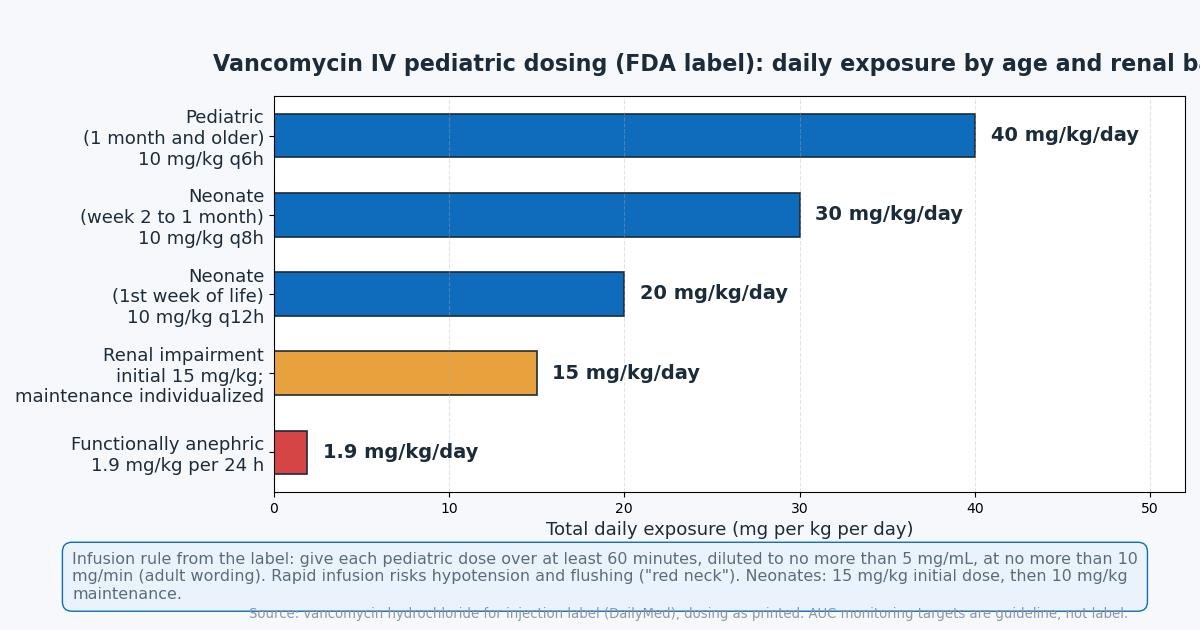
For pediatric patients 1 month of age and older with normal renal function, the label's dosing is a single sentence with no ambiguity: the usual intravenous dosage of vancomycin is 10 mg/kg per dose given every 6 hours, and each dose should be administered over a period of at least 60 minutes. Four doses a day at 10 mg/kg give a total daily exposure of 40 mg/kg/day. The label adds that close monitoring of serum concentrations of vancomycin may be warranted in these patients, which is the seed of everything the monitoring section discusses.
Applied to real weights, the label math is straightforward division. A 10 kg toddler receives 100 mg every 6 hours, for 400 mg per day. A 20 kg child receives 200 mg every 6 hours, for 800 mg per day. A 30 kg child receives 300 mg every 6 hours, for 1,200 mg per day. A 50 kg adolescent receives 500 mg every 6 hours, for 2,000 mg per day, which is the same per-dose amount an adult would receive at the usual 500 mg q6h schedule. Other patient factors such as age or obesity may call for modification of the usual daily dose, the label says, but it does not prescribe a weight-based cap for children, so any cap is a clinician decision informed by the infection, the renal function, and the measured serum concentrations.
Neonatal dosing: a loading dose, then age-gated intervals
The label gives neonates their own subsection because their kidneys clear vancomycin much more slowly than an older child's. In pediatric patients up to the age of 1 month, the total daily intravenous dosage may be lower. In neonates, an initial dose of 15 mg/kg is suggested, followed by 10 mg/kg every 12 hours for neonates in the 1st week of life and every 8 hours thereafter up to the age of 1 month. Each dose should be administered over 60 minutes. Close monitoring of serum concentrations of vancomycin is recommended in these patients: note the word "recommended" here, stronger than the "may be warranted" used for older children.
For a concrete example, a 3.5 kg neonate on day 3 of life receives an initial 52.5 mg dose, then 35 mg every 12 hours, totaling 70 mg per day during the maintenance phase. The same 3.5 kg infant on day 10 receives the same 52.5 mg initial dose, then 35 mg every 8 hours, totaling 105 mg per day. The boundary the label draws is the end of the first week of life: day 7 uses the 12-hour interval, day 8 moves to the 8-hour interval. The widget on this page enforces exactly these boundaries.
Prematurity changes the picture in a way the label describes but does not reduce to a table. In premature infants, vancomycin clearance decreases as postconceptional age decreases, and therefore longer dosing intervals may be necessary in premature infants. There is no printed premature-infant interval table in the label, so this page refuses to invent one: for premature neonates the widget shows the label's suggested 15 mg/kg initial dose and then gates the maintenance interval to the neonatal clinician, who sets it with serum concentration monitoring. That is what "verify against the label" demands: report the qualitative rule, do not fabricate the numbers.
One formulation note belongs here. The label's ADD-VANTAGE vial presentations should not be used in neonates, infants, or pediatric patients who require doses of less than 500 mg. Neonatal doses are tens of milligrams, far below that threshold, so this is a practical formulation warning rather than a dosing number: the pharmacy prepares neonatal doses from standard vials, not from ADD-VANTAGE containers.
Why every dose must be infused slowly
The label's warning on infusion reactions describes the mechanism and the familiar presentation. During or soon after rapid infusion, patients may develop anaphylactoid reactions including hypotension, wheezing, dyspnea, urticaria, or pruritus. Rapid infusion may also cause flushing of the upper body, sometimes called red neck, and pain and muscle spasm of the chest and back. These reactions usually resolve within 20 minutes but may persist for several hours. They are infrequent when vancomycin is given by a slow infusion over 60 minutes. The control is stated plainly: vancomycin hydrochloride for injection should be administered in a diluted solution over a period of not less than 60 minutes to avoid rapid-infusion-related reactions, and stopping the infusion usually results in prompt cessation of these reactions.
Two quantitative ceilings accompany the 60-minute minimum. The label states that concentrations of no more than 5 mg/mL and rates of no more than 10 mg/min are recommended in adults, and that in selected patients needing fluid restriction a concentration up to 10 mg/mL may be used with an increased risk of infusion-related events. An infusion rate of 10 mg/min or less is associated with fewer infusion-related events, but the label adds an honest caveat: infusion-related events may occur at any rate or concentration. For adults the label phrases the timing rule as no more than 10 mg/min or over a period of at least 60 minutes, whichever is longer. For children the label gives the simpler rule that each dose goes over at least 60 minutes. This page applies both: the 60-minute minimum for every pediatric dose, and the 10 mg/min ceiling as a conservative cap, which only governs doses above 600 mg (for example a 750 mg dose takes at least 75 minutes). Correcting the brief here too: the label's rate ceiling is 10 mg/min, which is 600 mg per hour, not approximately 1 g per hour.
Renal impairment: what the label actually says
This is the section where precision about the label matters most, because the label's renal guidance is more complete than summaries usually admit. The label's renal subsection begins with an unqualified requirement: dosage adjustment must be made in patients with impaired renal function. In premature infants and the elderly, greater dosage reductions than expected may be necessary because of decreased renal function. Measurement of vancomycin serum concentrations can be helpful in optimizing therapy, especially in seriously ill patients with changing renal function.
The label then prints a dosage table for vancomycin in patients with impaired renal function, adapted from the Moellering nomogram published in 1981. If creatinine clearance can be measured or estimated accurately, the label says, the dosage for most patients with renal impairment can be calculated using the table, and the dosage in mg per day is about 15 times the glomerular filtration rate in mL/min. The printed rows are exact: 100 mL/min maps to 1,545 mg per 24 hours; 90 to 1,390; 80 to 1,235; 70 to 1,080; 60 to 925; 50 to 770; 40 to 620; 30 to 465; 20 to 310; and 10 mL/min to 155 mg per 24 hours. Two constraints accompany the table. The initial dose should be no less than 15 mg/kg even in patients with mild to moderate renal insufficiency, so the first dose is never reduced. And the table is not valid for functionally anephric patients.
For functionally anephric patients the label gives a standalone rule: an initial dose of 15 mg/kg of body weight should be given to achieve prompt therapeutic serum concentrations, and the dose required to maintain stable concentrations is 1.9 mg/kg per 24 hours. In patients with marked renal impairment it may be more convenient to give maintenance doses of 250 to 1,000 mg once every several days rather than daily, and in anuria a dose of 1,000 mg every 7 to 10 days has been recommended. When only serum creatinine is known, the label gives the standard sex, weight, and age formula for estimating creatinine clearance, with the reminder that calculated clearances are only estimates and the clearance should be measured promptly.
What does this mean for a child with renal impairment? Honestly: the label's renal table is an adult-derived nomogram printed in a general renal subsection, and it does not give pediatric-specific maintenance intervals. The label-derived facts for a child are the minimum initial dose of 15 mg/kg in any degree of renal impairment, the 1.9 mg/kg per 24 hours maintenance figure for the functionally anephric case, and the requirement to individualize the rest with serum concentration measurement. That is why the widget computes the 15 mg/kg initial dose and then gates the maintenance schedule to the clinician rather than inventing a pediatric CrCl interval table. The table reference it shows is quoted as the label's own adult-derived nomogram, labeled as such, never presented as pediatric dosing.
What the clinical team monitors
Monitoring on vancomycin is organized around its two named toxicities plus the serum concentrations that connect dose to both. Nephrotoxicity: systemic vancomycin exposure may result in acute kidney injury, and the risk of AKI increases as systemic exposure and serum levels increase. The label directs monitoring of renal function in all patients, with emphasis on patients with underlying renal impairment, patients with comorbidities that predispose to renal impairment, and patients receiving concomitant therapy with a drug known to be nephrotoxic. Interstitial nephritis has also been reported.
Ototoxicity: it has occurred in patients receiving vancomycin and may be transient or permanent. The label reports that it has been reported mostly in patients who have been given excessive doses, who have an underlying hearing loss, or who are receiving concomitant therapy with another ototoxic agent such as an aminoglycoside. Vancomycin should be used with caution in patients with renal insufficiency because the risk of toxicity is appreciably increased by high, prolonged blood concentrations. The label adds that serial tests of auditory function may be helpful to minimize the risk of ototoxicity.
Two further monitoring rules round out the label. Vancomycin serum concentrations can be measured by microbiologic assay, radioimmunoassay, fluorescence polarization immunoassay, fluorescence immunoassay, or high-pressure liquid chromatography, and measuring trough serum concentrations helps optimize therapy, especially in seriously ill patients with changing renal function. Reversible neutropenia has been reported, usually starting 1 week or more after the onset of therapy or after a total dosage of more than 25 g, so patients who will undergo prolonged therapy or who receive concomitant drugs that may cause neutropenia should have periodic monitoring of the leukocyte count.
One honest distinction belongs here. Modern practice in many hospitals uses AUC-guided monitoring, with targets from the therapeutic drug monitoring guideline by Rybak and colleagues published in 2020. That guideline recommends Bayesian or AUC-based monitoring with AUC to minimum inhibitory concentration targets rather than trough-only monitoring. Those targets are guideline recommendations, not label requirements. The FDA label speaks only of measuring trough serum vancomycin concentrations to guide therapy. This page reports both, and labels each correctly.
Reconstitution, dilution, and storage
The label's preparation section is exact enough to quote directly. At the time of use, vials are reconstituted with sterile water for injection to a concentration of 50 mg of vancomycin per mL: 10 mL for the 500 mg vial, 15 mL for the 750 mg vial, and 20 mL for the 1 g vial. After reconstitution the vials may be stored in a refrigerator for 14 days without significant loss of potency. Reconstitution is not the final step: reconstituted solutions must be further diluted before use. The 500 mg solution must be further diluted in at least 100 mL of a suitable infusion solution, the 750 mg solution in at least 150 mL, and the 1 g solution in at least 200 mL. The desired dose diluted in this manner is administered by intermittent intravenous infusion over at least 60 minutes, and intermittent infusion is the label's recommended method of administration.
Compatible diluents listed in the label are 5 percent dextrose injection, 5 percent dextrose with 0.9 percent sodium chloride, lactated Ringer's injection, 5 percent dextrose with lactated Ringer's, Normosol-M with 5 percent dextrose, 0.9 percent sodium chloride injection, and Isolyte E. Solutions diluted with 5 percent dextrose or 0.9 percent sodium chloride may be refrigerated for 14 days without significant loss of potency; solutions diluted with the other listed fluids may be refrigerated for 96 hours. Two compatibility cautions close the section: mixtures of vancomycin and beta-lactam antibiotics are physically incompatible, with precipitation more likely at higher vancomycin concentrations, so intravenous lines should be flushed between these antibiotics and vancomycin solutions diluted to 5 mg/mL or less; and vancomycin solution has a low pH and may cause physical or chemical instability when mixed with other compounds.
Label verification note
This page was verified against the current DailyMed listing for vancomycin hydrochloride for injection (Fresenius Kabi, label revised April 2023) on 5 October 2026, and three corrections to the original content brief are documented here. First, the brief stated that the label has no fixed renal dosing table; it does. The label prints a creatinine-clearance table with exact rows from 1,545 mg per 24 hours at 100 mL/min down to 155 mg per 24 hours at 10 mL/min, a minimum initial dose of 15 mg/kg in any degree of renal impairment, and the 1.9 mg/kg per 24 hours maintenance rule for functionally anephric patients. This page quotes all of it and marks the table as the adult-derived Moellering nomogram it is. Second, the brief described the infusion rule as at least 60 minutes per 500 mg and a rate cap near 1 g per hour; the label's pediatric rule is at least 60 minutes per dose, and its rate ceiling is 10 mg/min, which is 600 mg per hour. Third, the brief's note that AUC-guided monitoring is guideline rather than label was confirmed and is stated plainly in the monitoring section. Where the label stops, for example premature-infant maintenance intervals and pediatric maintenance schedules in renal impairment, this page stops too and gates those decisions to the clinician rather than inventing numbers.
Related pediatric guides
Dosing information for other common pediatric medicines is available in the same collection: see the dosage guides for ibuprofen and paracetamol (acetaminophen), the furosemide pediatric dosing guide, and the propranolol pediatric dosing guide.